Route: Paso Sico – San Pedro de Atacama – Ge!seres El Tatio – Inacaliri – San Pedro – Ollague
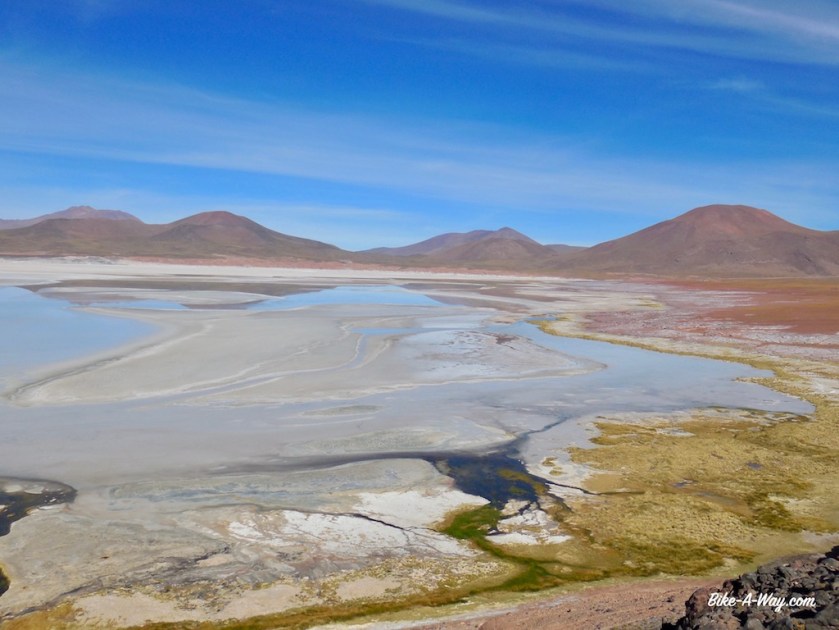
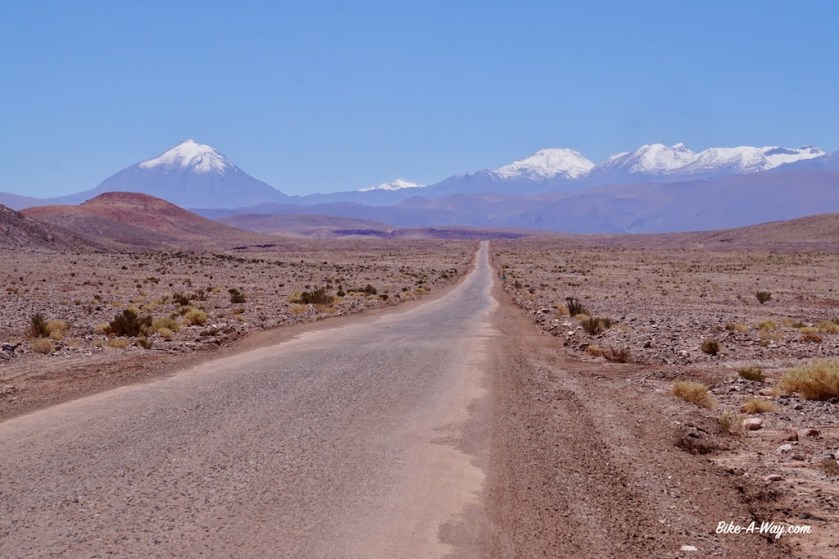
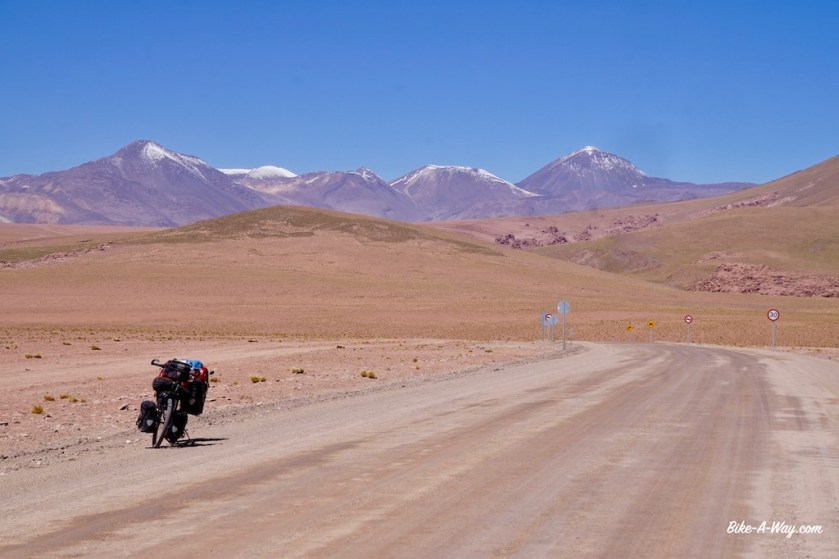
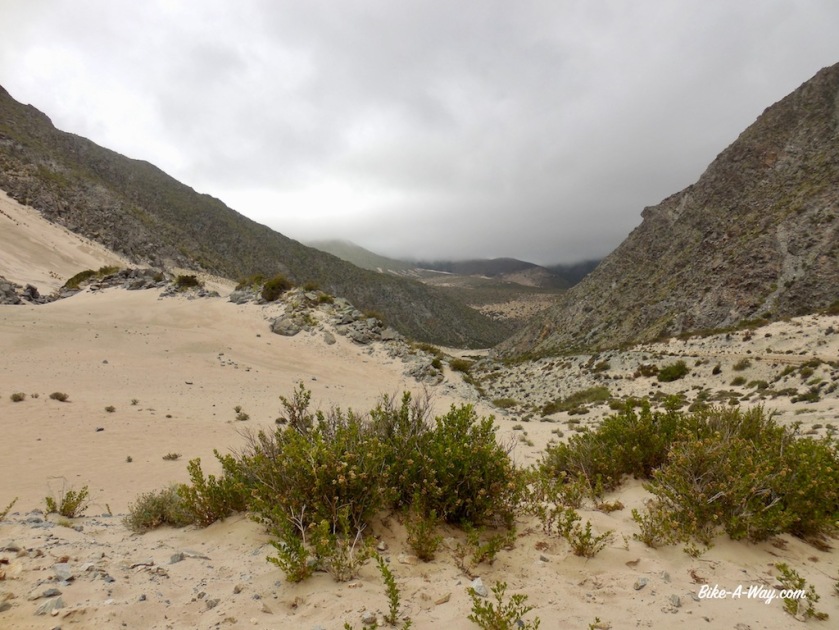
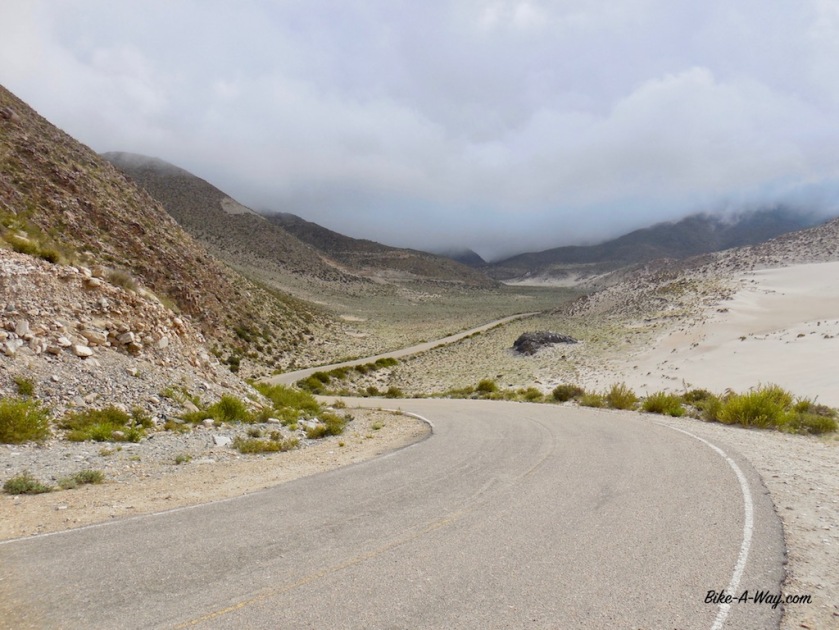
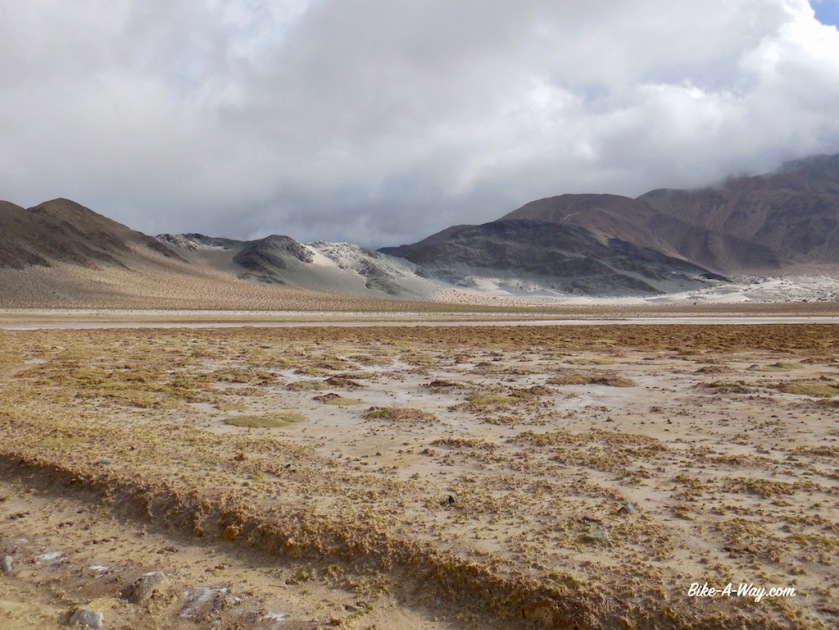
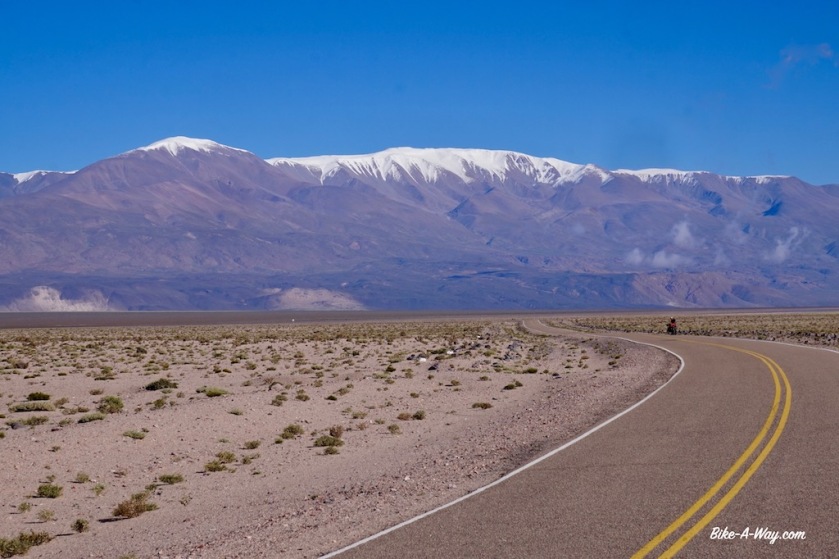
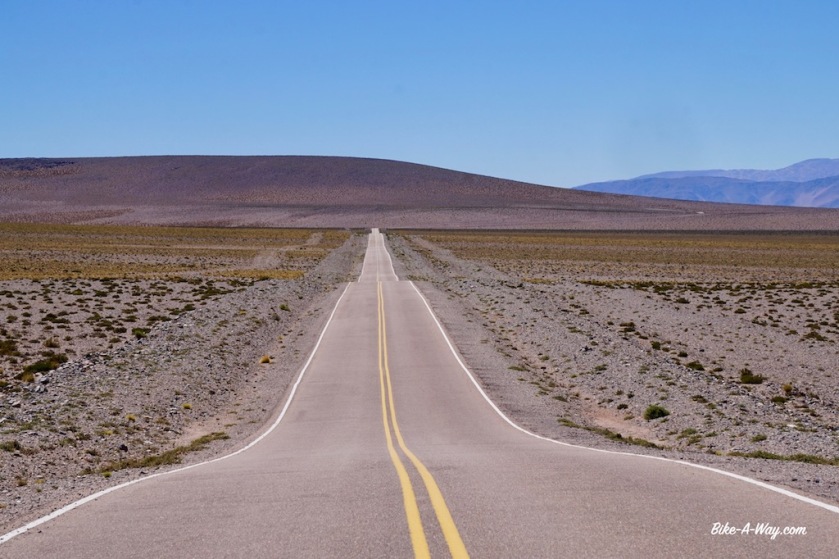
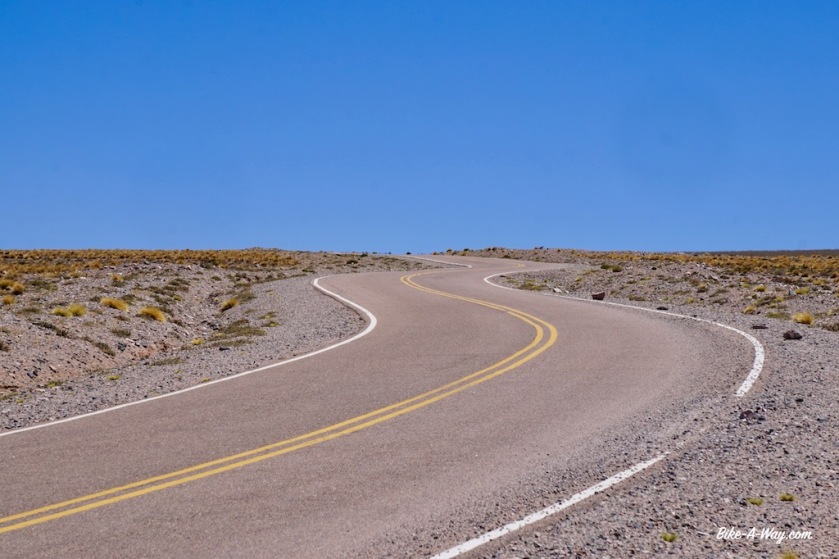
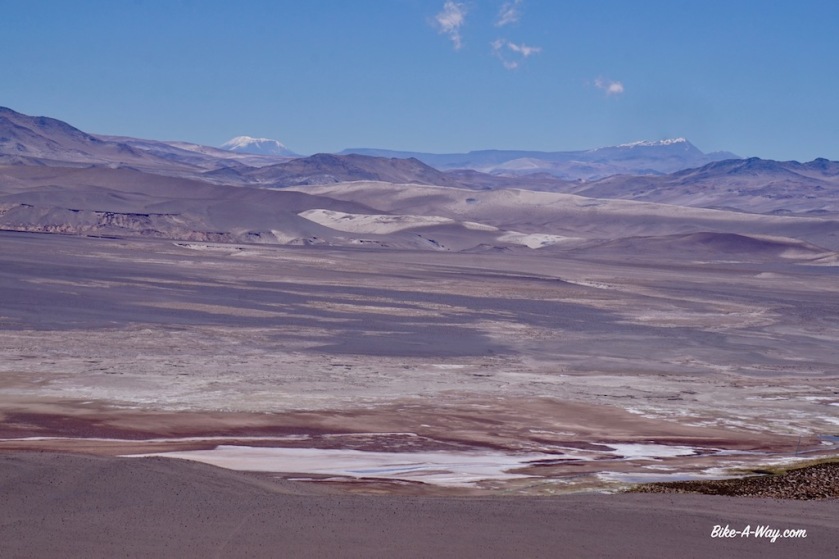
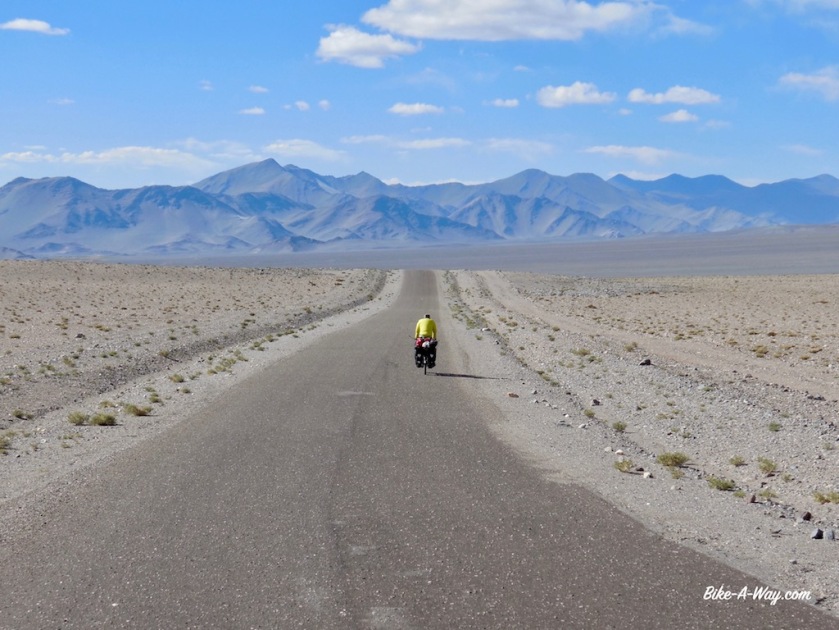
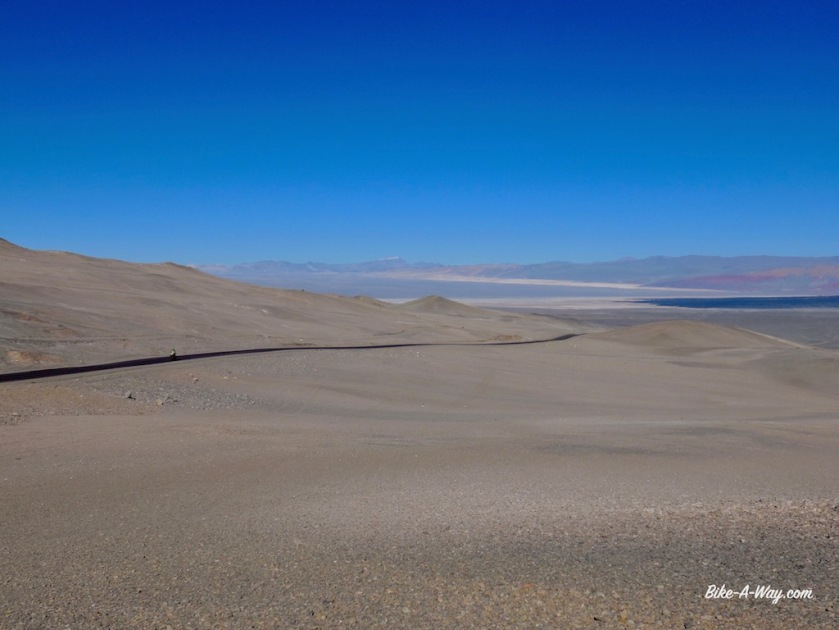
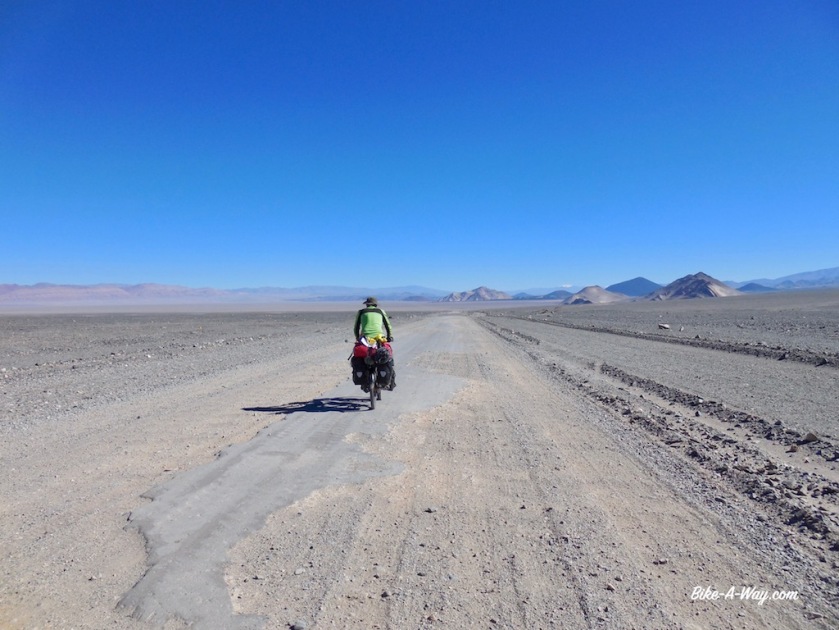
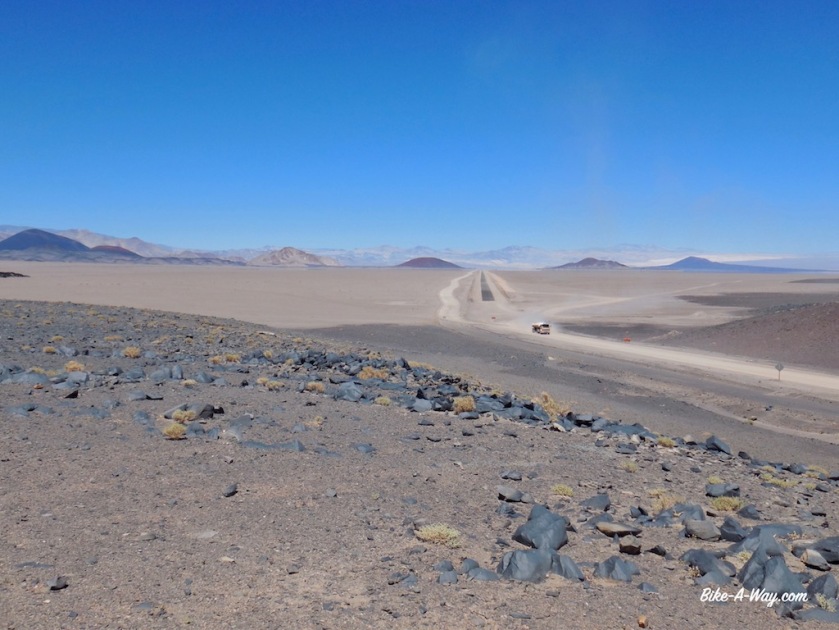
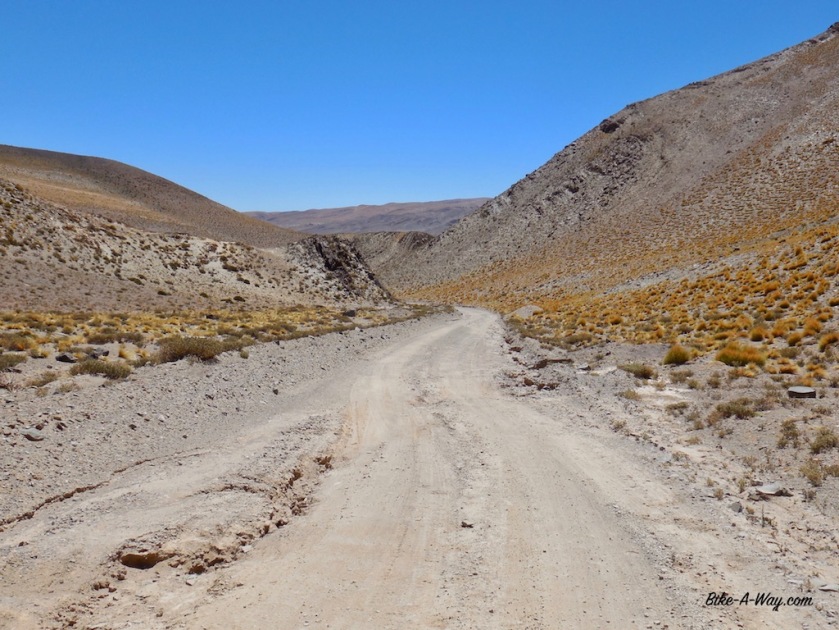
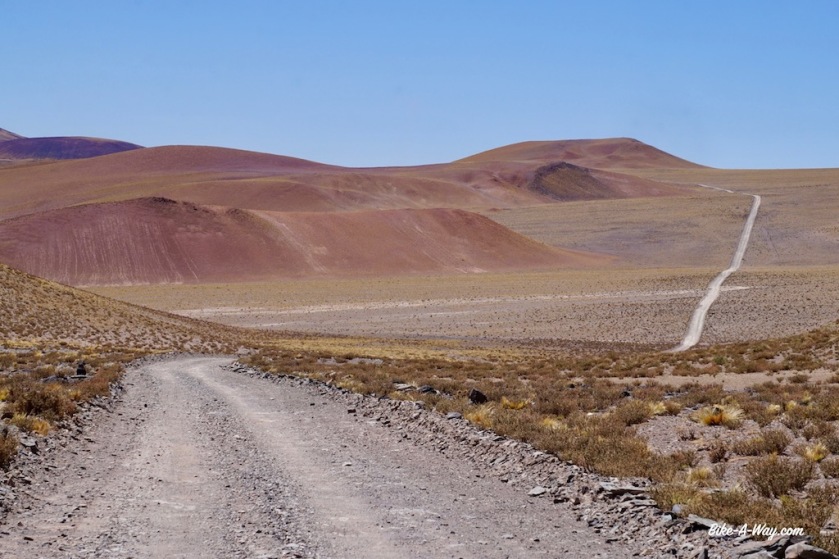
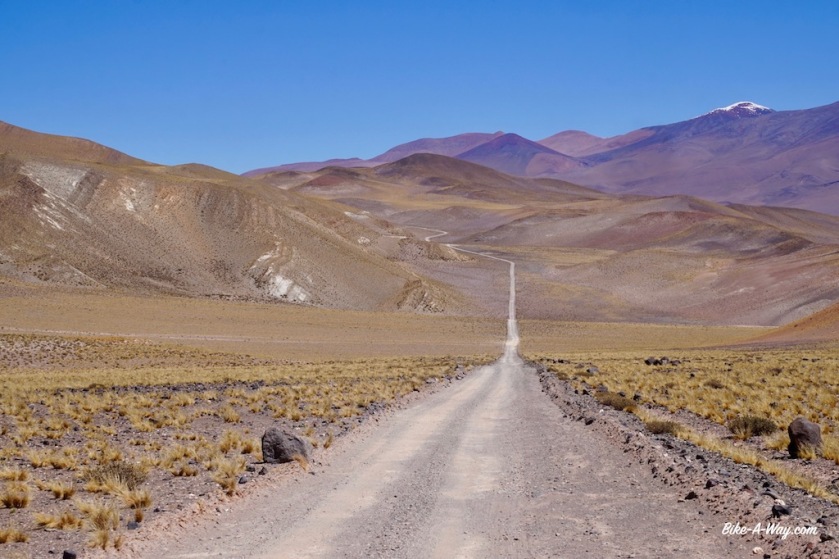
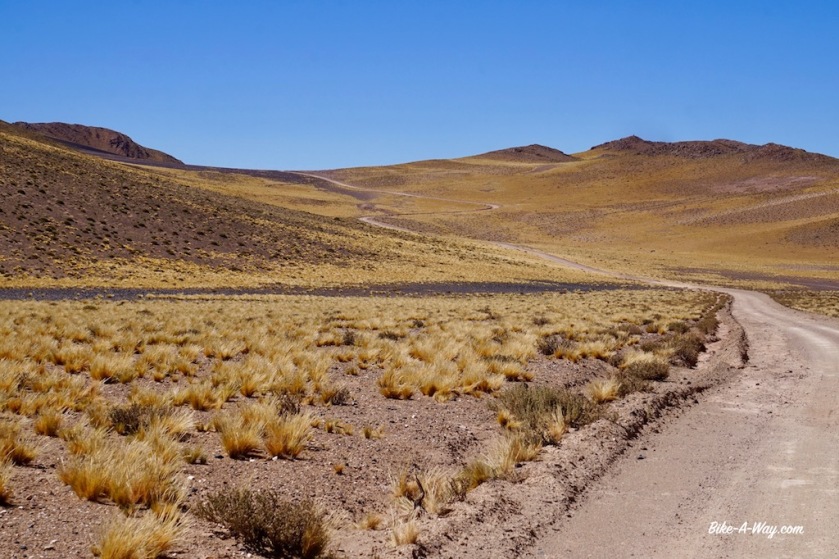
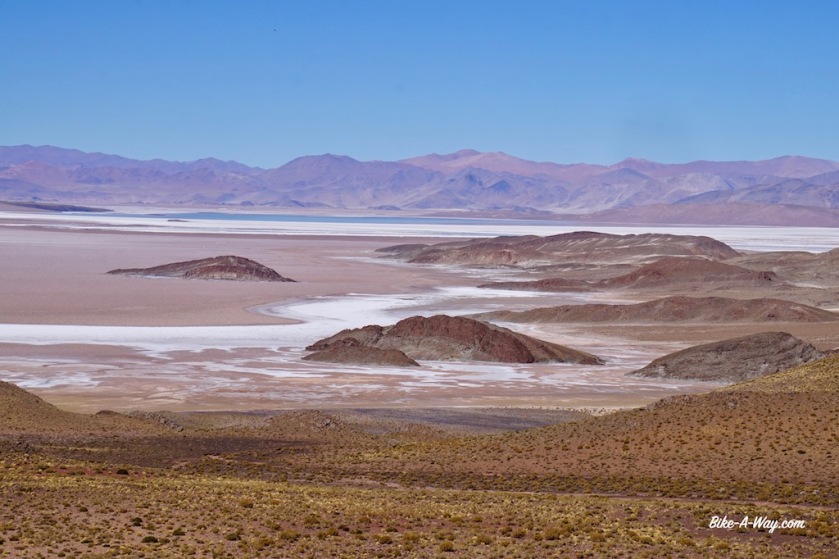
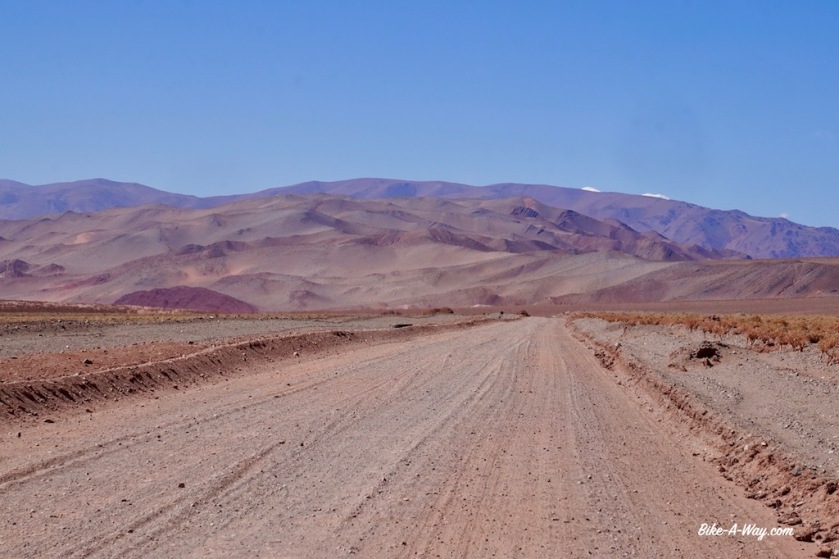
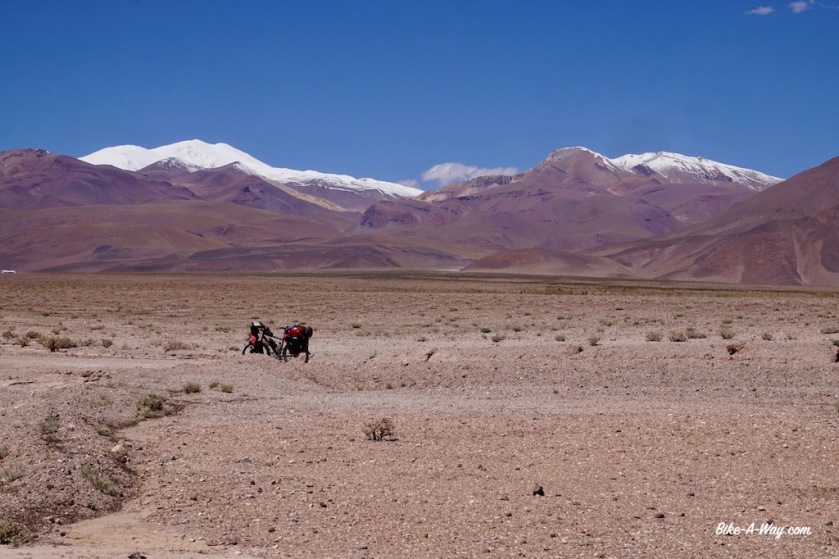
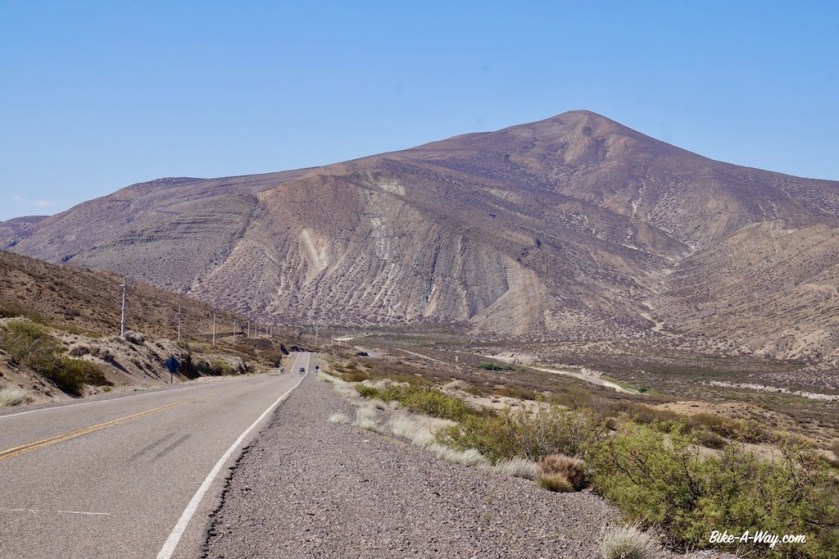
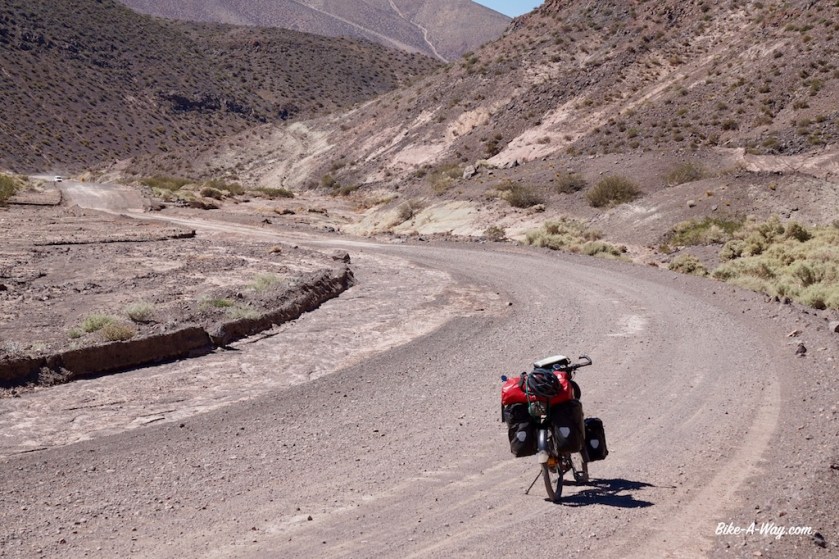
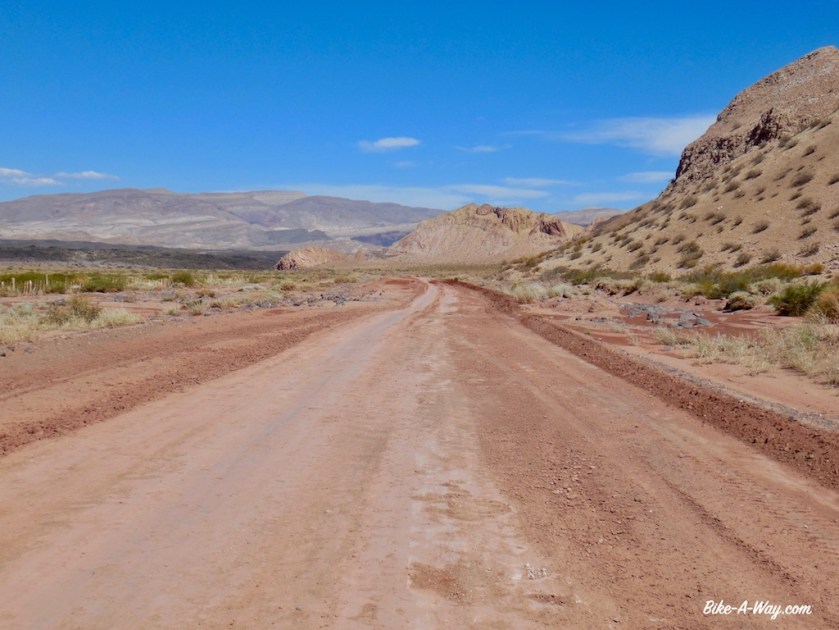
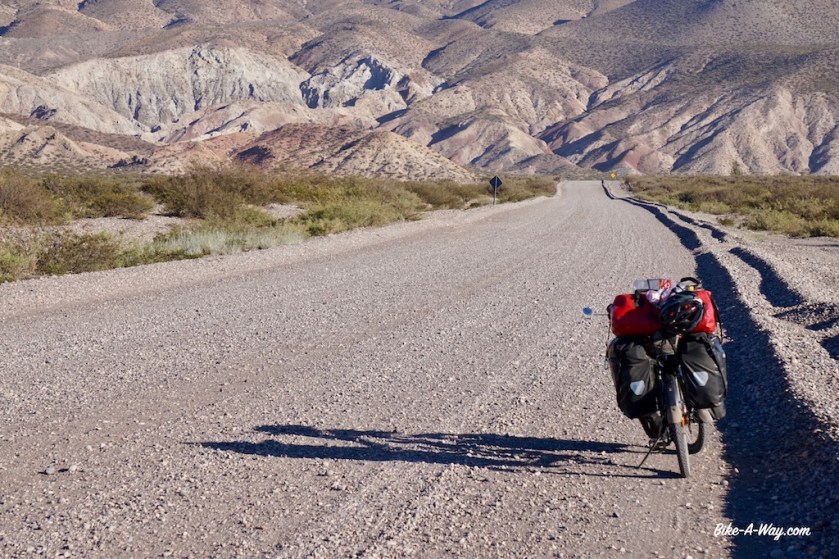
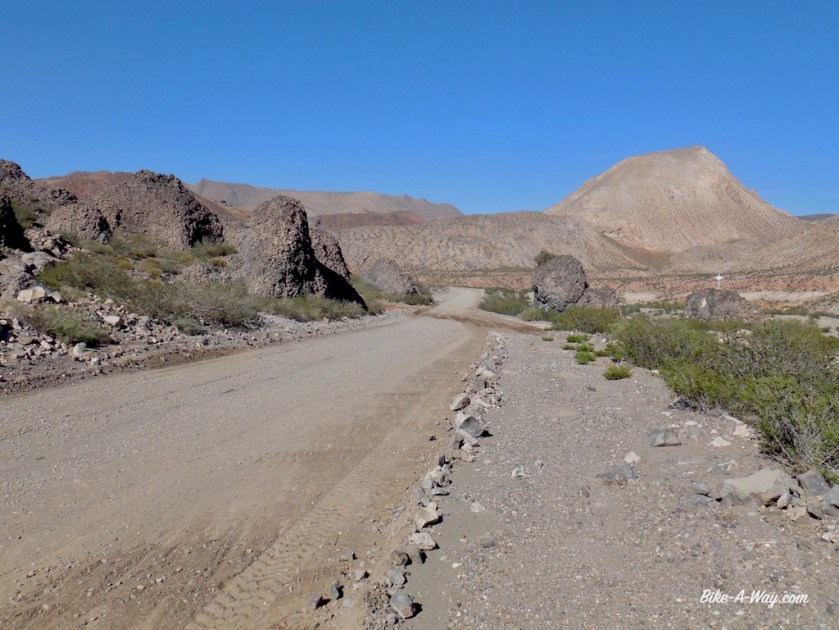
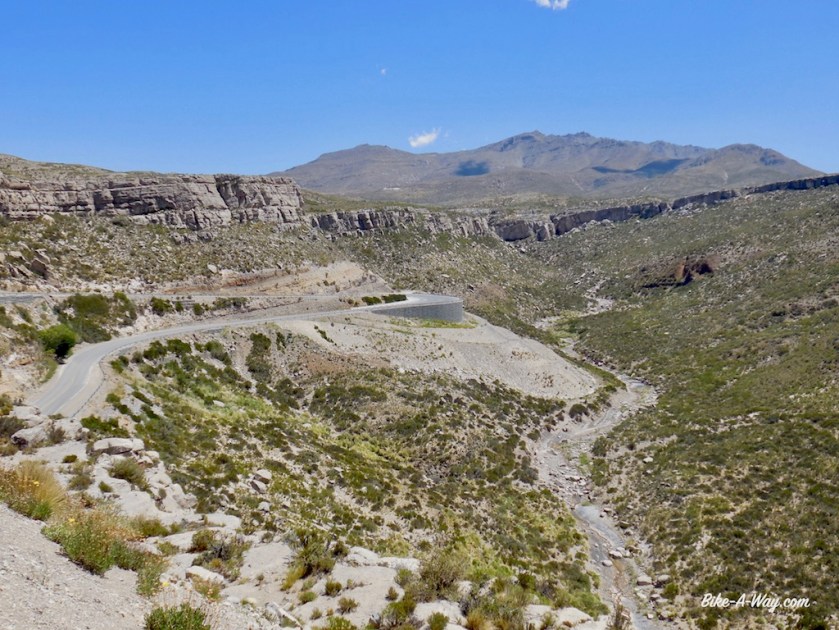
After our windy night a few kilometer passed the Argentinean border, the road kept going up and up. Paso Sico is not the highest point. We, Frederic and I, keep climbing to a first pas at 4.450 meter. The good news is that right at the Chilean side of the border, the gravel road turned into smooth asphalt. And no traffic. After a welcome descent, we climb to another pass at 4.570 meter, yet another record for me. In the distance we see several smaller salt lakes.
As the customs wanted give me only 1,5 liter of water, and nothing to Frederic, we were running low. Luckily, there’s a Chilean police post as well further down the road and they are more accommodating.
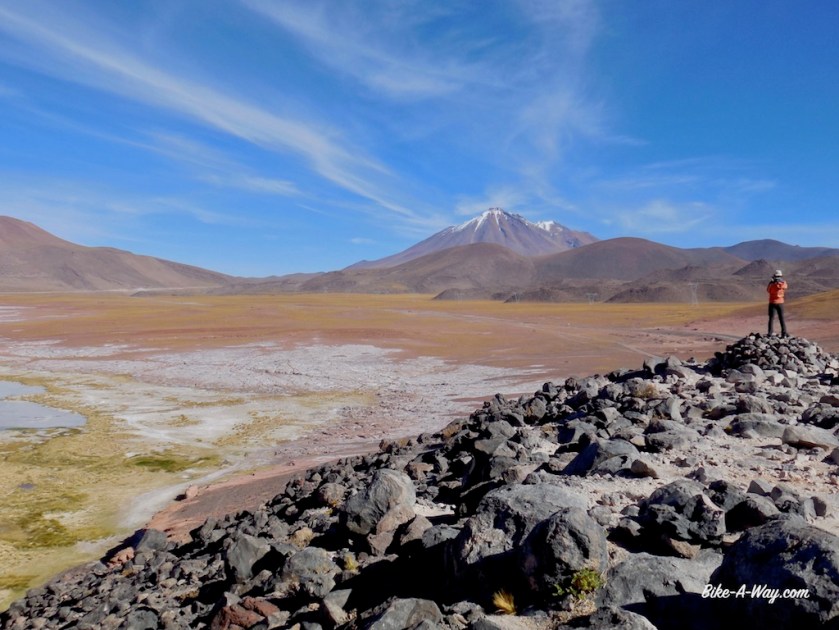
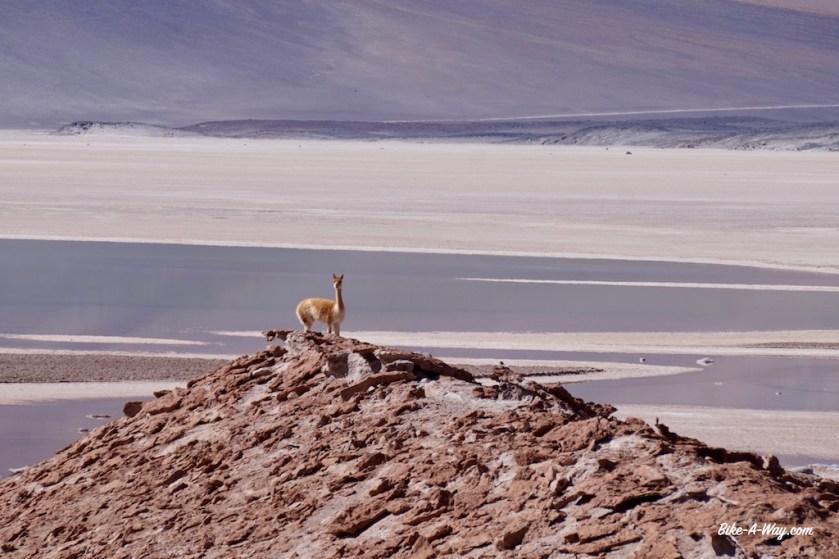
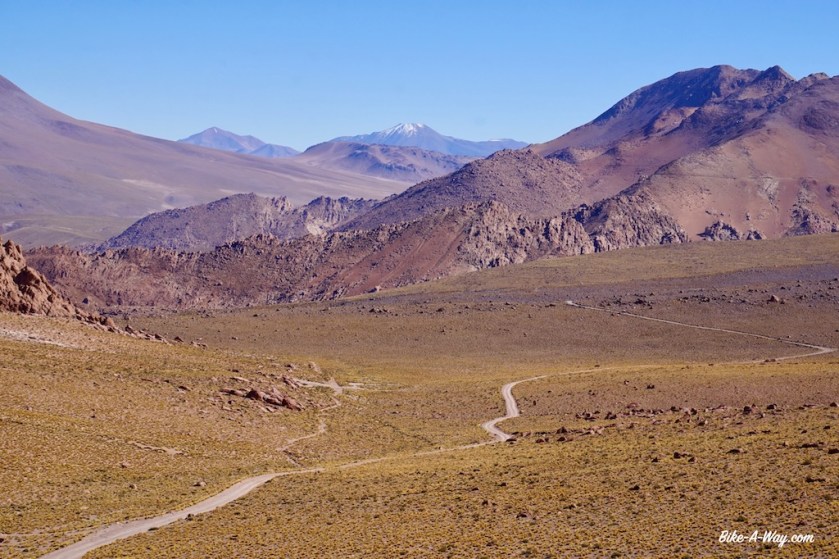
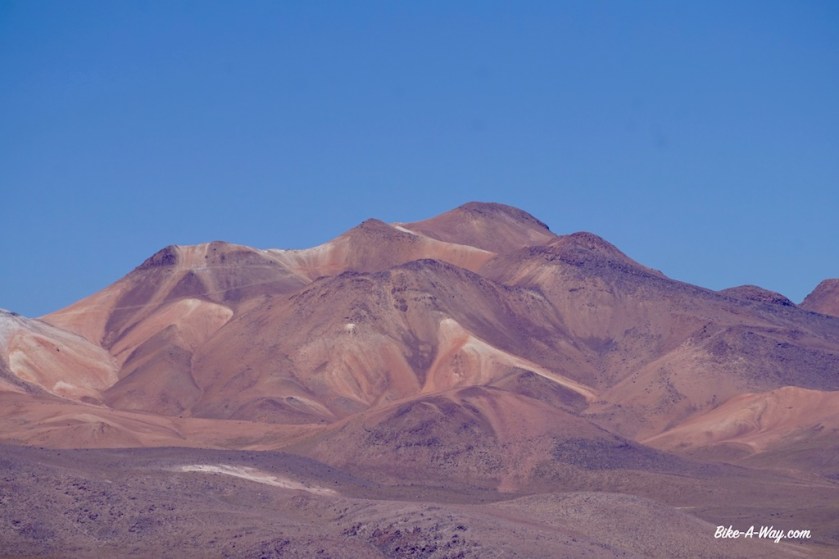
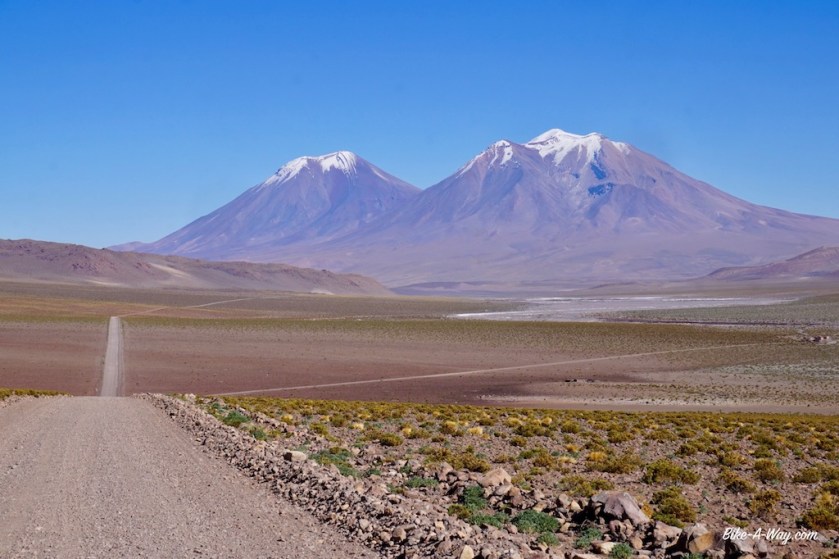
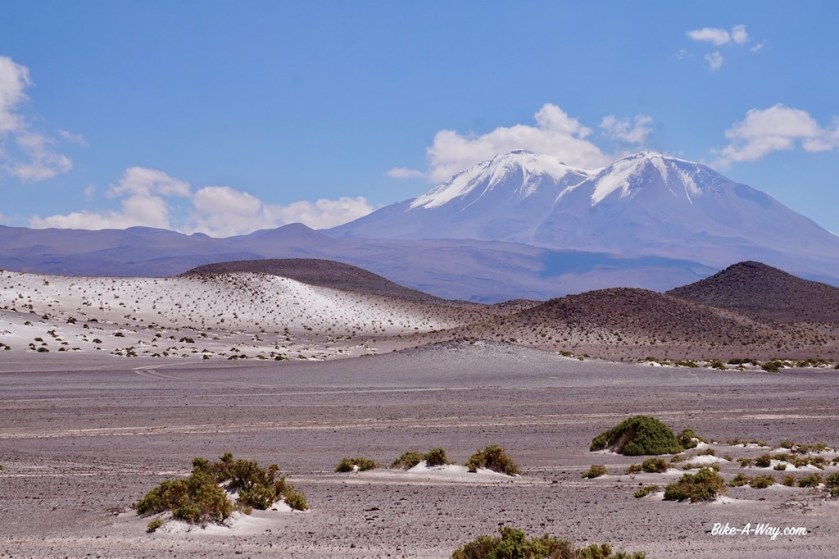
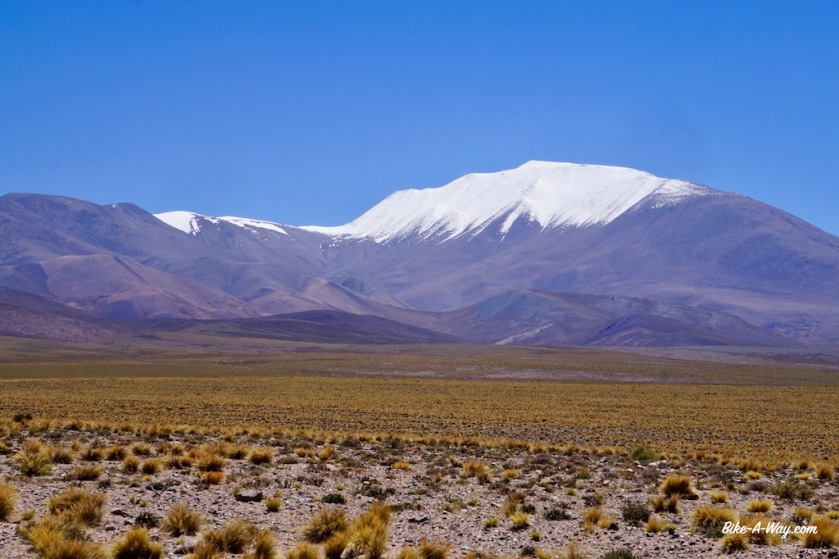
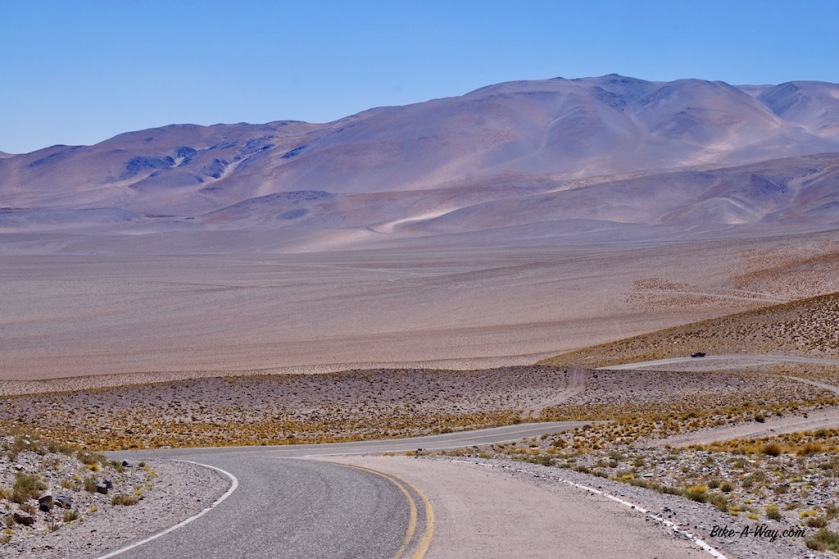
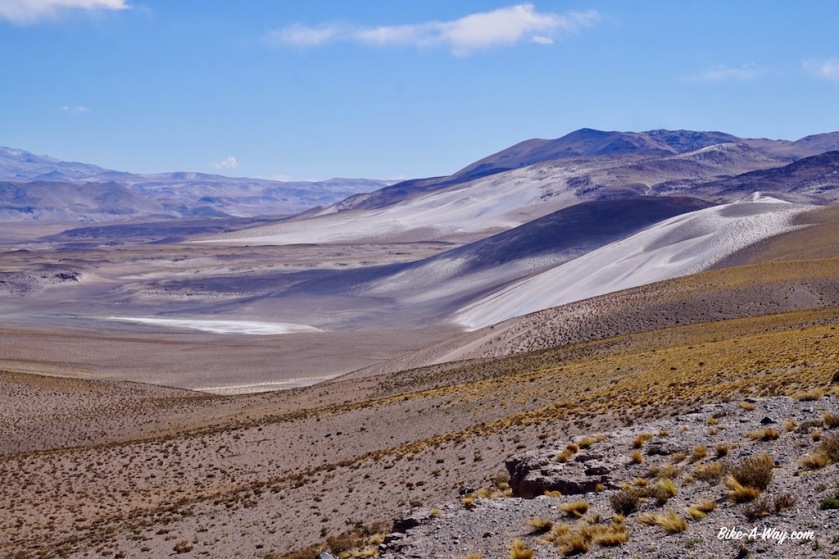
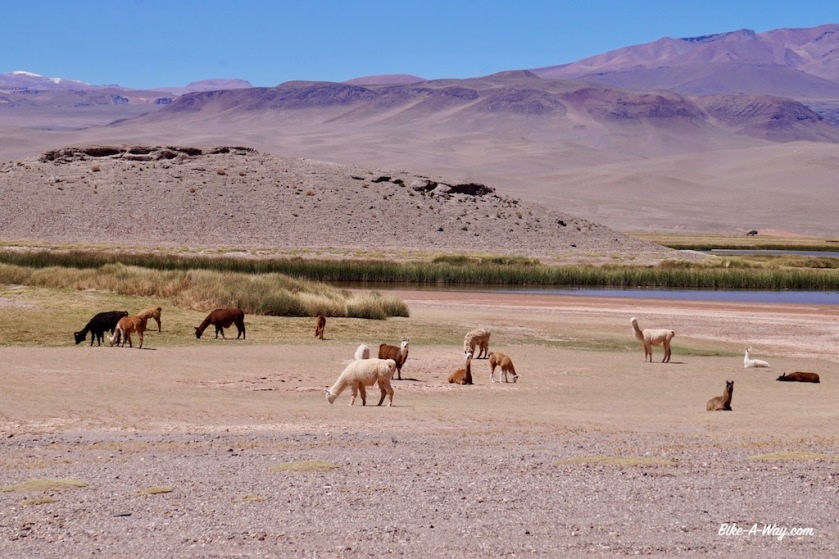
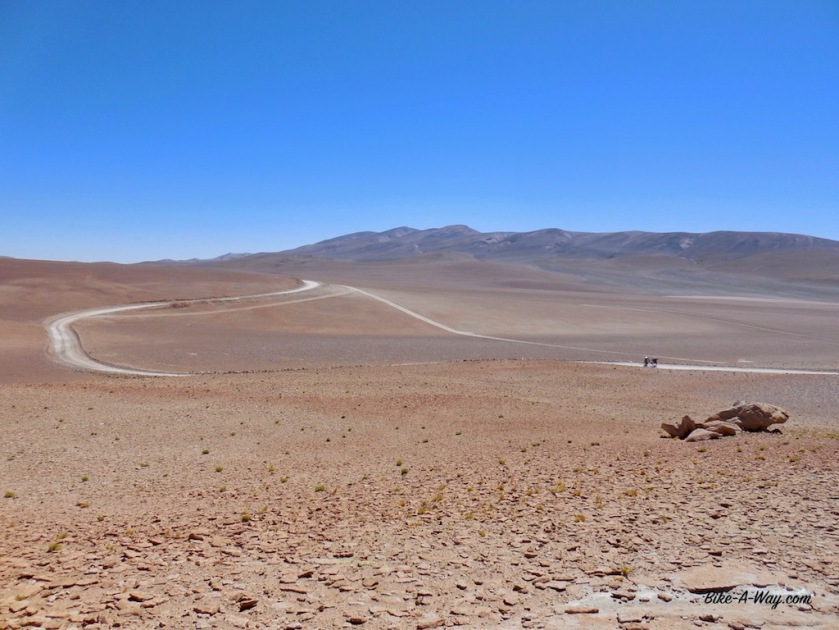
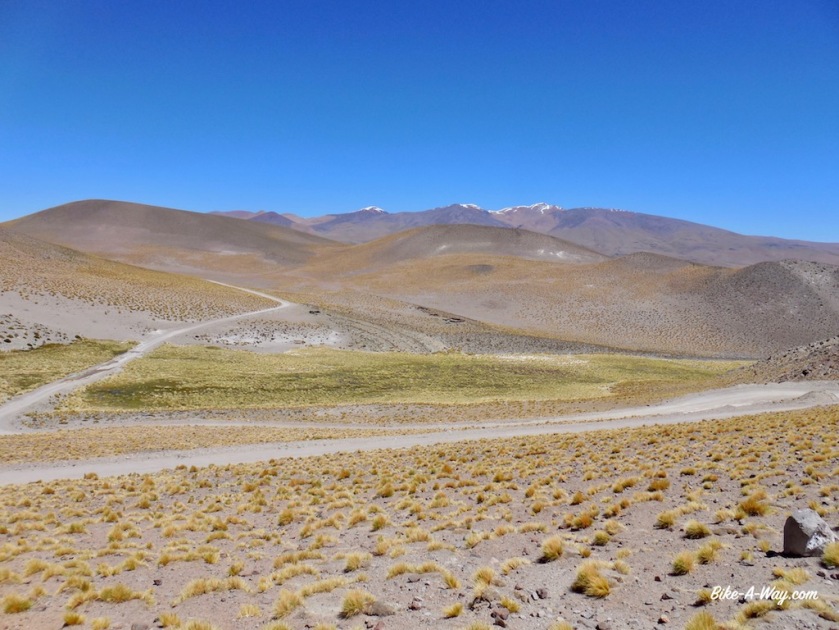
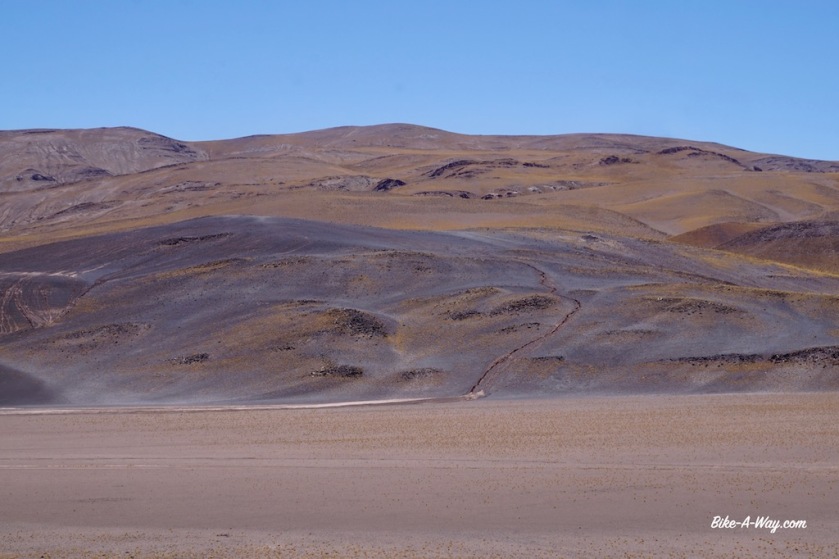
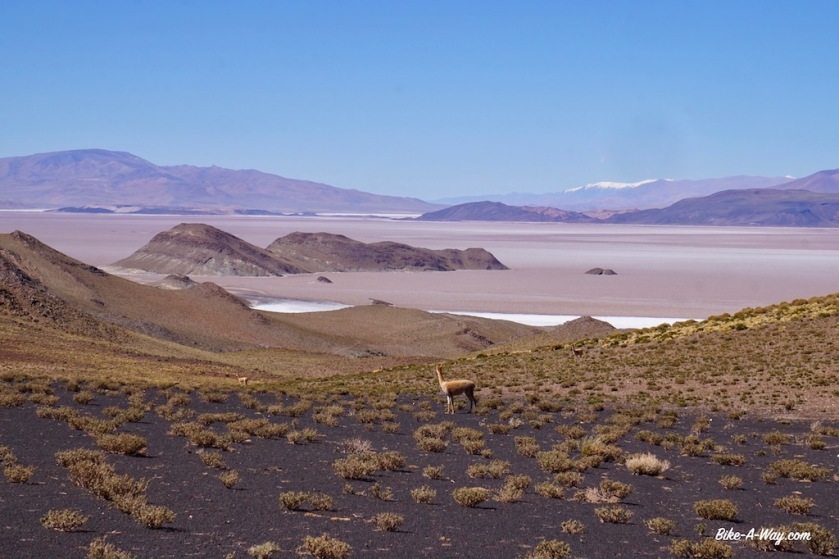
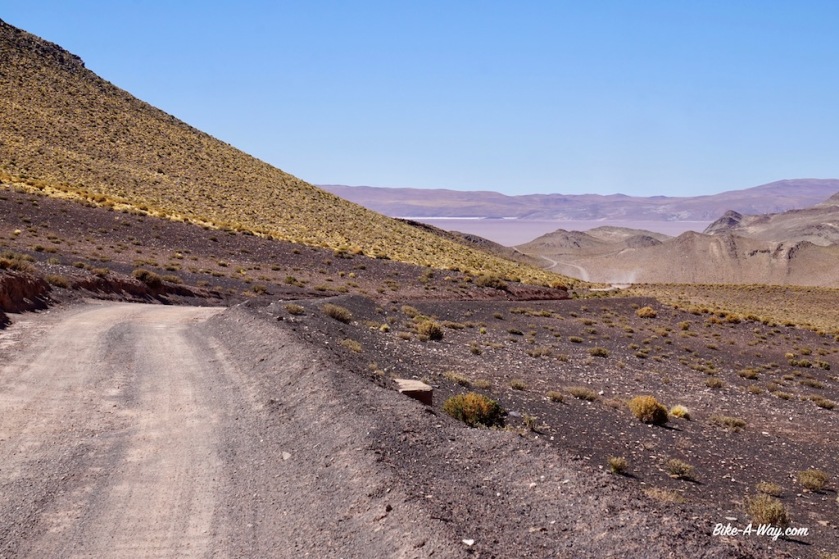
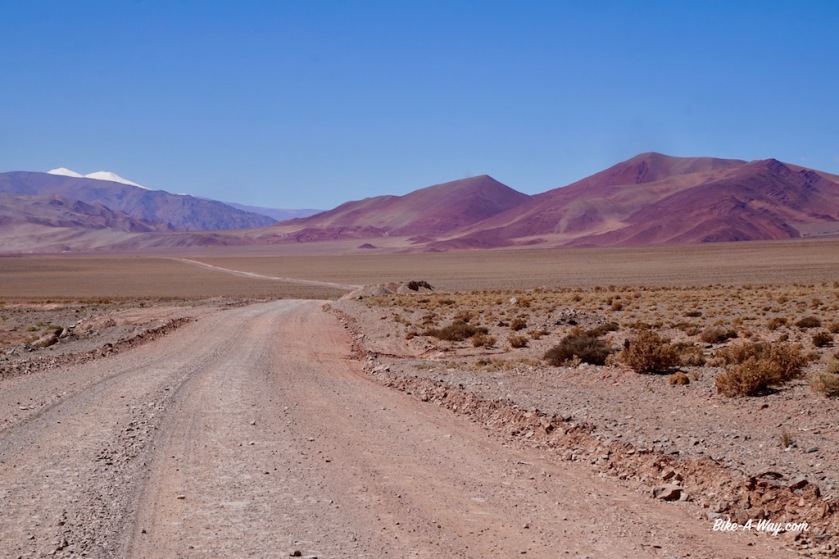
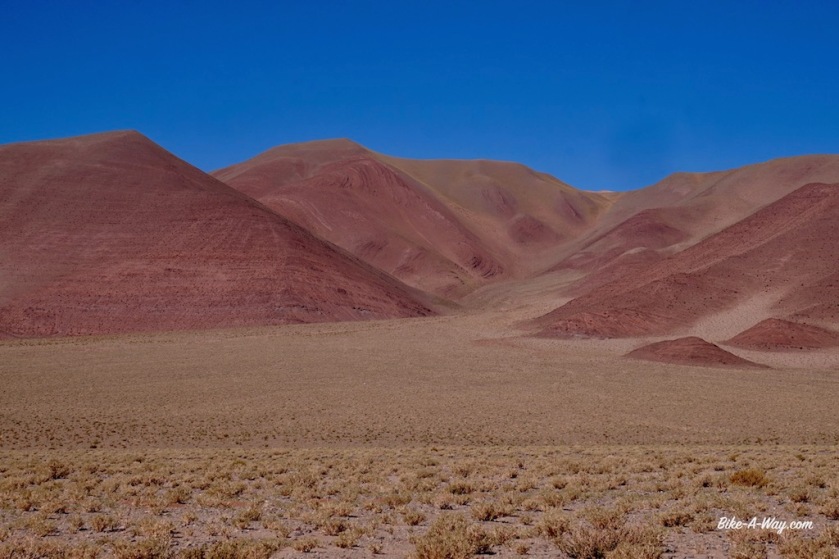
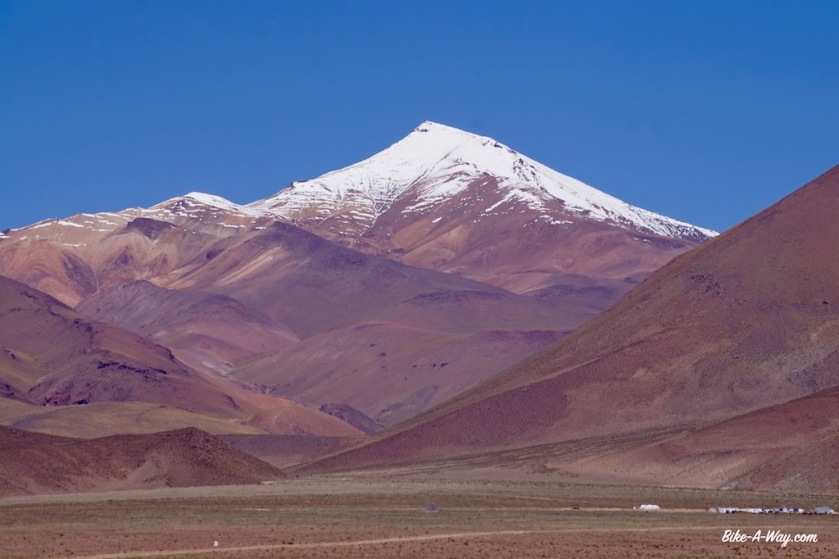
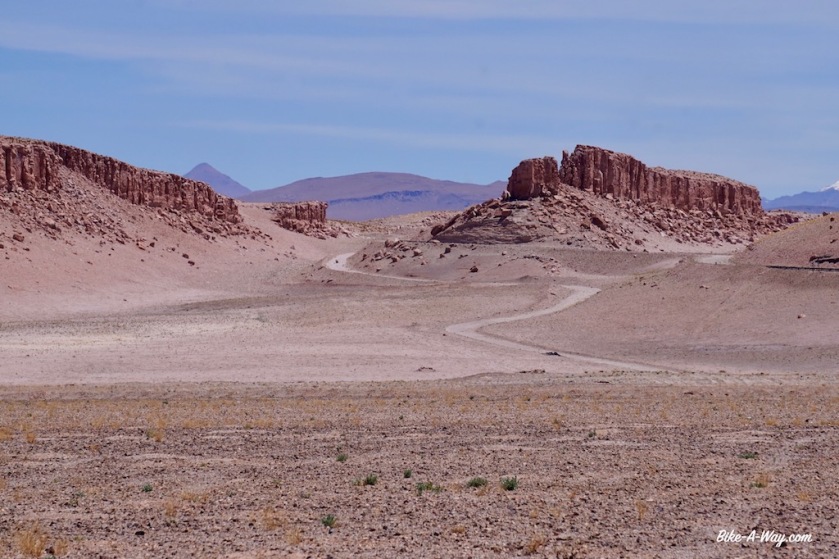
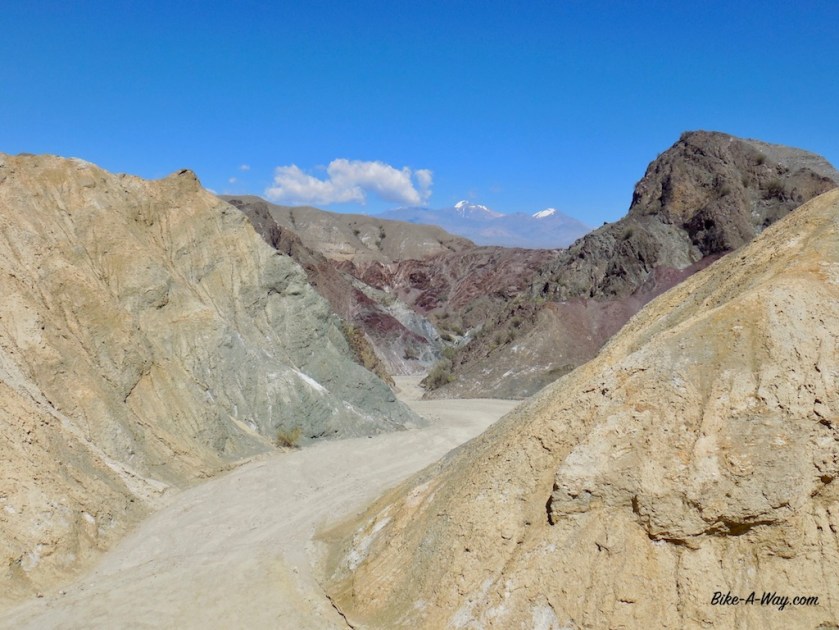
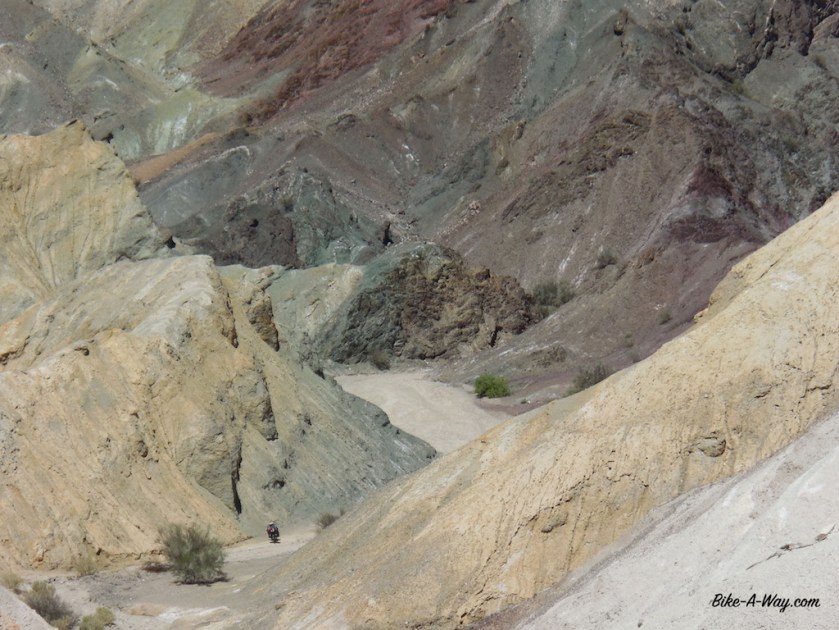
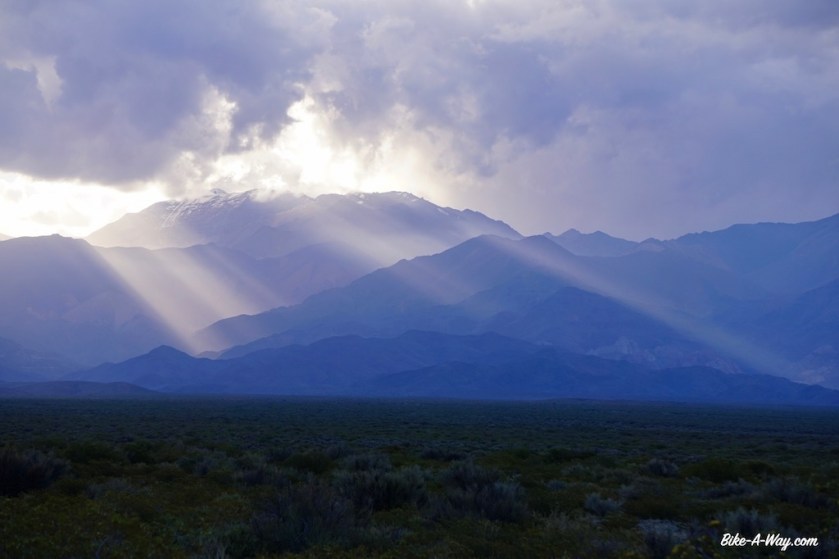
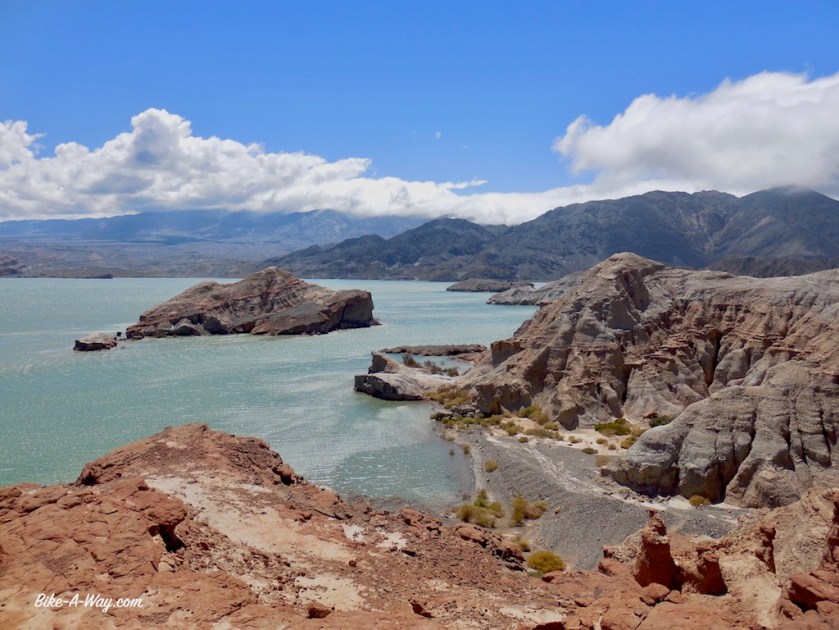
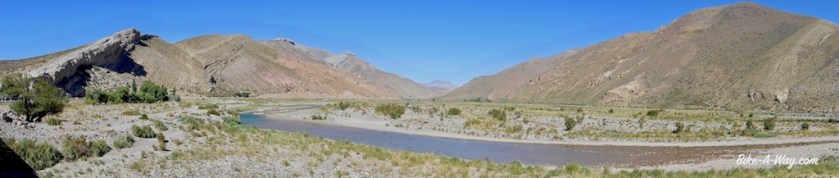
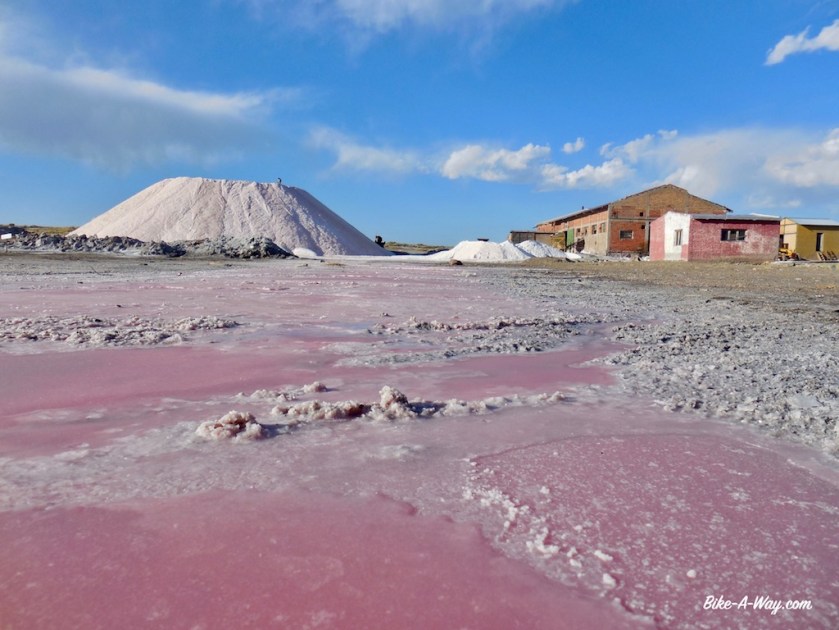
The scenery is definitely the most stunning I’v seen so far in South-America. Colorful mountains, electric blue sky, white salt flats and then … the first laguna appears. With that also the first tourist bus that seems to come up all the way from San Pedro de Atacama, still three days away for us on the bike. Luckily, they don’t stay too long. They have a busy schedule to follow, I reckon 🙂
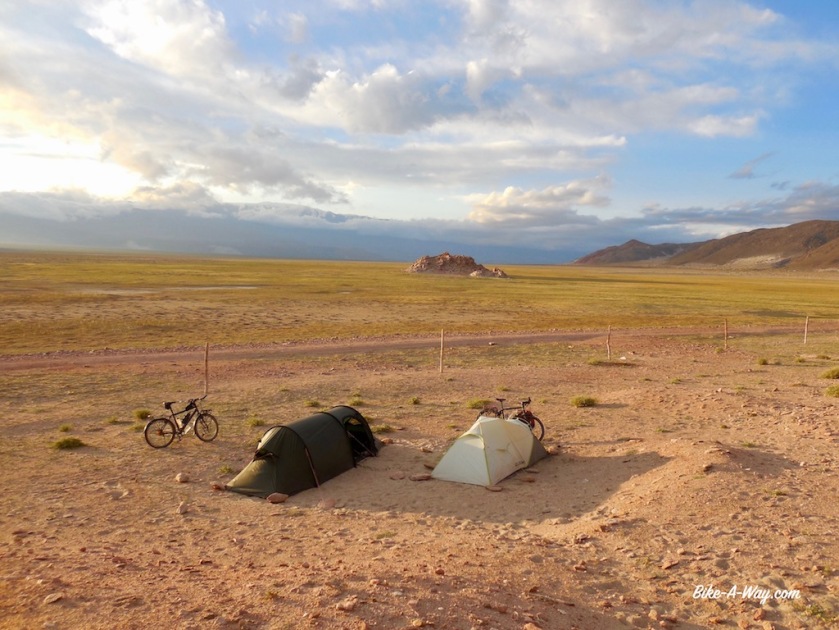
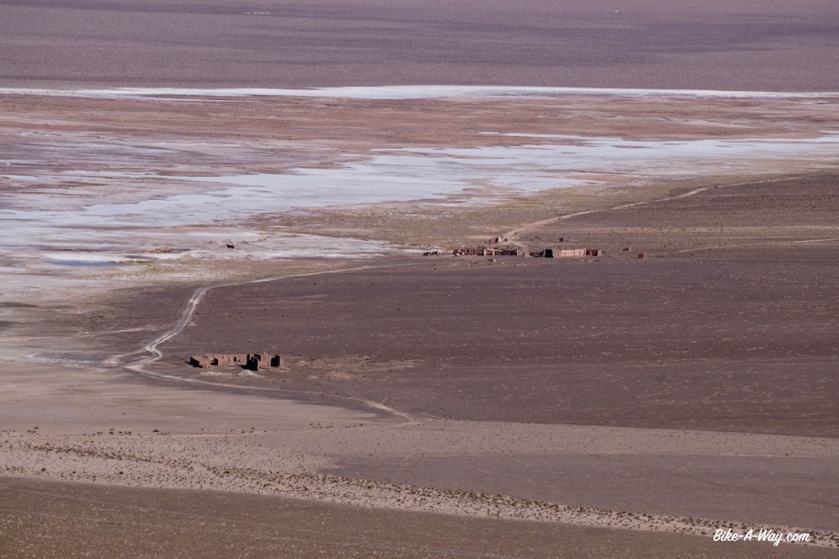
In an old mining post, still manned buy two friendly guys, we manage to get a warm meal and a shower for a very decent price. We could even stay for the night, but there are still a couple of hours daylight left, and we choose to carry on. We end up spending the night at an army camp. A team of about 30 guys, and a medic, goes out every day to clean up the anti personnel mines, which apparently still lay around in abundance along the Chilean / Argentinean border. And even more along the Chilean / Bolivian border, the soldiers tell me. I don’t know whether that’s a Pinochet thing ?
But I cycled along huge mine fields near the Strait of Magellan as well. All these countries here don’t have a very friendly past with one another.
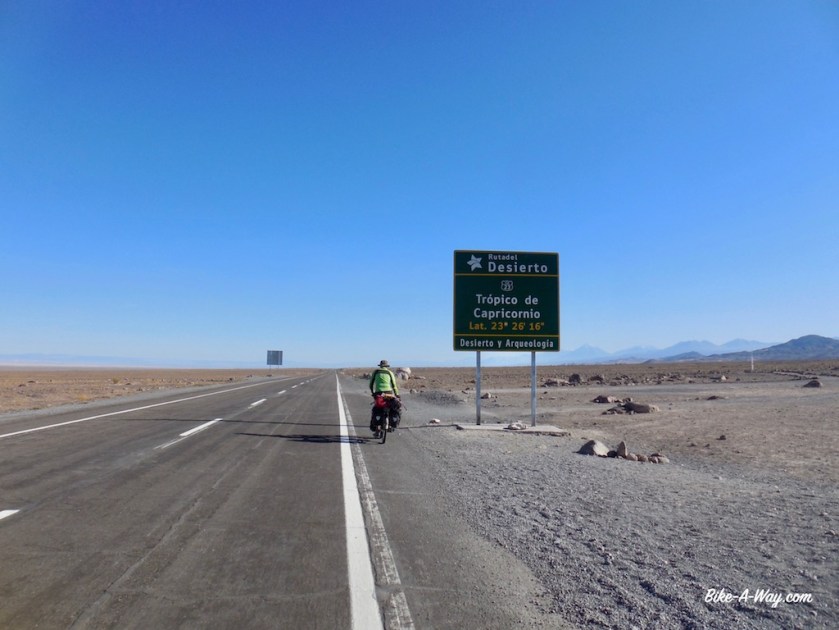
Passing the Tropic of Capricorn in the Atacama desert, a few kilometer before entering San Pedro de Atacama, I enter the tropics.
Next day, the wind blows like hell. We have to take turns riding in the front so the other can have a small break. The going is tough, but we are rewarded with more snowcapped volcanos and another laguna.
After Toconao, the road gets bussier.
I stayed for six nights in San Pedro de Atacama in a nice room to get a good rest, do some bicycle maintenance, update the website and prepare my route into Bolivia.
Many cyclists take the so called ‘Laguna Route’ towards Uyuni in Bolivia, but I read, and heard horror stories about how sandy that stretch is, and the numerous tourist Jeeps that pass you all day long at high speed, covering you in dust. I say goodbye to Frederic, who will ride this route.
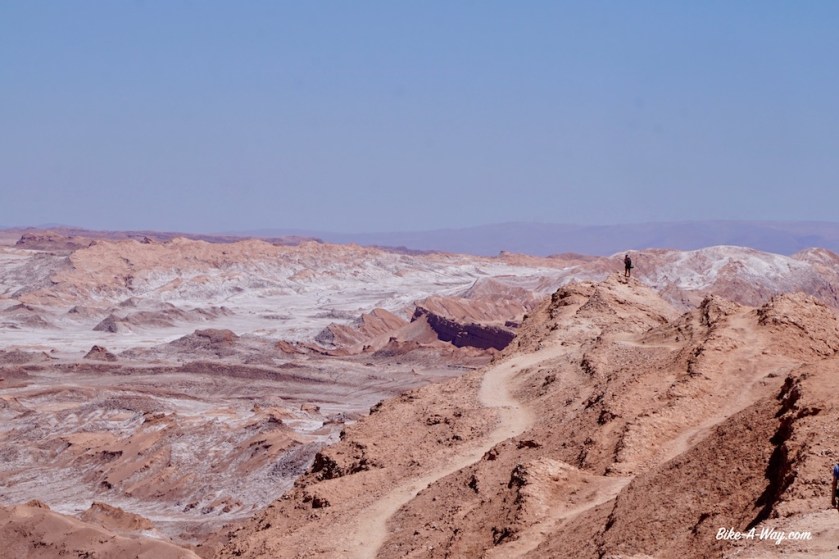
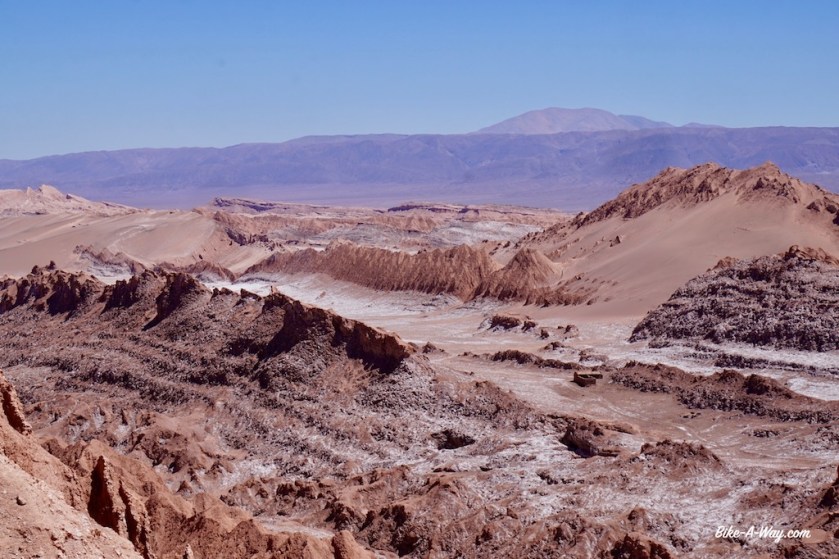
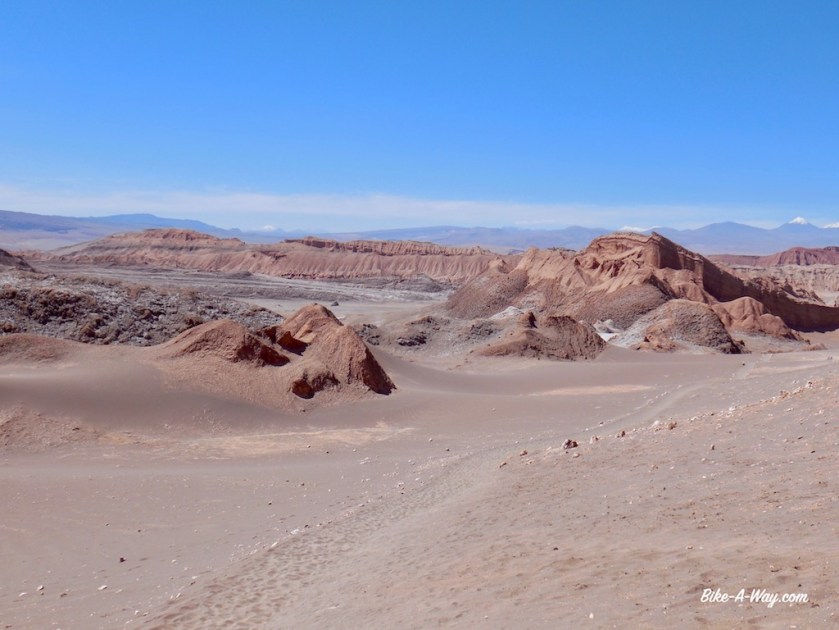
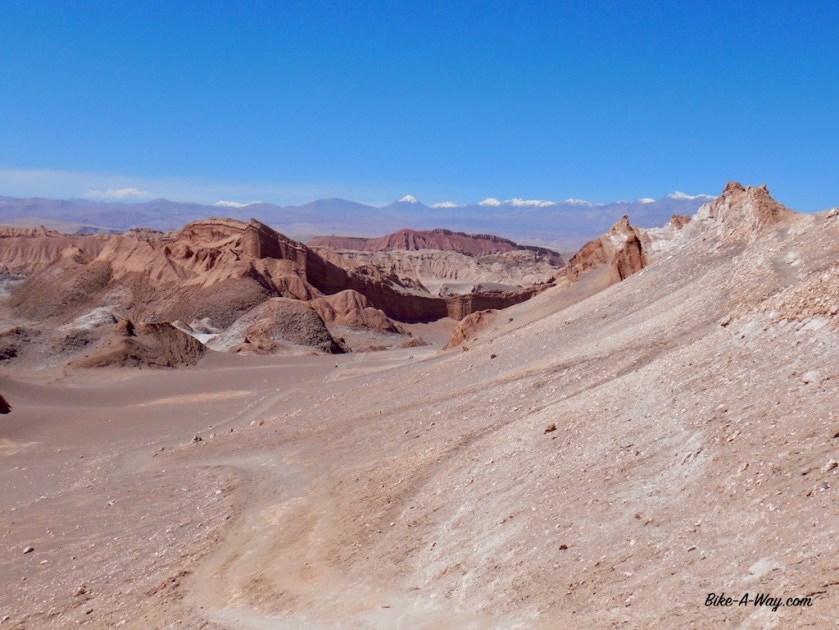
One of my last days in San Pedro de Atacama, I cycled towards the Valle de Luna. I went around noon-time, which is ideal. You have the place almost to yourself. All toursits do the same thing, and one of these things is ‘sunset at Valle de Luna’.
If the scenery coming down from Paso Sico was so beautiful already, this Vale de Luna is even more spectacular. I can imagine astronauts would come here to practice. It really looks like the moon or Mars.
On my way back to the hotel, later that afternoon, I count 32 minibuses driving to the Val de Luna, plus Jeeps and cars.
They must be sitting on that hill with close to a thousand people, watching the sunset.
Charming.
From San Pedro de Atacama, I headed straight north towards the El Tatio Geysers. Back from 2.600 meter, up to the ‘Altiplano’ above 4.000 meter. The climb isn’t very steep, but the road is some sort of destroyed asphalt.
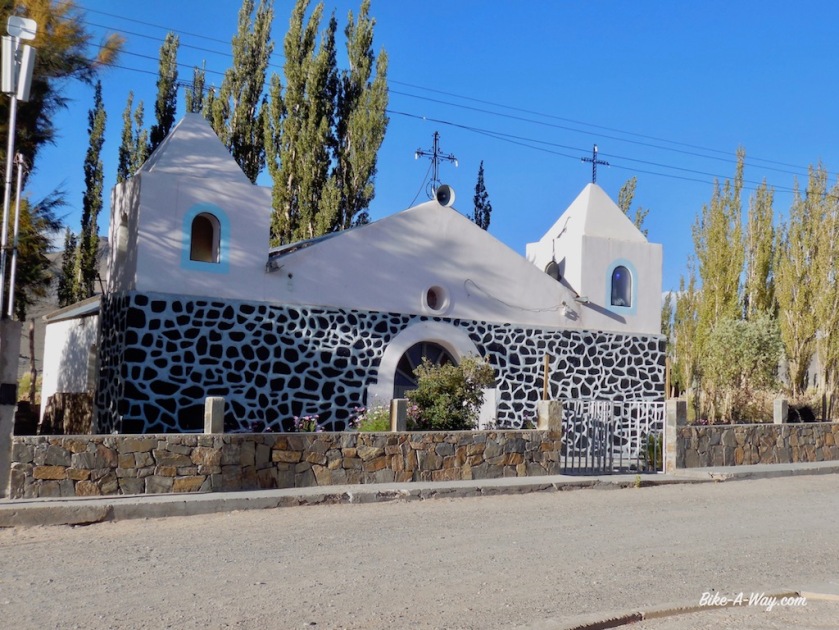
The church in San Pedro de Atacama.
Flamenco’s, from north to south in Chile & Argentina, at sea level and at + 4.000 meter, always looking for food. A bit like me.On my way up the altiplano, I passed a small hamlet where I could buy some empanadas with Lama meat. They were delicious, and I reckon that meat is pretty healthy.
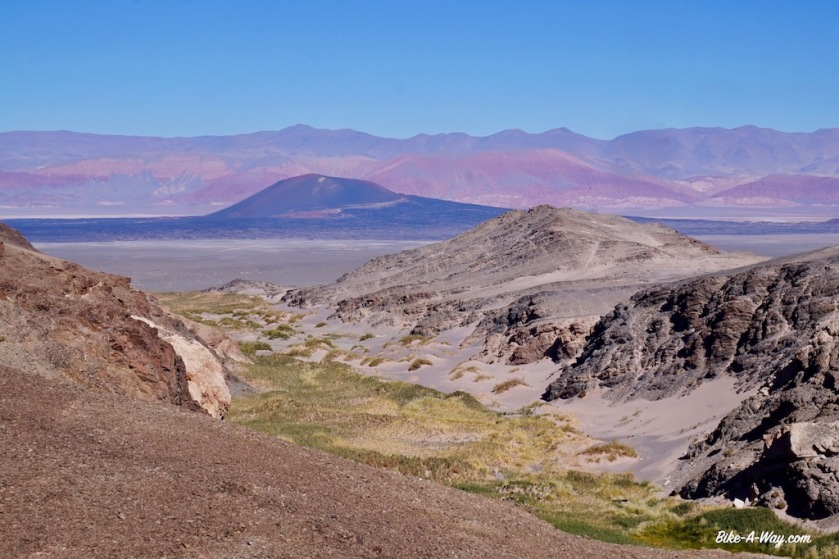
Behind those mountains is Bolivia.The whole border is lined with volcanos, this one releasing some yellow smoke.
Late in the afternoon on my second day out of San Pedro de Atacama I arrive at the El Tatio Geyser. The park rangers say it is closed for the day and I should camp at the parking lot.
I tell them I’m not here for the geyser, that I’m on my way to Ollague, at the Bolivian border. They look stunned at me.
“You have to go via Calama”, they say.
I’m not very pleased with that answer. I tell them it took me two days to cycle up here, and there is no way I will go back. “Look, here is my map, and there’s a little road going further north from here towards Inacaliri. I can even see the track going up over there, behind the geysers”.
They don’t really know what to do with this information. One of the guys tells me that sometimes they have a cyclist coming up to the geyser, but never one that wanted to go beyond here.
They consult another guy who just arrived from San Pedro de Atacama in a Jeep with some supplies.
Luckily for me, he says that it might be possible with a bicycle.
There is a German couple with an off-road camper on the parking lot, and they are not allowed through. The track seems to be out of use.
After a while, and after filling up my water bootles, they let me go through.
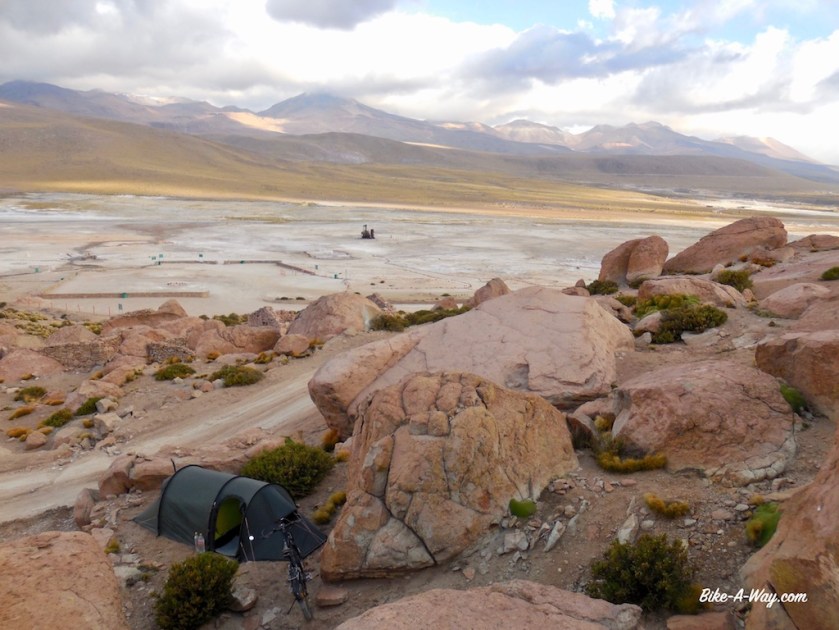
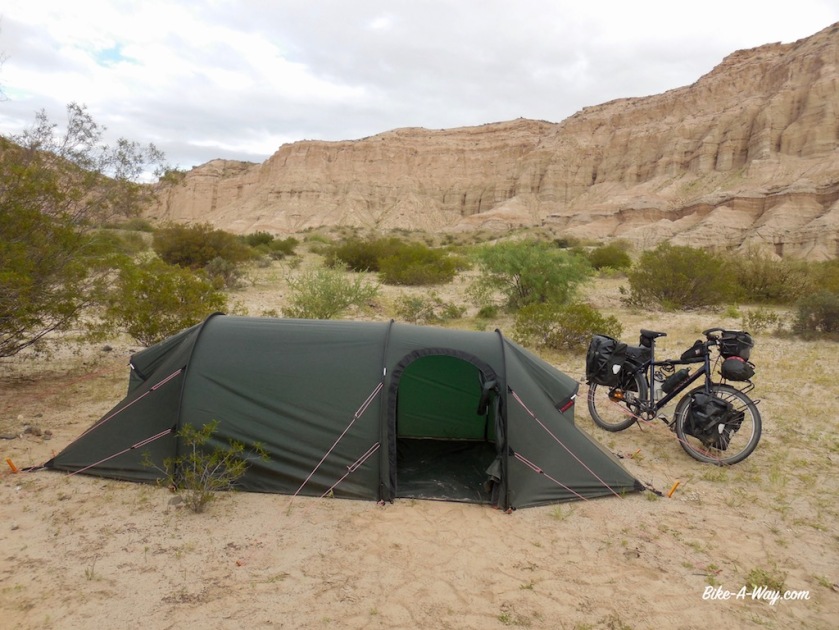
I pitch my tent at the far end of they geyser field. It will be a bad night.
I’m camping at 4.30O meter, it is freezing at night and …. I have mice in my tent ! I take all my bags in the inner tent, because these little bastards are famous for biting holes in your panniers. But I’m also afraid they will damage my tent. Several times a minute I have to chase them away, but they keep coming back, all night long. Why aren’t they going down to San Pedro de Atacama, where it’s warm and where there’s a lot of food ?
Mice at 4.300 meter …. 😦
Camping just above the geyser field.The friendly German Couple gave me a beer for the night. For Belgians, Heineken is the worst beer in the world, but still it tasted wonderful and at 4.300 m, it was nicely chilled.
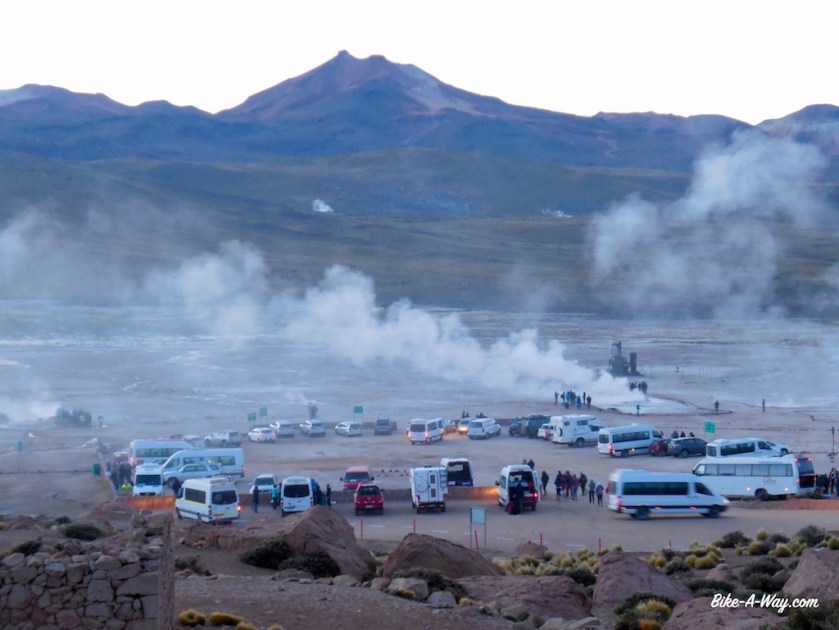
Next morning, I hear all the tourist buses, Jeeps, cars arriving before the sunrise.
As they all go to the sunset together, they come here for the sunrise.
The Jeeps and buses leave San Pedro de Atacama at 4:30 am.
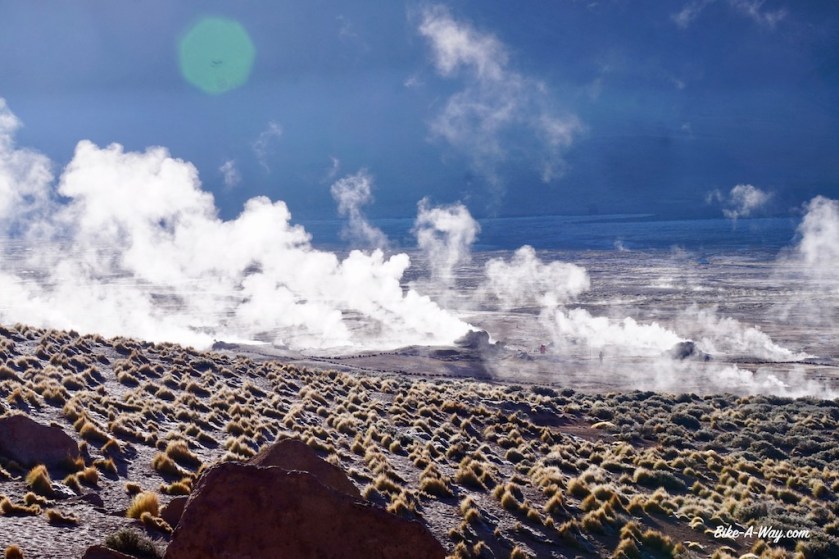
And … I find it all a bit disappointing. No spectacular geysers like you see them in Iceland, Yellowstone or Rotorua, New-Zealand. Just a bit of smoking coming from the earth at several place and some water bubbling up.
If I had to get out of bed before 4 am to see that ….
The reason they come that early is that later in the day it warms up and you even don’t see the smoke anymore.
It’s a tourist trap, don’t do it when you’re here.
This is just one of the parking lots. There are several, all packed. By 9:30 am, they’re all gone again and the place is deserted.
Yesterday, late evening two military vehicles passed my tent. Probably this ‘road’, skirting the border, is only used by them.
The Germans with the camper tried to sneak through this morning, but had to turn back as there were too many big rocks on the road.
On the bike, it’s a fine trail.
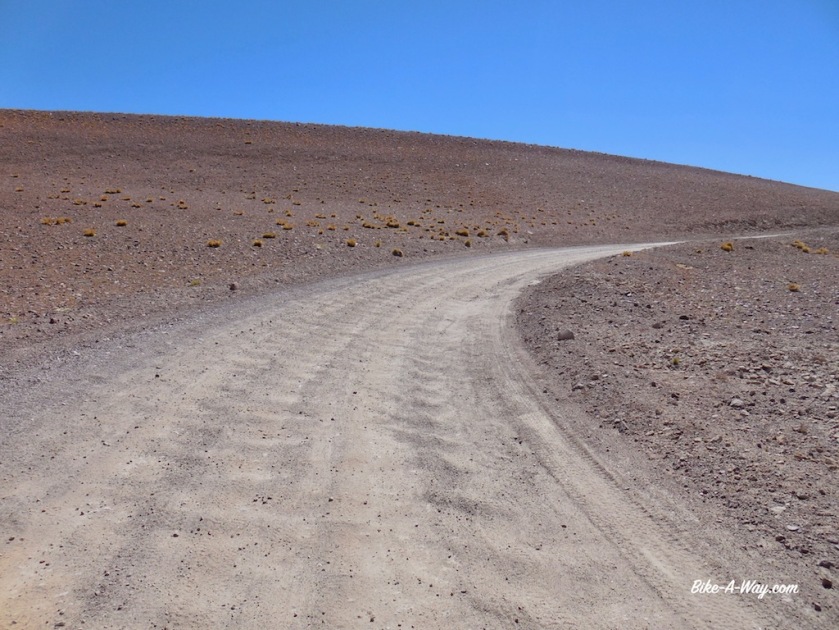
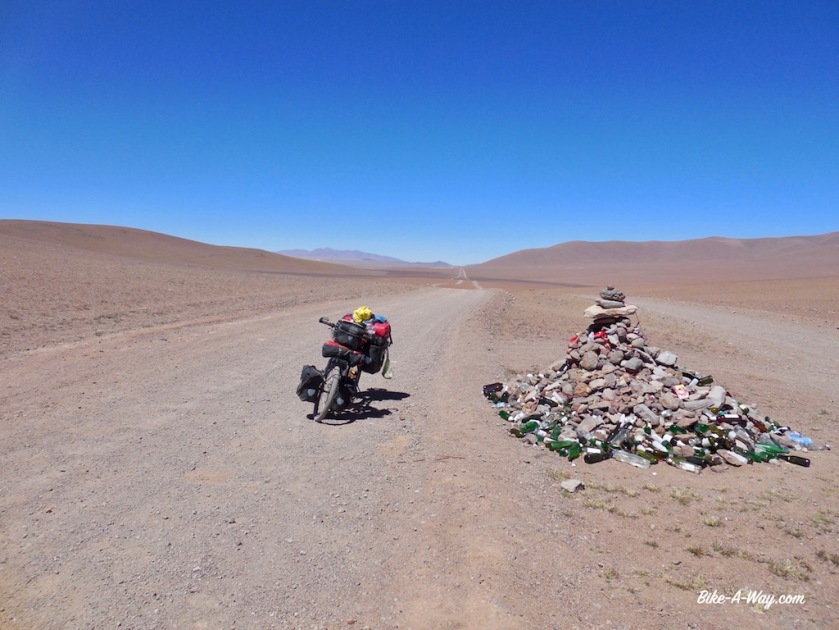
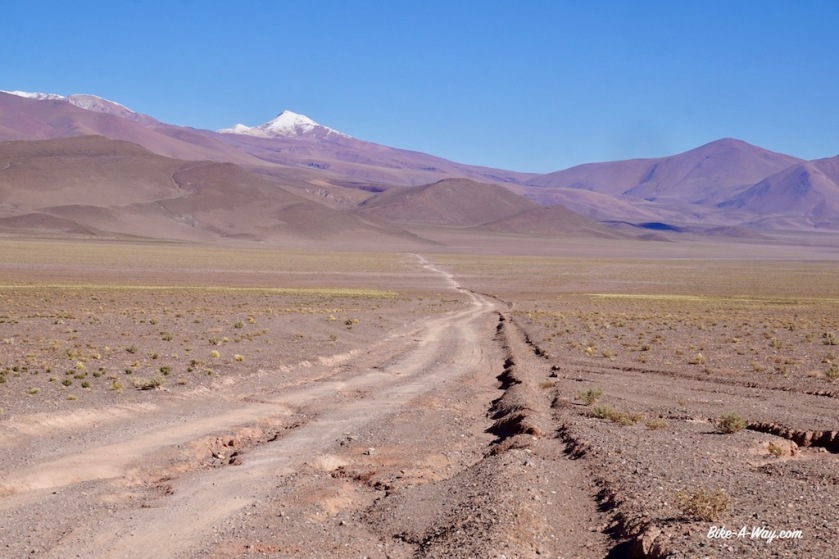
It’s hard. The road climbs again over 4.500 meter and has a section with deep sand where I have to push for a few hours. It gets cold here at night, there’s no water (hey, you’re in the Atacama, driest place on earth) and I haven’t seen a single soul in 48 hours. You’re on your own here. Nobody will come to rescue you when things go wrong.
And that’s fine.
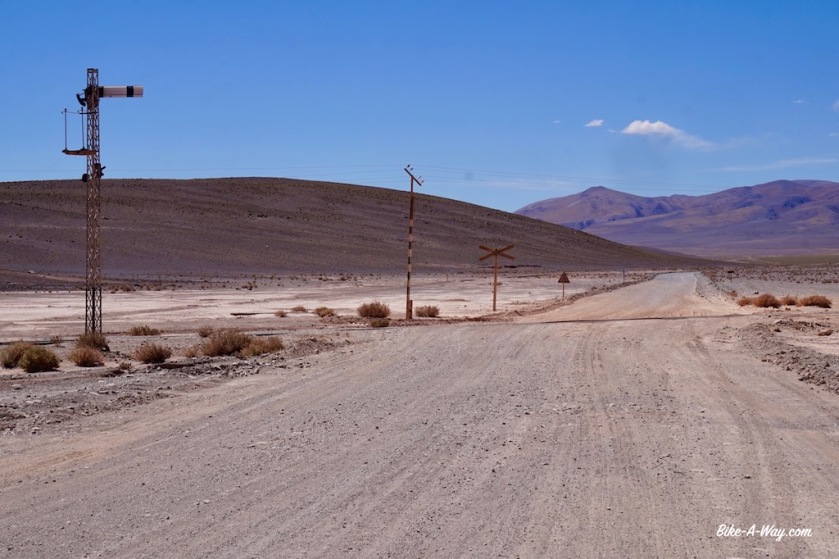
I hit the pavement again at San Pedro, which is basically a train station with some slums around it. There’s a big white water tank at the other side of the railway line, which has potable water. I didn’t see any place to eat, or to buy food. Which is no problem, I still carry enough from San Pedro de Atacama.
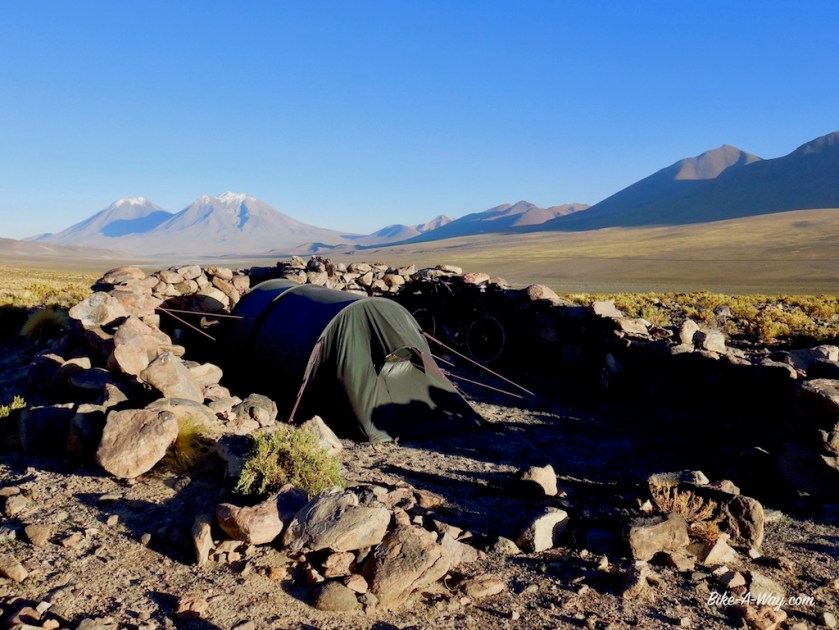
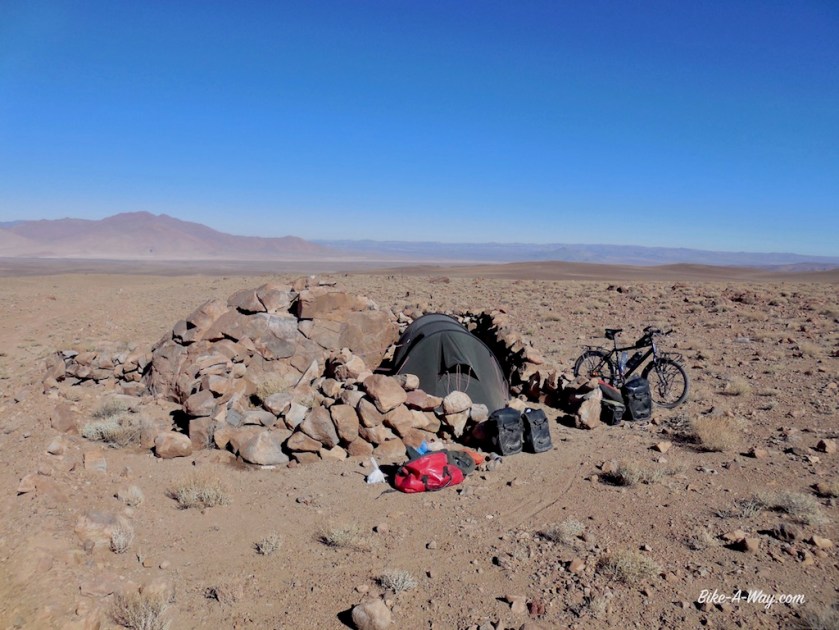
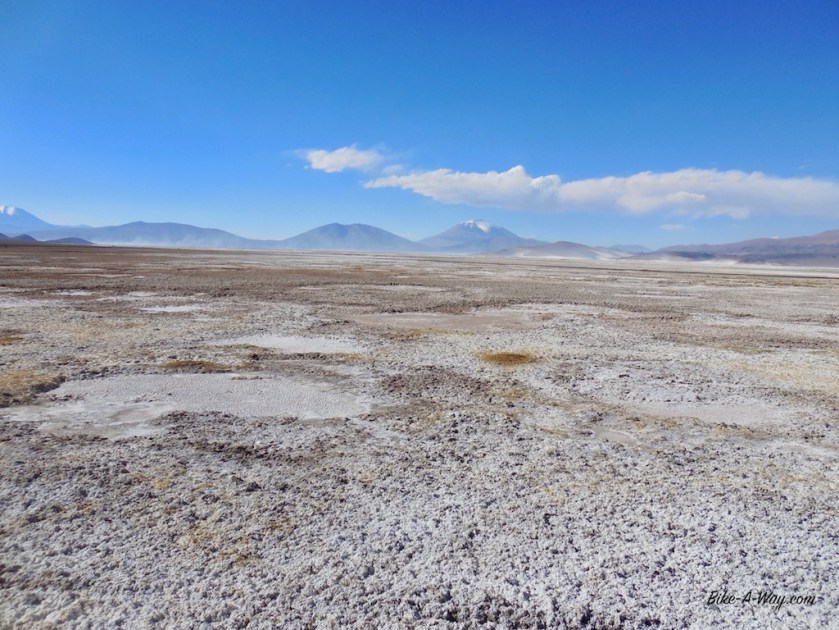
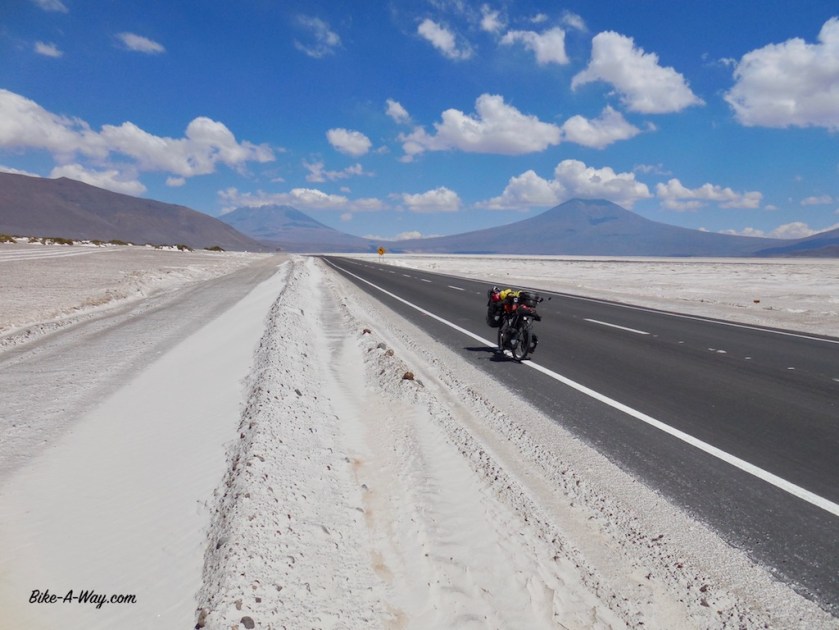
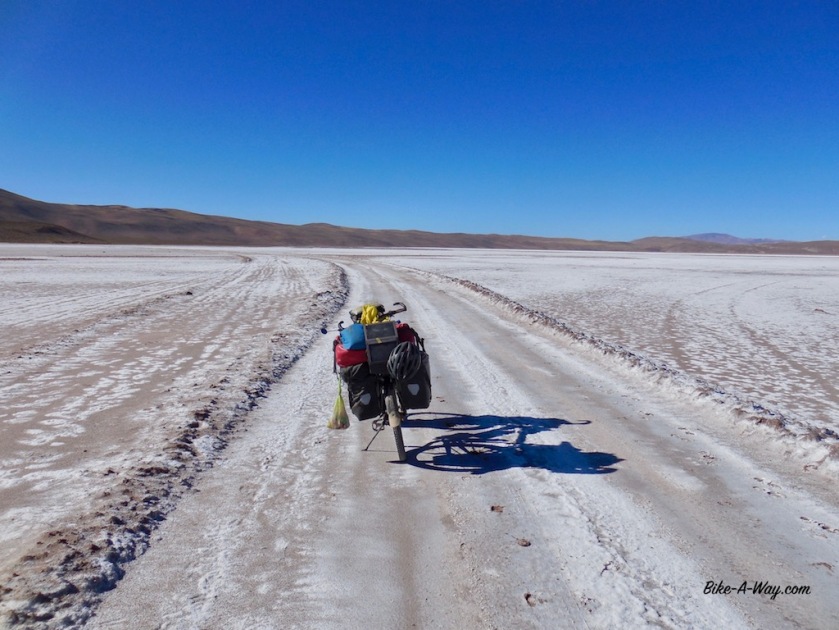
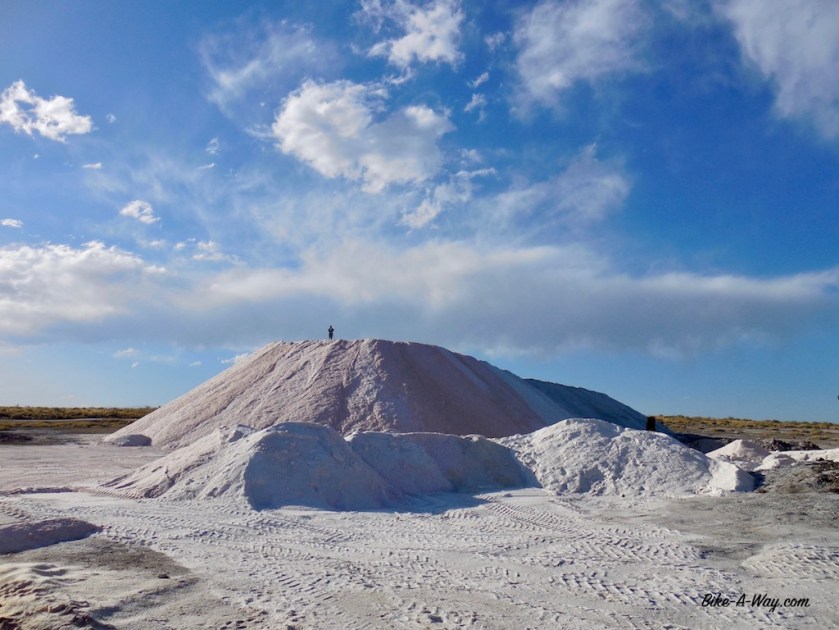
From here, the road is paved all the way to the border. I’m passing several other salt flats and have to be creative in finding places to pitch the tent. The wind blows here, and there’s not much shelter.
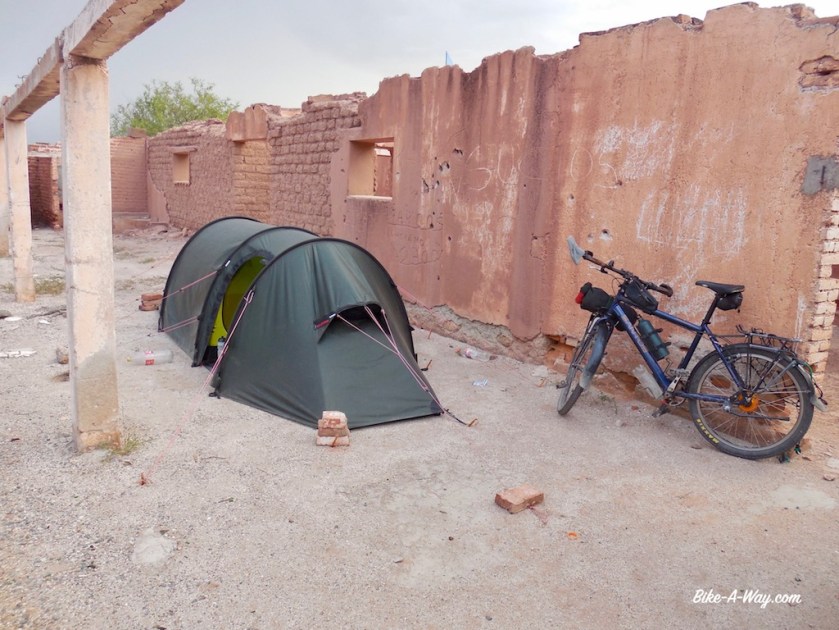
Had to rebuilt the walls a bit here in order to fit the tent.
Camping near Cebollar, a train station and some sheds next to one of the salars. It looks like camping in Beirut, but at least it has good shelter from the wind. And for the second time in four nights… mice in the tent 😦
At Ollague I finish what you could call the first part of this trip. The last seven months I spend in Argentinië and Chile, where I cycled 10.132 kilometer.
Total since I’ve started this trip in April 2016: 30.843 km.
Route: Belén – El Eje – Antofagasta de la Sierra – Salar de Pocitos – Paso de Sico
Since days I’m in doubt whether to continue my route north via ruta 40, which goes along some spectacular ravines and over the Abra del Acay, Argentina’s highest mountain pass (4.972 meter), or via Antofagasta de la Sierra through the ‘Puna de Atacama’, a very desolate high plateau.
The website from the ‘Vialidad’, that must be the Argentinian organization responsible for the roads, says since a while the road over Abra del Acay is closed due to flooding.
Not very promising.
On the other hand, two cyclist I met further south who came via Antofagasta de la Sierra said it would be horrible to cycle that road in a northerly direction.
Tough choices to make, as both options seem to throw their difficulties at me.
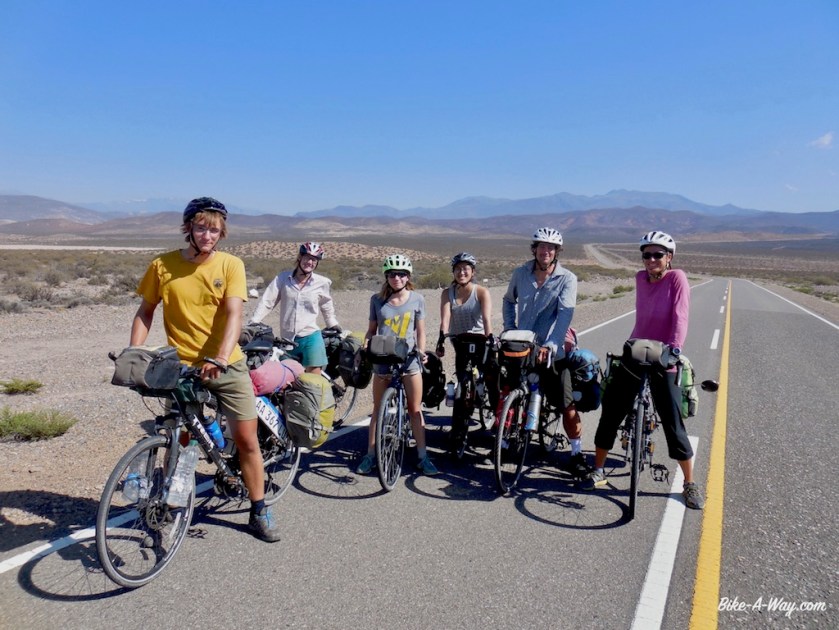
In Belén, I ride into Frederic again, a French cyclist I briefly met further south in Villa Union.
Together with him I ride that same day towards EL Ejen and decide to ride the route via the Puna, towards Antofagsta de la Sierra.
Starting from Londres at 1.200 meter, El Eje at 1.775 meter, we cycle up towards a height of 3.992 meter at Portezuelo de Pasto Ventura.
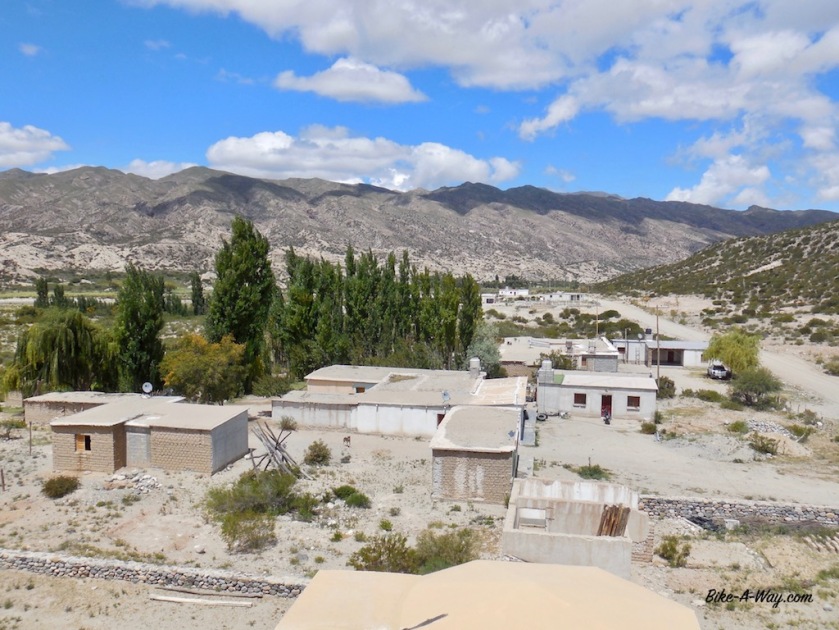
Hamlet along the road to Antofagsta DLS.
The first day of our climb onto the Puna (altiplano), the weather was still cloudy, until we climbed out of this valley.
The straight road of 20 kilometer into the hamlet ‘El Peno,’, at 3.350 meter seemed to take forever against the strong Puna winds.
It seems the elevation doesn’t affect me too much so far, but both Frederic and I have diarrhea, probably from water we took from a pipe at El Bolson. And diarrhea sucks a lot of energy out of your body.
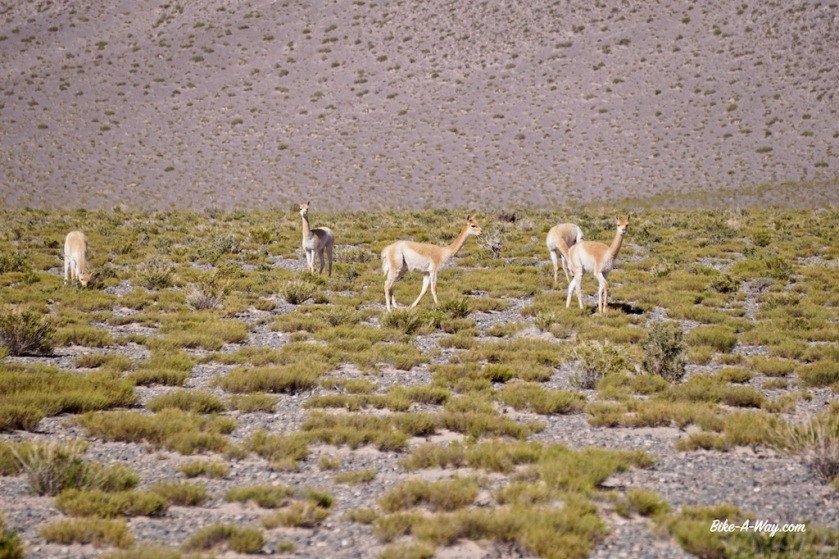
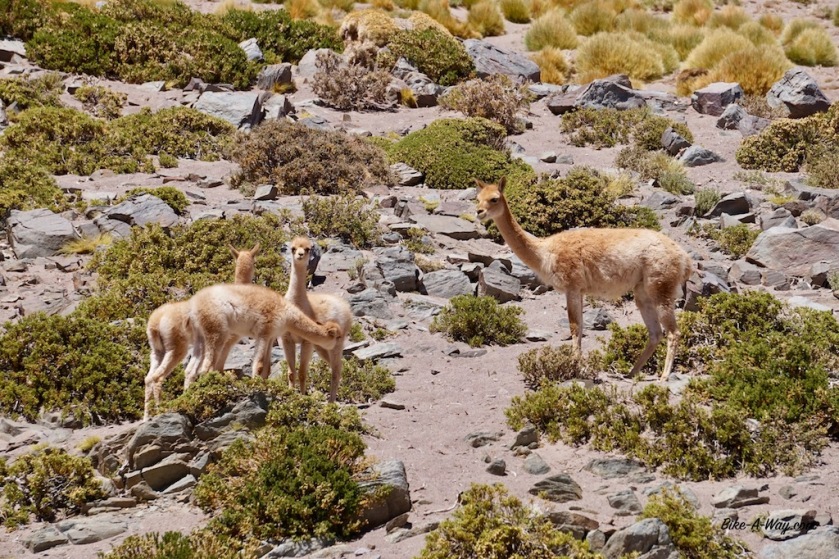
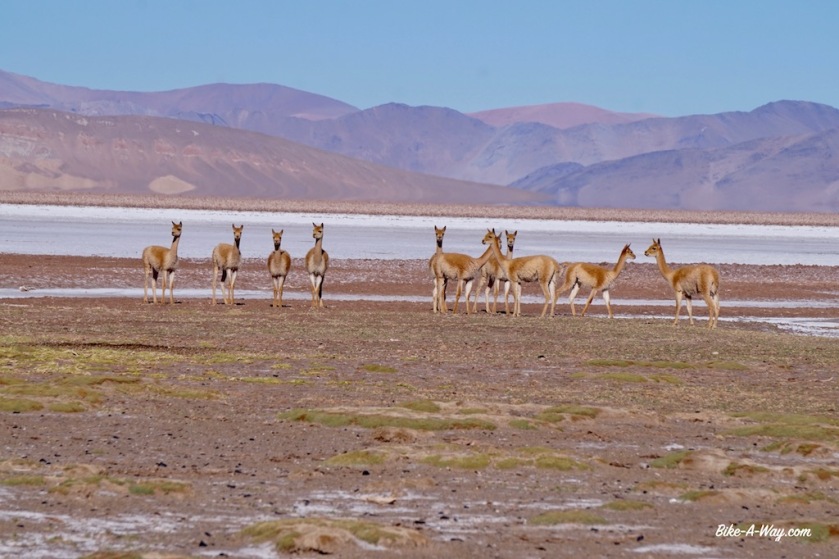
Cerro Laguna Blanca, just above or just under 6.000 m, depending on which source you use.Vicunas, not as rare anymore as a couple of years ago.
Again, Cerro Laguna Blanca
Find the car to appreciate the grandeur of this landscape.
Sixty three kilometers separate El Penon from Antofagasta de la Sierra with only 400 climbing meters. Luckily the wind was quiet. If you have it in the face here, it’ll be a terrible day.
Frederic continues his route towards Antofalla and I stop and check in the hostel in Antofagasta de la Sierra to have a half day rest and a good meal tonight.
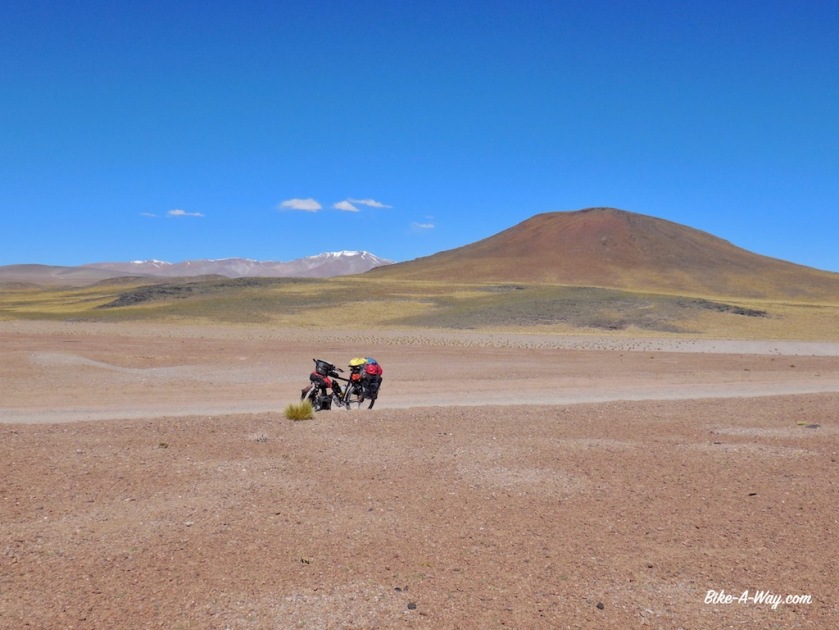
You can see me cycling in the distance 🙂
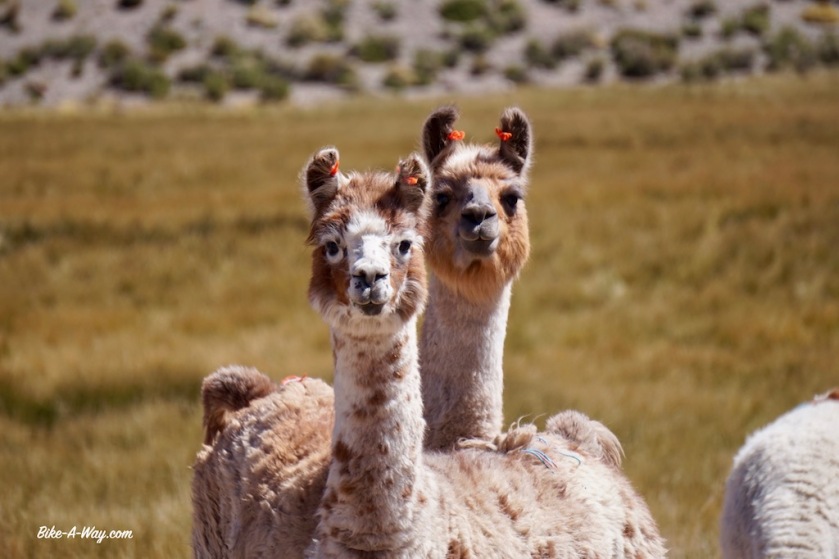
A new asphalt road is being built between El Penon and Antofagasta de la Sierra, but so far, traffic still has to take the sandy roads right & left of it. We cycled the asphalt.Llamas at a lake just outside Antofagasta DLS.
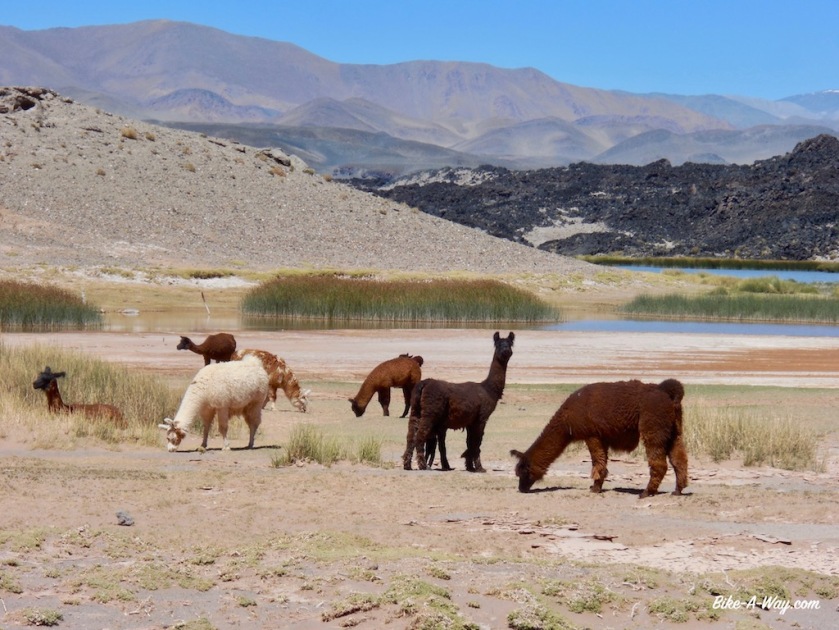
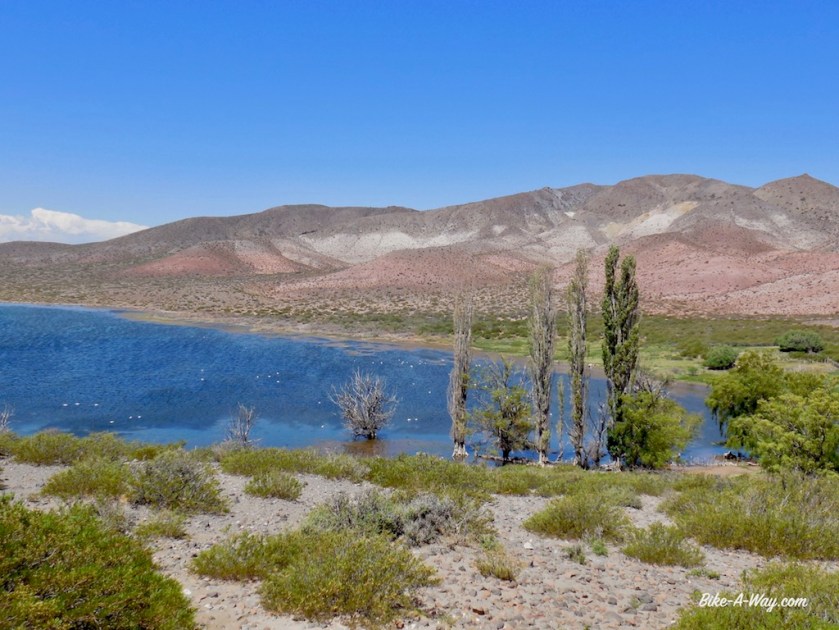
And flamingo’s, which I saw all the way from the cold lowlands of Tierra del Fuego, all the way through Patagonia and also here high up in the Puna.
The big test comes after Antofagasta DLS, the climb from 3.300 meter to the ‘Abra Falda Cienaga’, a pass at 4.442 meter.
Riding stretches like this, it is not only elevation what makes it difficult. The road promises to be a mess, there’s the wind at this altitudes, the total absence of water, no villages for provisions and the sun which is burning immensely now in summer. The days are hot, but after the sun sets, it cools down very rapidly.
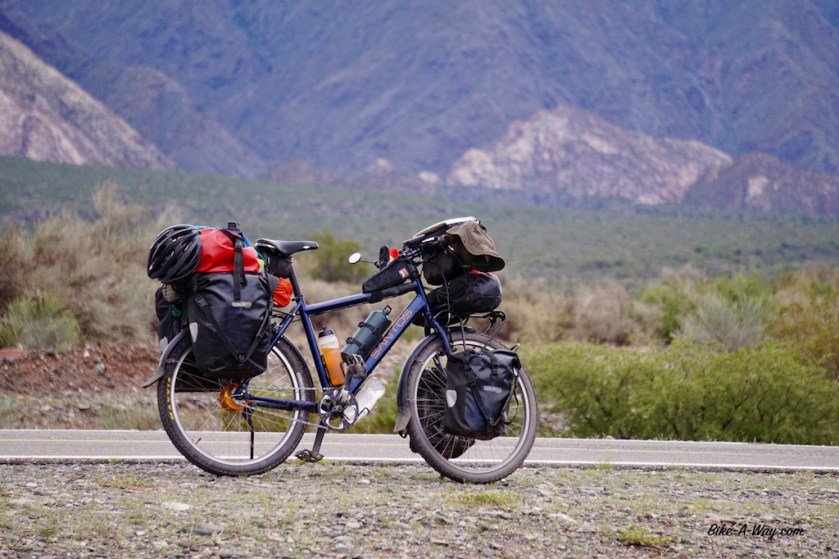
I leave town with four days worth of food, i.e. 1,2 kg of bread, two large packages of chocolate, six tins of paté, a pot of ‘dulcé de leche’ (which I find awful, but is easy to carry), two cans of tuna, two tins sardines, 500 grams oats meal, 500 grams rice, 500 grams spaghetti, three tomato’s, two peppers, three onions, garlic, parmesan cheese, a lot of cookies, an apple, a banana, dried fruit, nuts, tomato sauce, curry powder, milk powder, chocolate milk powder, tea, instant coffee and …. sixteen liters of water.
I hope to ride to Salar de Pocito’s, the next hamlet 220 kilometer away in three days.
So I’ll have 5 liters of water a day to drink and for cooking, dishes and 0,33 liter/day to brush my teeth.
Three Imodium tablets should keep the intestines at bay.
Antofagasta de la Sierra, the ‘loneliest’ town in Argentina.
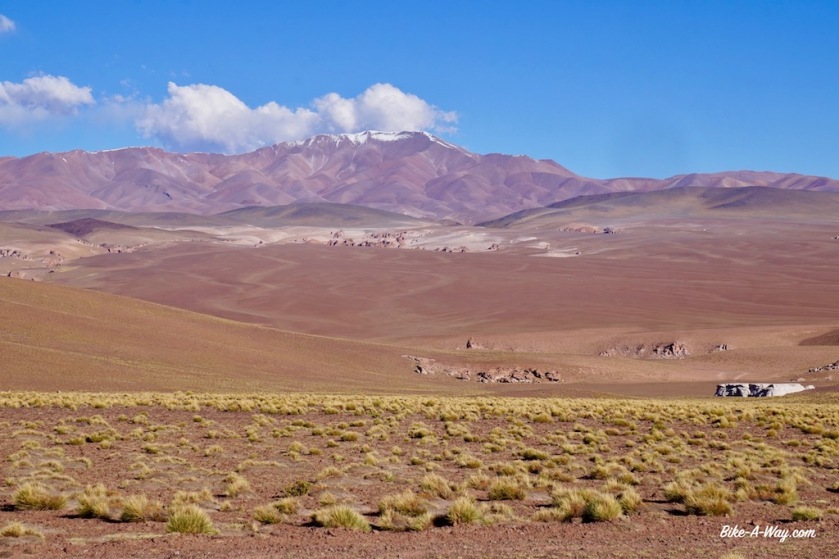
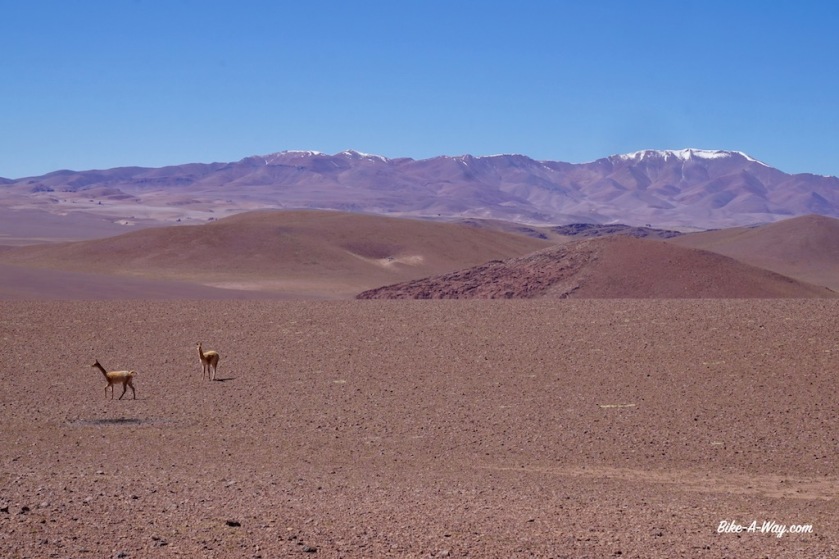
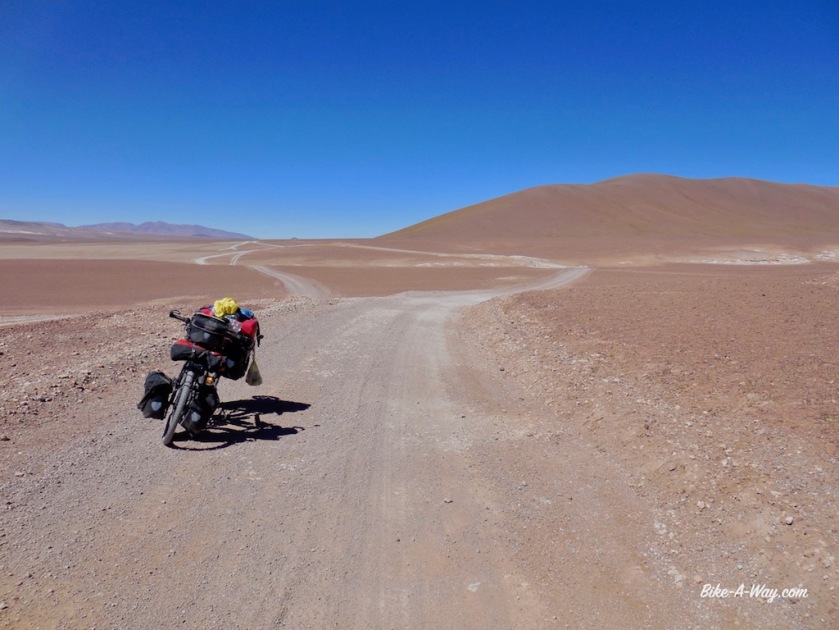
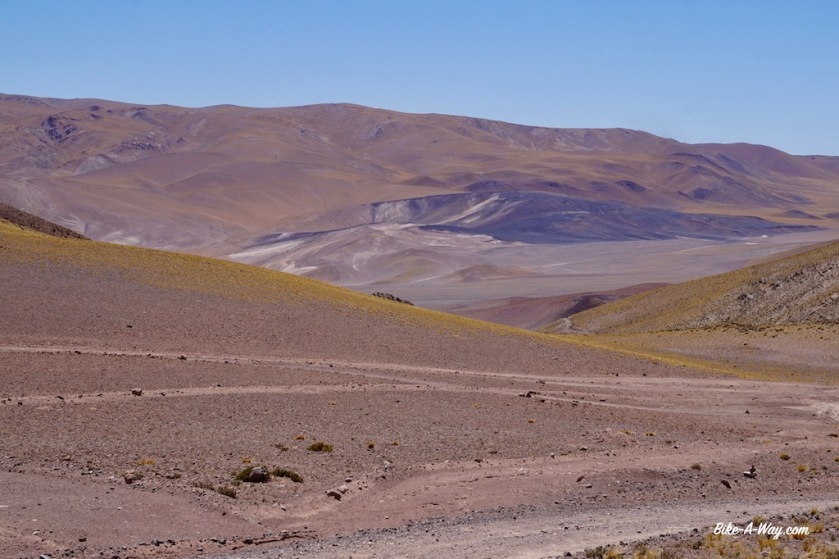
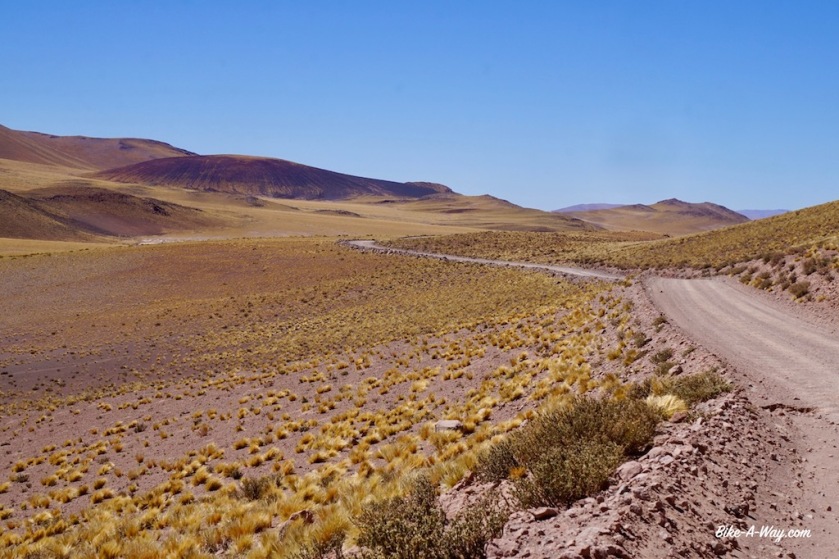
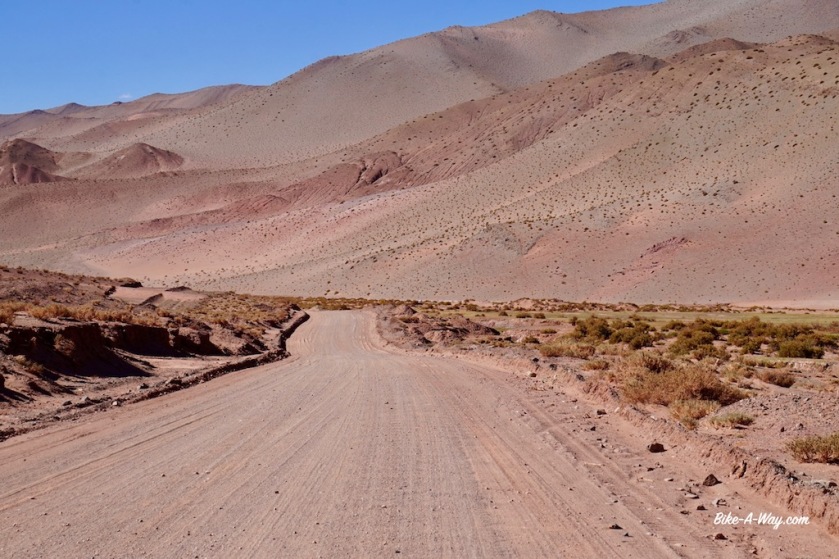
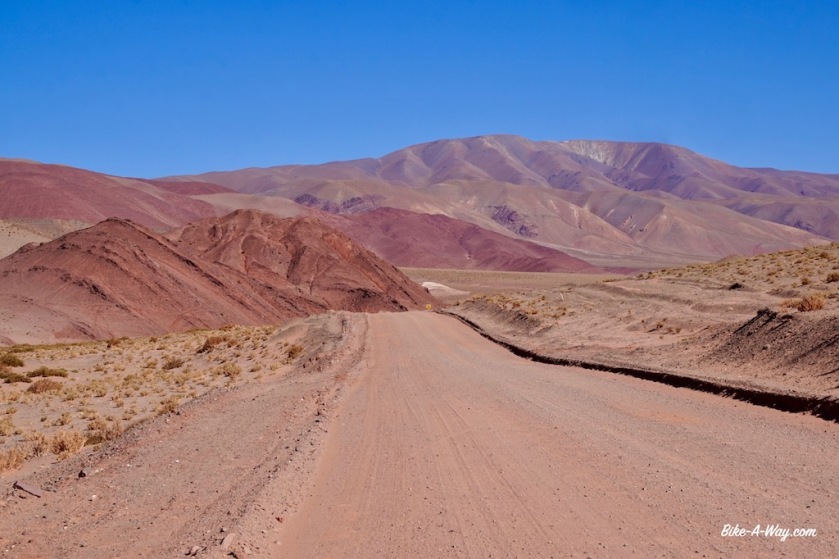
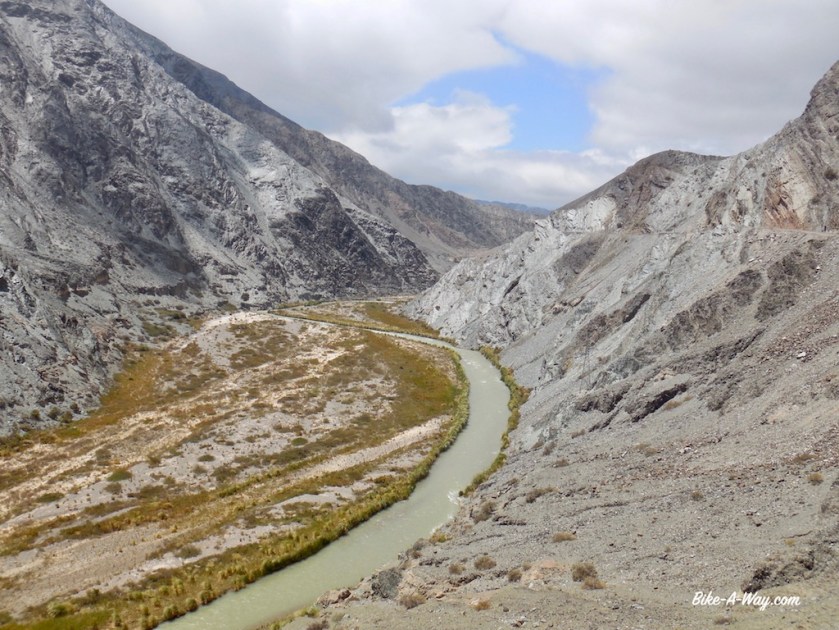
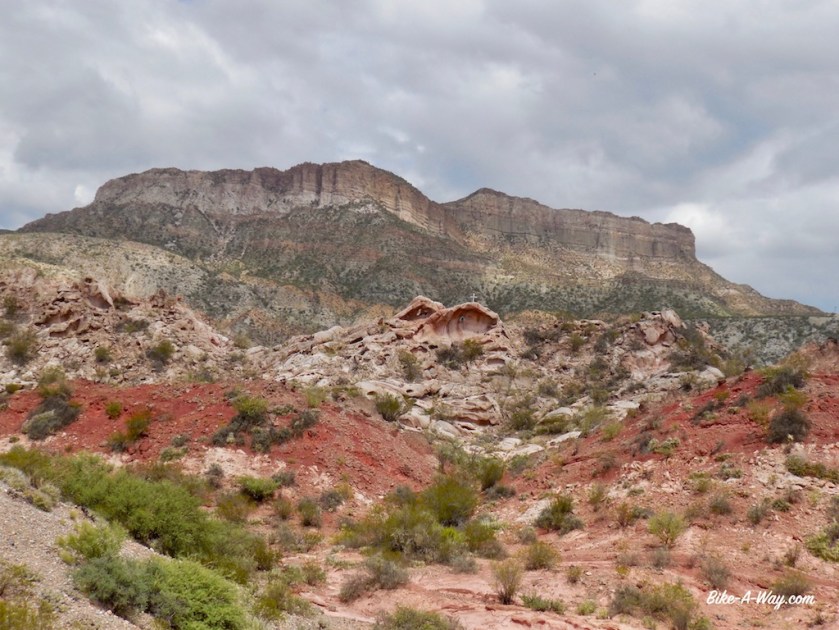
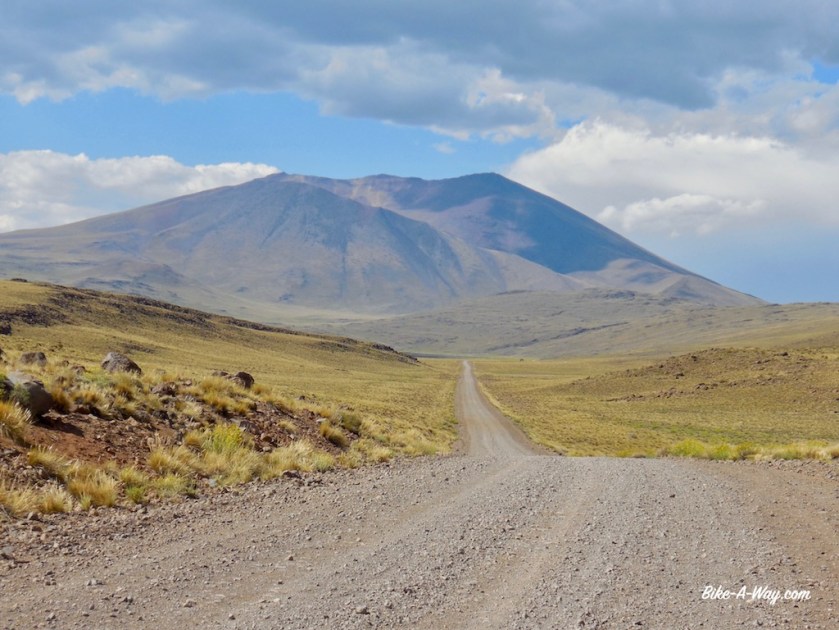
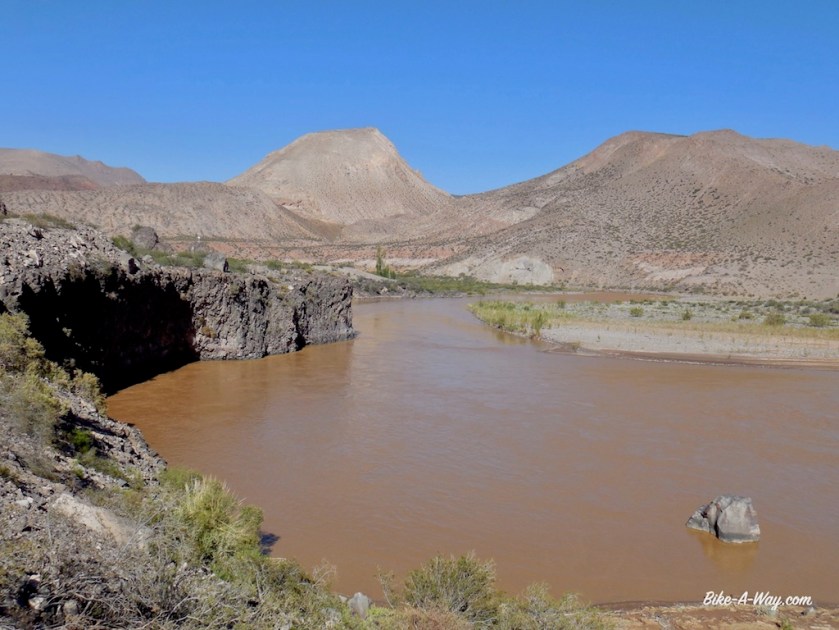
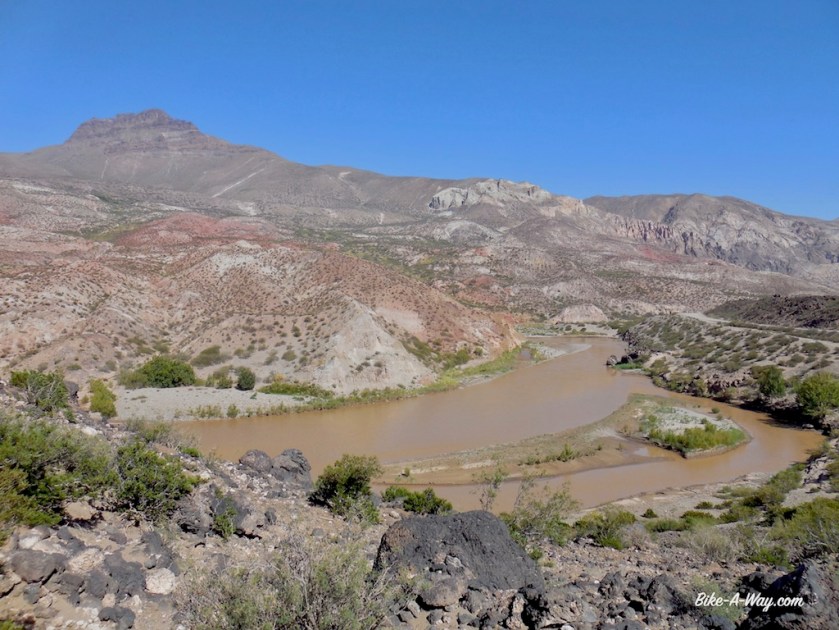
The road starts to climb seriously at Paycuqui, a hamlet of three or four houses. I thought the Puna would be a colorless, desolate high plateau, but it is much, much more beautiful as expected. Mountains in grey, yellow, green and red, many Vicunas and …. a little tail wind to help me up !
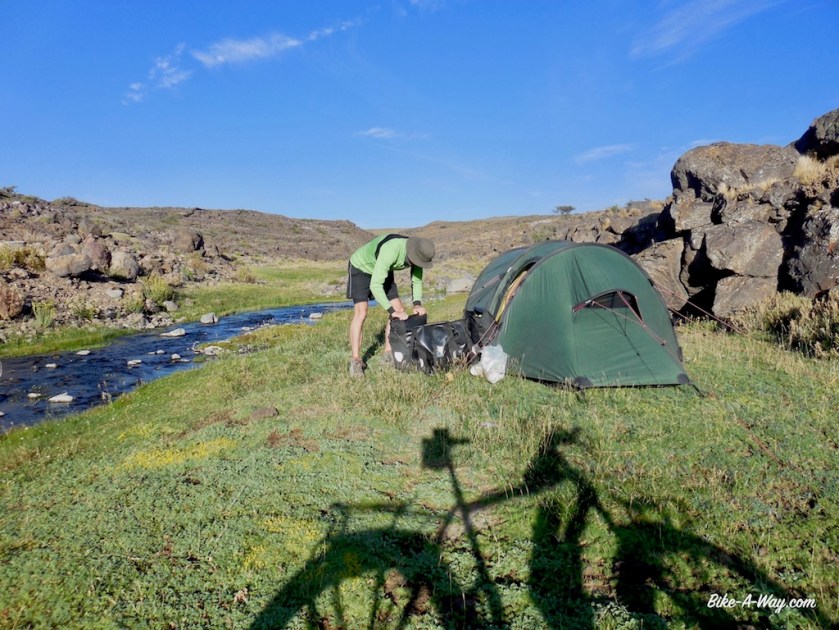
I camp just under the pass at an elevation of 4.358 meter, my highest camping spot ever. Some large rocks protect me well from the wind.
Many cyclists I meet seem to get by on a diet of just pasta with tomato sauce or even only olive oil, but that doesn’t work for me.
So as the sun sets at 19:45, I’m cutting peppers, onions and garlic to make a nice rice & curry dish, with some tuna at this altitude
At 22:00, I shortly leave the tent again. The last brightness from the sun in the west is gone. The moon rises after midnight today. No light pollution for hundreds of kilometer, and at this elevation, the night sky is simply unreal. A shame I don’t have a camera anymore with which I could catch it, but I’ll always remember it.
My highest camp so far at 4.358 meter, well protected from the winds.
From my camp spot the next day, the road undulates for a while and it seems to take forever to reach the pass. A while ago I downloaded a bunch of episodes from ‘The Date on Friday’ from 2016 and 2017 (De Afspraak op vrijdag), a program from Belgian television discussing the political events of the last week. So I’m getting a little bit up-to-date again.
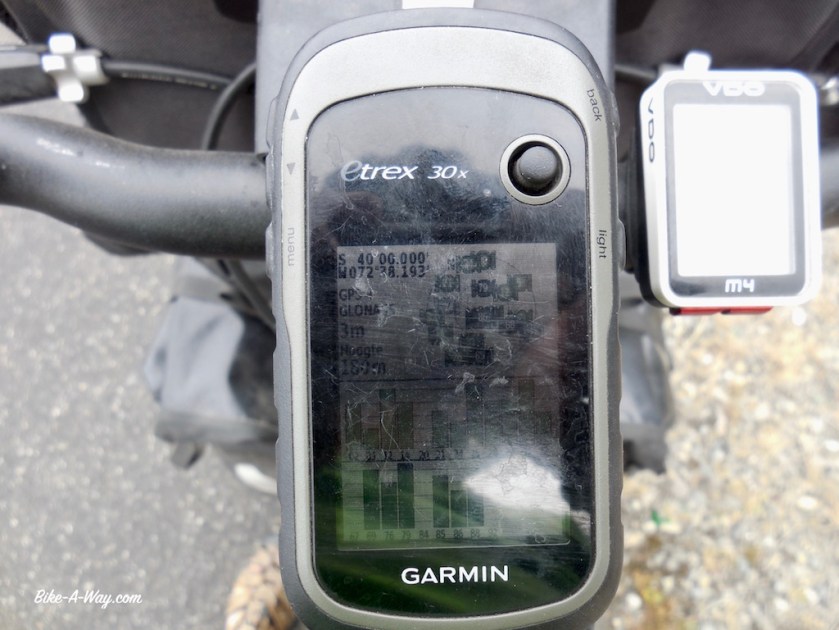
After 20 kilometer or so, I’m finally at the top. 4.432 meter according to my gps readings. I also passed the 30.000 kilometer since I started this trip in April 2016.
Wobble, wobble, wobble…Some vicuna’s, surviving one way or the other above 4.000 m.
It keeps going up and down for a while before I finally reach the highest point, but what a spectacular environment.This guy lives at + 4.400 meter.‘Abra Falda Cienaga’, the highest point on this Argentinean Puna route at 4.432 meter.
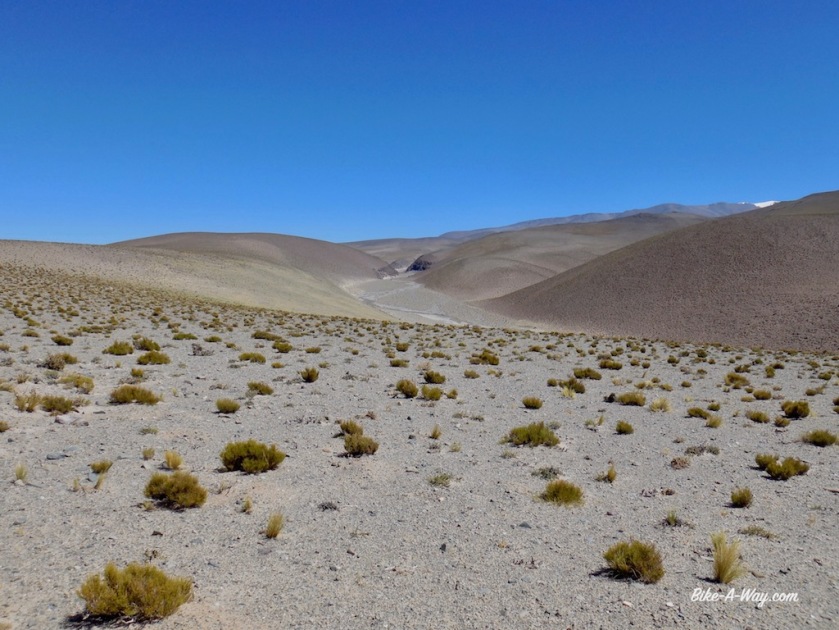
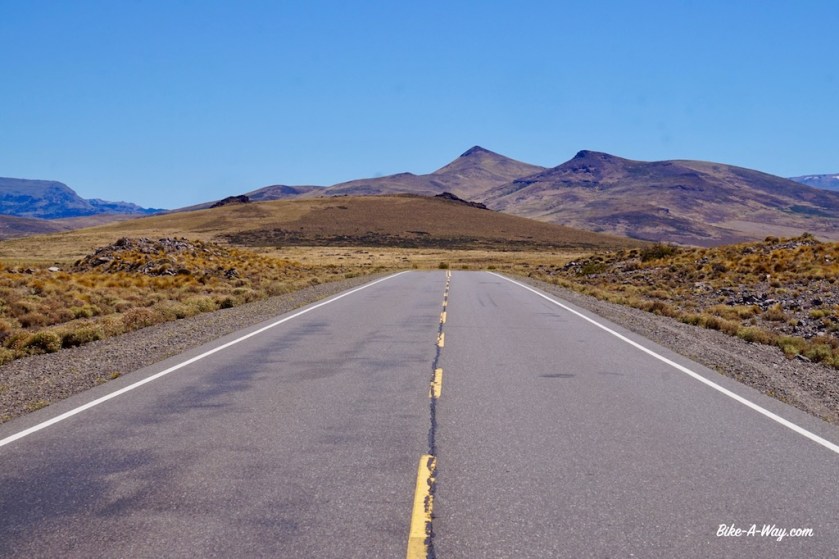
After yesterdays short day of 47 kilometer, I was hoping to make some better progress today but the road keeps descending and climbing. I cycle slow but even then I still stop to just look around. It’s like I’m cycling on Mars.
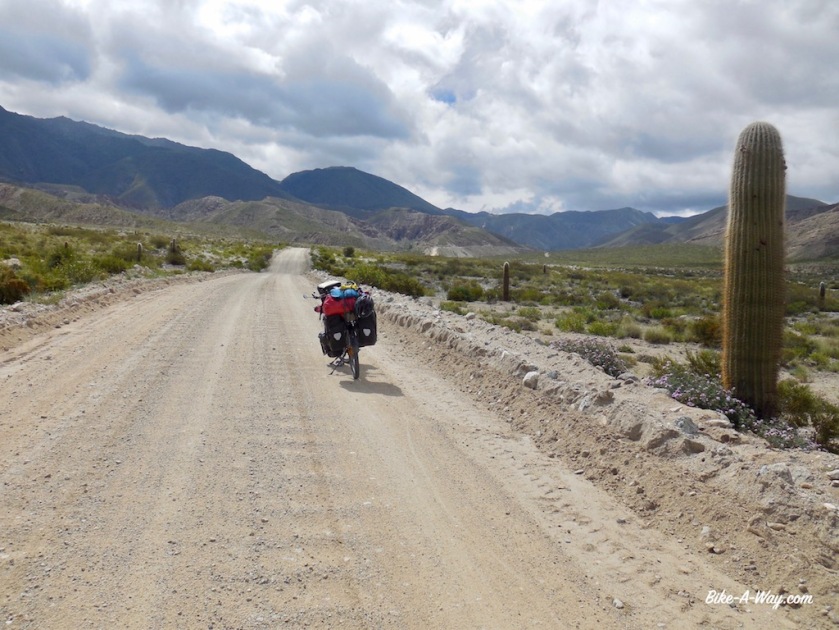
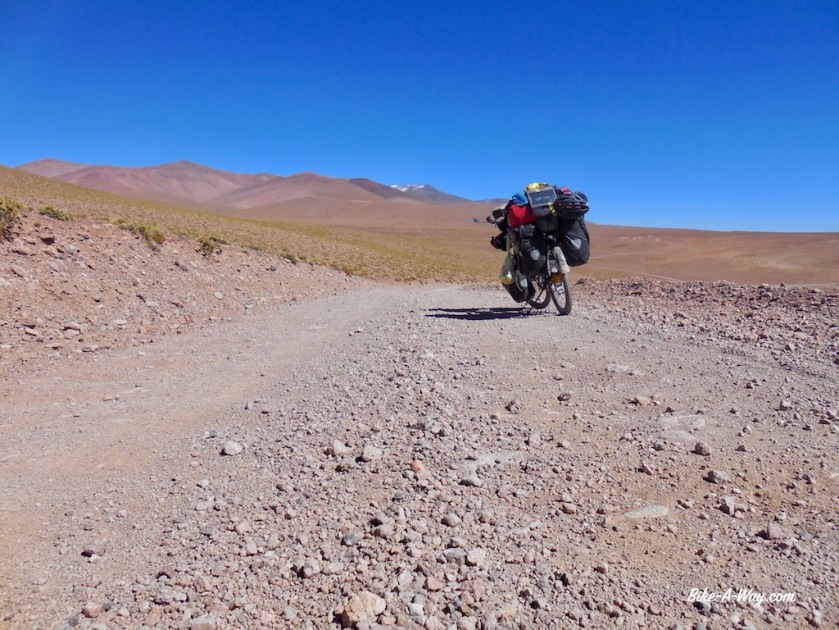
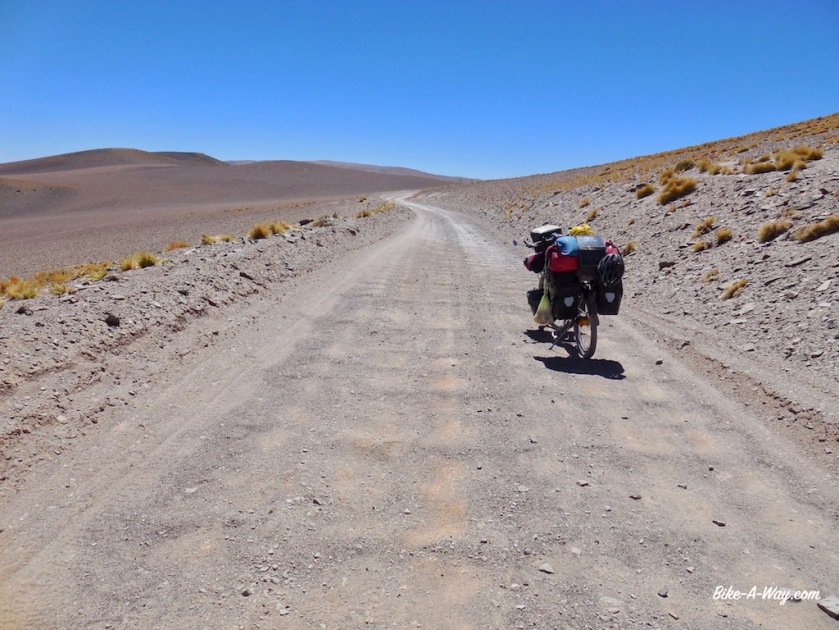
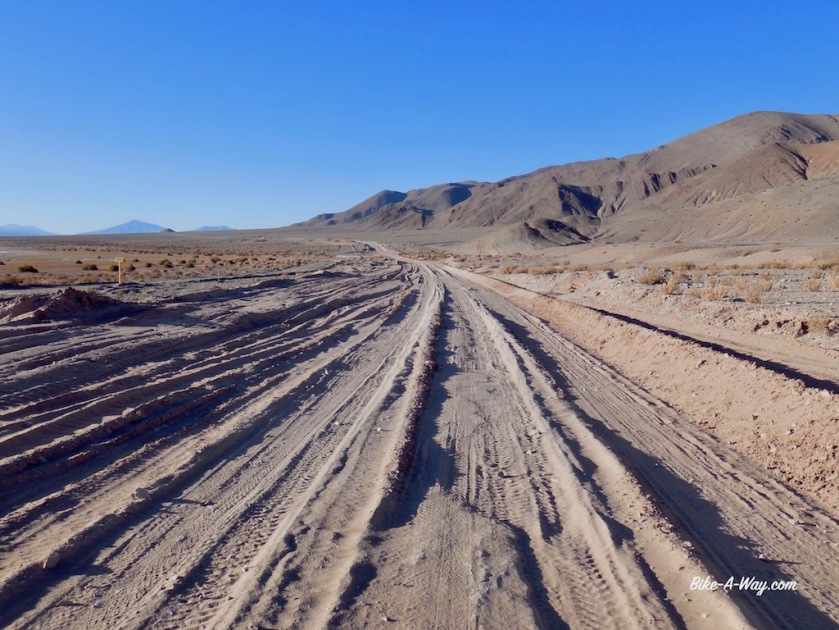
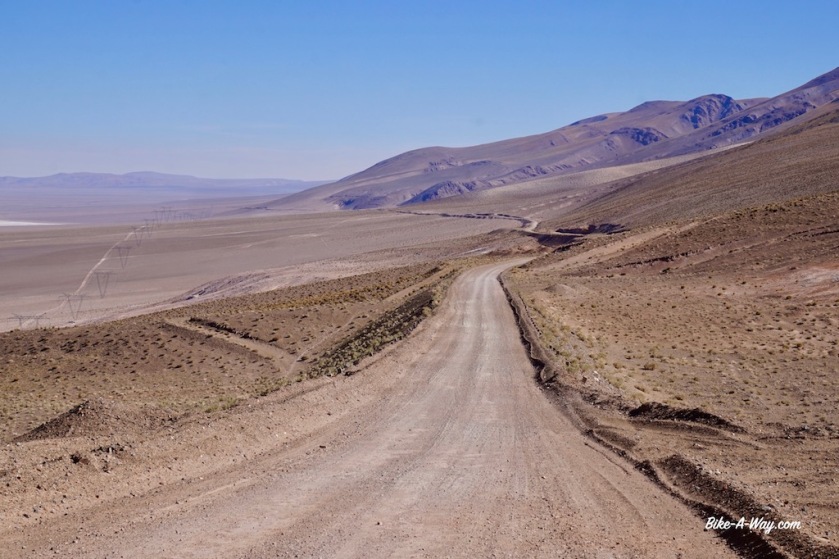
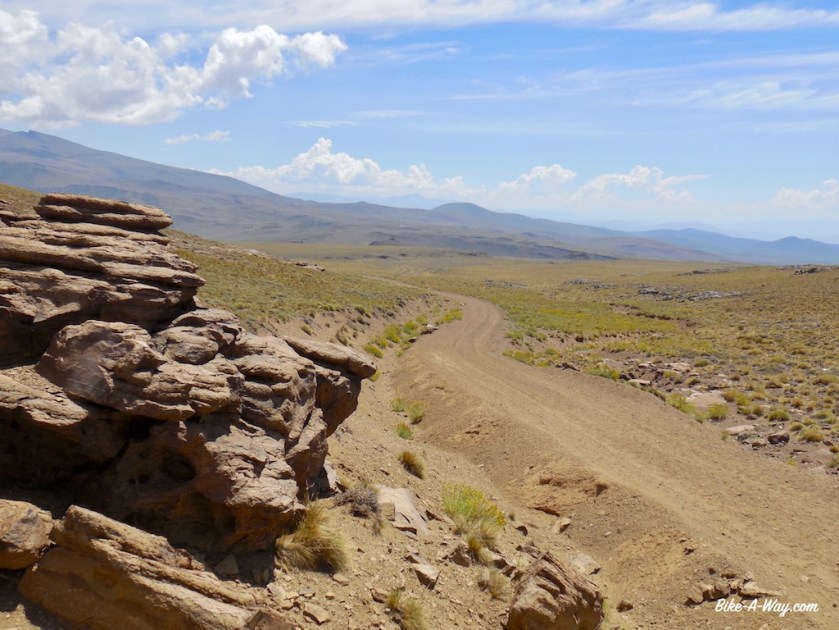
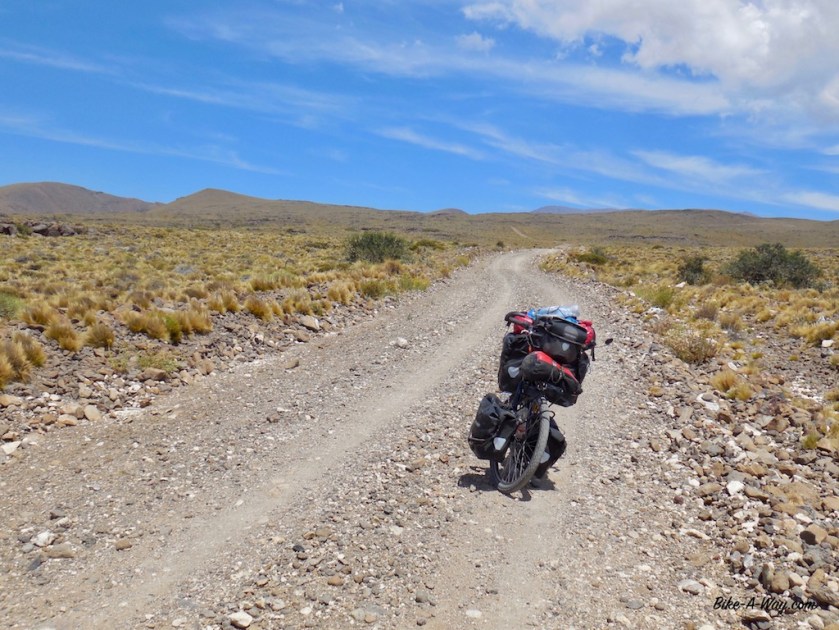
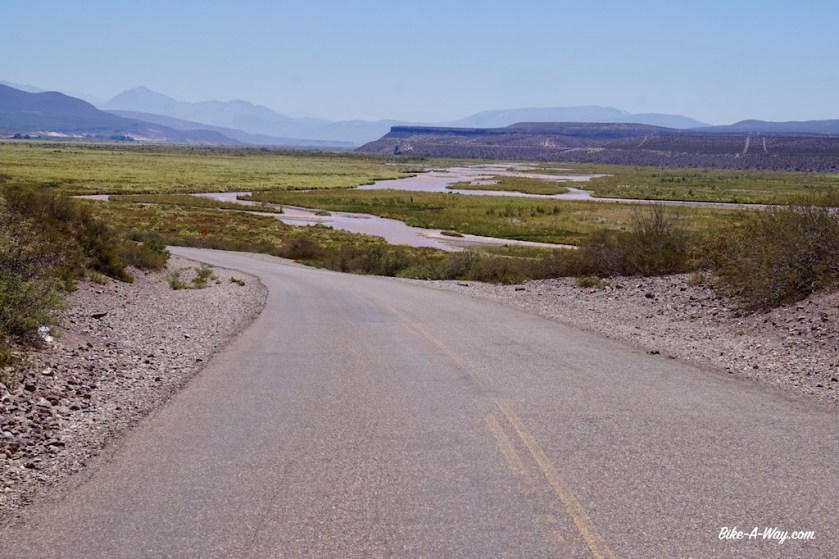
The road is dramatically bad. It’s washboard all the time, with often deep sand thrown in to it. Many times I need to push the bike, which sinks into the sand with all that weight. I breathe heavily at this altitude.
Good, rideable sections are short.
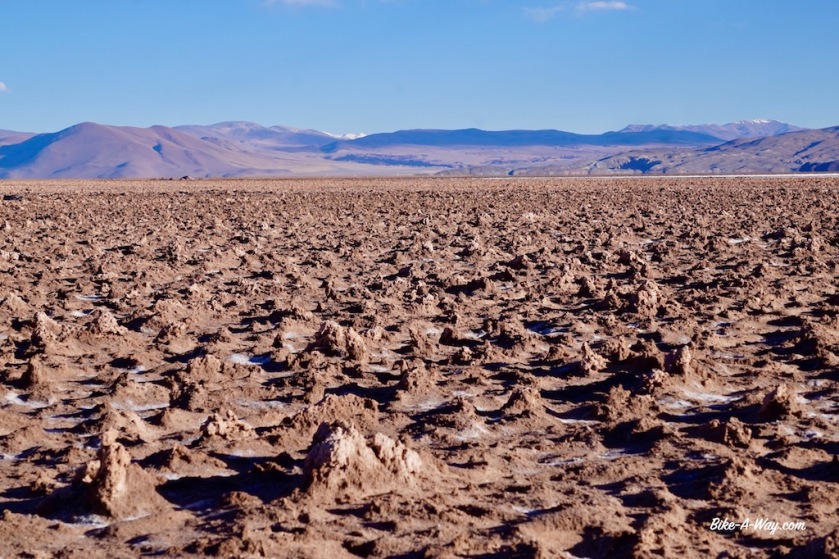
Especially the downhill towards the ‘Salar del Hombre Muerto’ (salt plain of the death man) is awful, as are some parts of the track around it.
After cycling all day above 4.000 meter, the salar is at an elevation of 3.980 meter.
After sixty kilometer I arrive at the unmanned police post north of the salar. It’s basically just two containers which are unfortunately locked. They have a water tank behind them, which I opened from the top. The water was lukewarm from the sun all day, so I had a nice shower in this dry high altitude desert.
I pitch the tent behind one of the containers. Less scenic then the day before, but again properly sheltered from the wind.
Now I’m already 32 kilometer ‘behind schedule’, so it’s good I took again too much food.
I filtered water from the tank, which I use for cooking, do the dishes and brushing teeth. Even with a day extra, I should be fine with the water to reach Salar de Pocitos.
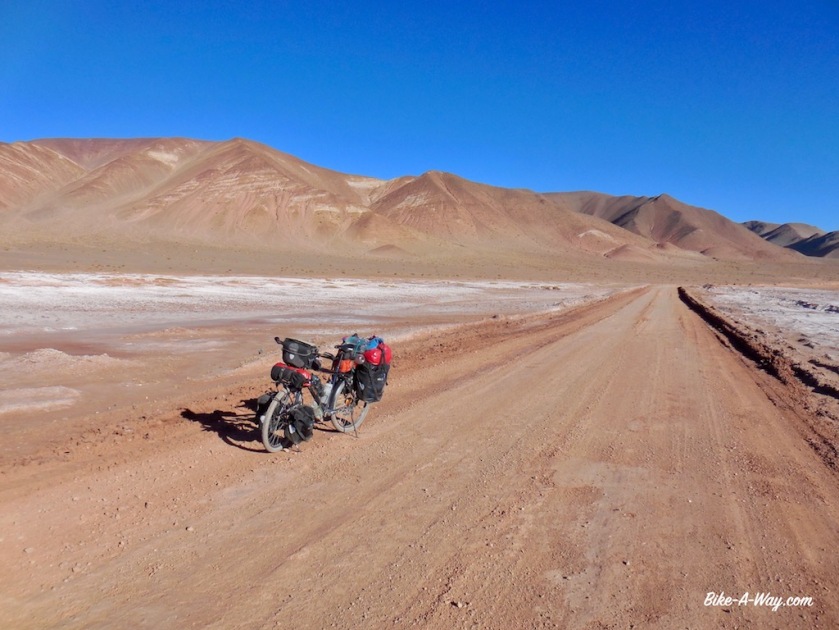
The stretch between‘Abra Falda Cienaga’ and Salar del Hombre Muerto was definitely the most spectacular (and no traffic apart from three jeeps in the morning with ‘adventure tourists’ visiting the salar.
Another little, unnamed salt plain.Every 0,7 seconds your back, pulses, shoulders get smashed on these roads. It’ll make you stronger.
A vicuna on his lonesome admiring the Salar del Hombre Muerto.
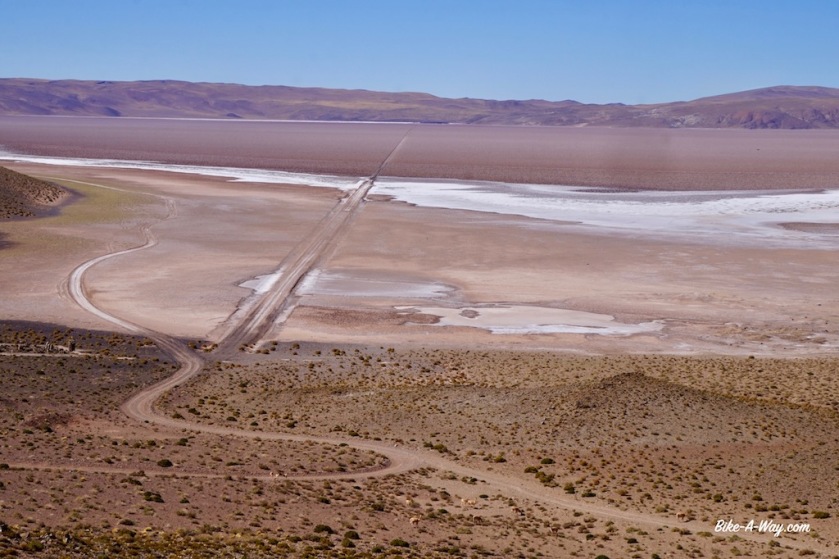
Salar del Hombre Muerto, 3.980 meter above sea level.There are two roads to the other side. The straight one in the middle seemed too muddy so I took the long way around to the left, adding +/- 15 kilometer to the trip.
North of the Salar del Hombre Muerto, I have to climb another unnamed pass of 4.195 meter. The road is better for a while but becomes again really sandy and bumpy as the day carries on. As I was virtually on my own between Antofagasta de la Sierra and the salar, now north of this salt plain there is again some traffic of pick-up trucks and big trucks.
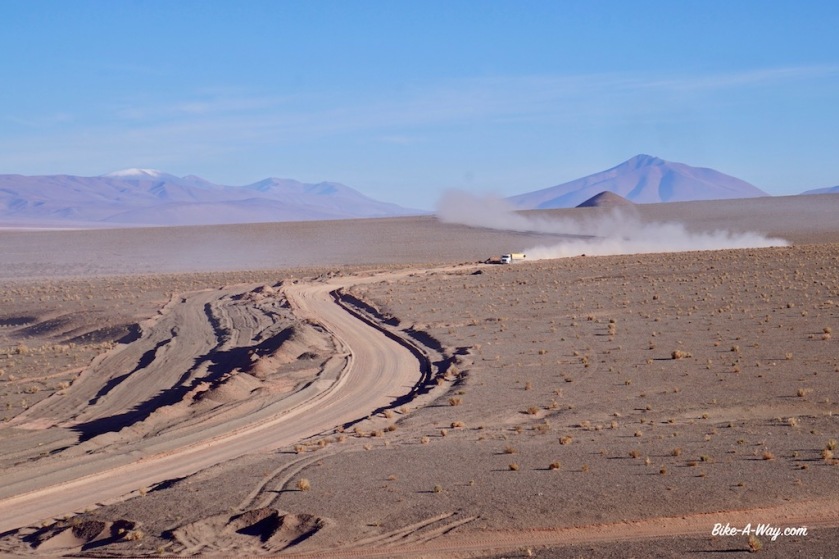
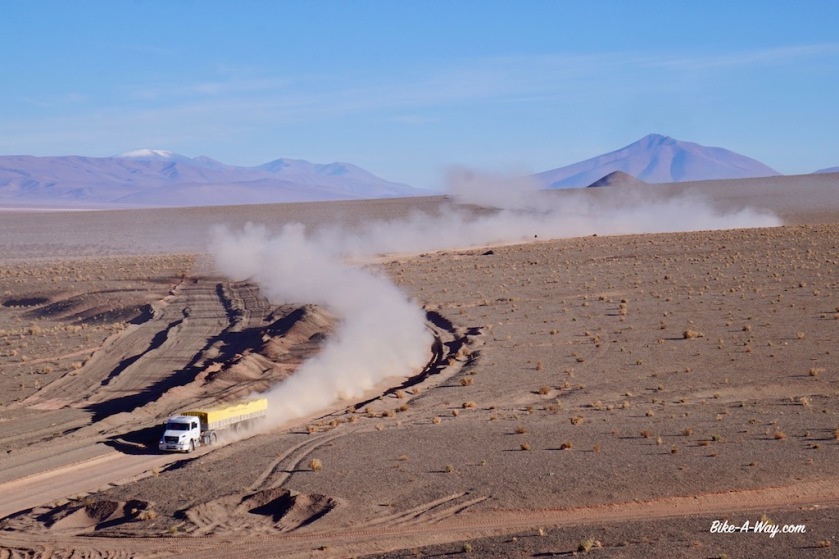
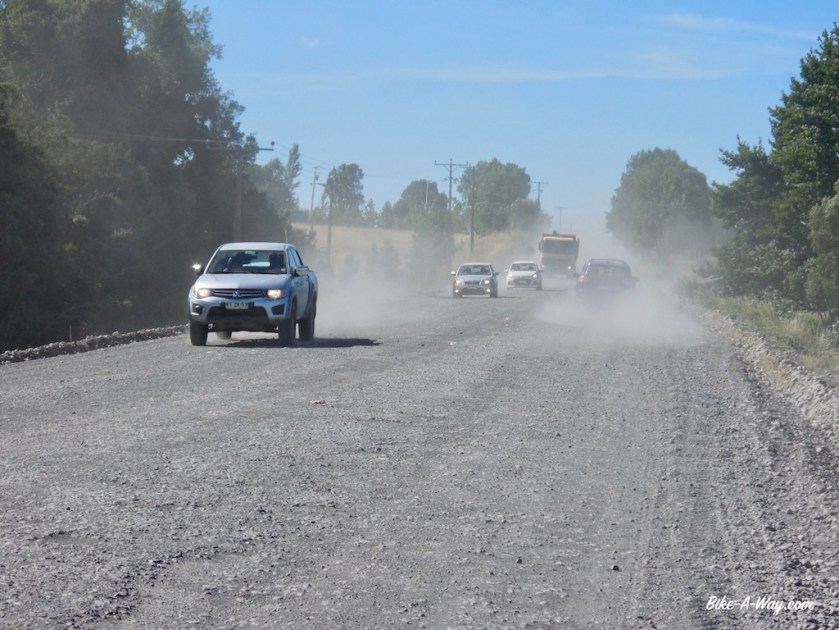
None of them symphatic enough to slow down the slightest and leaving me in a cloud of dust every time.
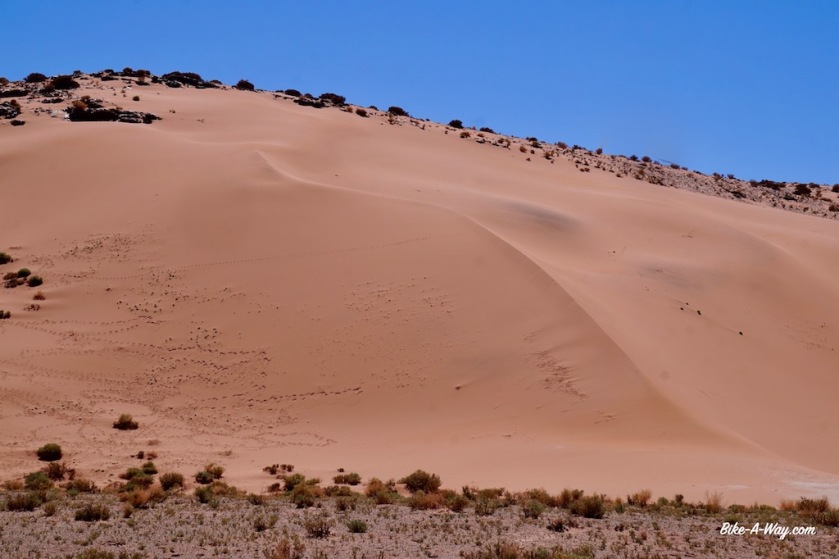
The landscape offers an incredible variety of colors again, with even some sand dunes.
As if red, green, brown and yellow rocks and salt flats aren’t enough to keep you busy, nature throws in some sand dunes for you to admire as well.
You might think, “what is he always moaning about this traffic..”, well watch this truck coming …..This is where he passes you, never slowing down the least bit. See how you’re in that dust cloud for minutes, all sticking to your body covered in sun cream.
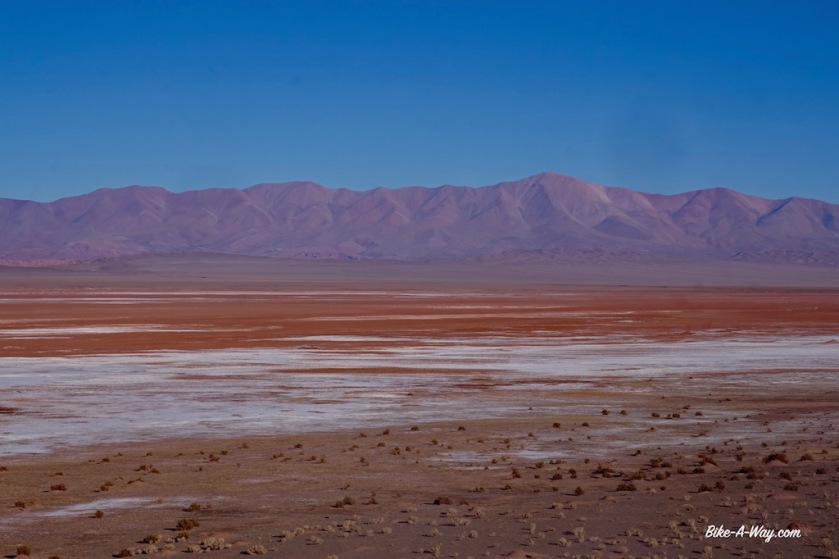
Next day, riding along the salar in a combination of white and red colors, the Volcan Galantop (6.740 m) behind it, I stop for lunch in Salar de Pocitos. Still on ripio road, I climb again to a hill top over 4.000 meter and set up camp for the day looking at Volcan Queva (6.130 m) from the porch of my tent and Cerro del Rincon (5.606 m) on the other side of the tent.
The red house on the left is the restaurant and the village shop. They can give you a place to sleep as well. Service was friendly and the food was simple but okay.
I took this short cut from the ruta 27, out of Solar de Pocito’s towards ruta 51.Nice place to spend the night, again above 4.000 meter, admiring Volcano Queva (6.130 m)
My last kilometers in Argentina are, yet again, along a difficult to ride stretch of ripio and loose sand road along the Salar del Rincon. I met an Argentinean guy on my way up who was invited to stay the night at the immigration post. Also the Japanese cyclist I met in Londres could stay there.
As I had still a lot of vegetables which the Chilean customs would confiscate, I cooked a warm meal at the border post. No shops after the border to stock up on new vitamins.
To my surprise, Frederic arrives as well. I thought he would be a day ahead of me by now.
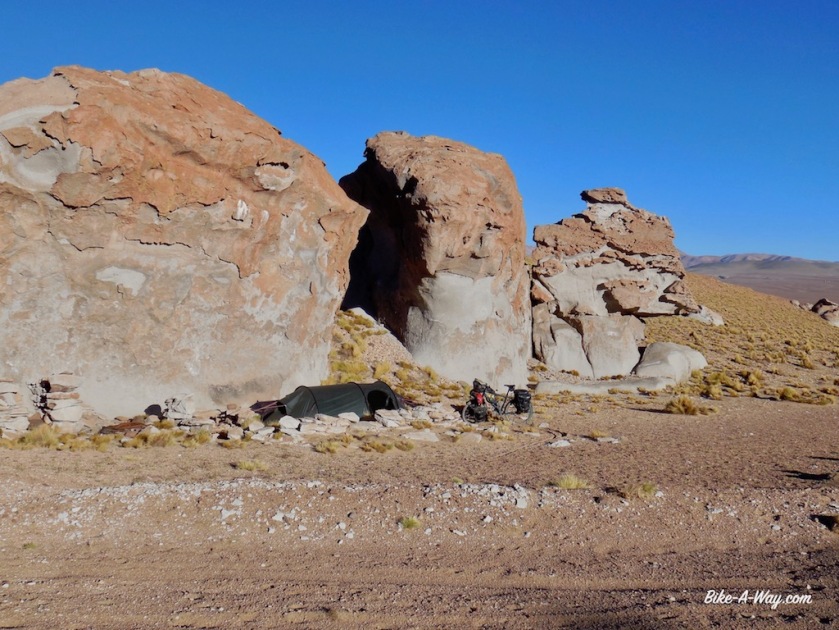
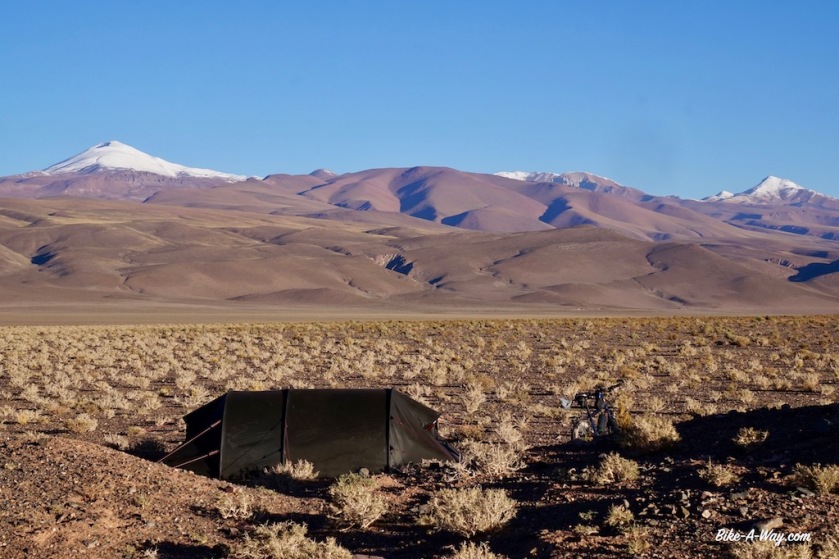
For whatever reason, we were not allowed to spend the night at the immigration. They send us out at 16:30 hrs, a few hrs before sunset, and with a big climb still ahead of us, the wind blowing like hell from the west. Three kilometer after the immigration, we found some rocky boulders which gave minimal shelter from the hard wind and called it a day.
Tomorrow up and over the Paso de Sico for a final, short stretch in Chile.
Salar del Rincon on the left.Salar del Rincon
Passo Icalma – Paso Sico
Distance: 2.568 km (of which 238 km by bus)
Average km per cycling day: 58,25 km
Altimeter: 23.707 meter
Nights slept inside: 11 (8 in hostel, 2 in the refugio Volcan ‘El Tromen’ and 1 at Salar del diamante)
Nights slept outside: 35 (of which 34 wild camping and on in hell-Camping El Festival in Tunuyan)
Flat tires: 3
Route: Uspallata – Calingasta – Iglesia – Rodeo – San José de Jachal – Villa Union – Chilecito – Alpasinche – Belén
Route nbr 40 between the provincial capitals Mendoza and San Juan will probably not be a big joy to ride, so I chose a smaller option closer to the Andes range, Ruta 149 from Uspallata towards Calingasta, Rodeo and San José de Jachal.
My map suggested the road from Uspallata to Calingasta would be paved all the way. A false claim.
Pretty soon I’m back on gravel.
The map also showed on various points ‘Qhapaq Nan’. I had no clue what it was. Along the road, I learned this means ‘Inca Road’, and I’m now on the southern most section of this historic trail (the Incas’ southern progress was stopped here by the Mapuches).
To my west, I have views of the Cordillera del Tigre with again a bunch of 5.000 + m high mountains.
Unfortunately, Parque Nacional El Leoncito was closed, due to serious damages in the park after the heavy rains.
Proceeding north, the Sierra del Tigre now the east of me, I visit the stunning Cerro El Alcazar.
It being rainy season, I encountered regular rain showers and electrical storms.View from Cerro el Alcazar
You can see the bike down in the valley.
While having lunch at the ‘plaza’ in Calingasta, I learn from a teacher who’s waiting for the bus to Villa Nueva there wouldn’t be any possibilities to buy provisions there. But she promises to refill my water bottles in the school tomorrow.
On the way in the next day, I meet some German guys who drove a big chunk of the South-American continent with their Paris-Dakar style moto’s the last three months.
They warn me for the upcoming stretch of ripio, saying it was some of the hardest they encountered. They even had to dismount their motor bikes in the loose sand.
I don’t see the teacher back in Villa Nueva, but she told her colleagues I would show up.
Talking way too long with them, and the German guys, it’s already afternoon, and very hot, when I leave Villa Nueva.
I enquired with the teachers whether there wasn’t a small kiosko or anything to buy some bread, but they said there wasn’t. You could only buy alcohol here.
But, on my way out, of ‘town’, there was a small wooden sign outside a shed that claimed they sold food and beverages.
Entering the building, a fragile centenarian was just having his lunch.
He had some basic stuff, like cans of tuna, pasta, olives, …
No bread.
I bought some extra pasta, tuna, onions and dry, tasteless cookies. Then I saw his fridge.
Aaah, “a cold coke please”, I asked.
But indeed, he only had beer in that fridge.
What a shame. I told him he should put some coke in there for passing cyclist.
I would have bought one, and who knows another cyclist will show up on his doorstep later today ?
In the end, he gave me also what was left of his bread, so I was good to go.
Eighty kilometer of very bad road was coming up, he said.
It wasn’t all that bad at first. Lot’s of washboard. Up and down. Some sandy stretches.
But no traffic.
Nothing.
What a good road !
At the beginning of a particularly bad stretch, I was just trying to push my last meters before dismounting, I saw a cyclist coming from the other side.
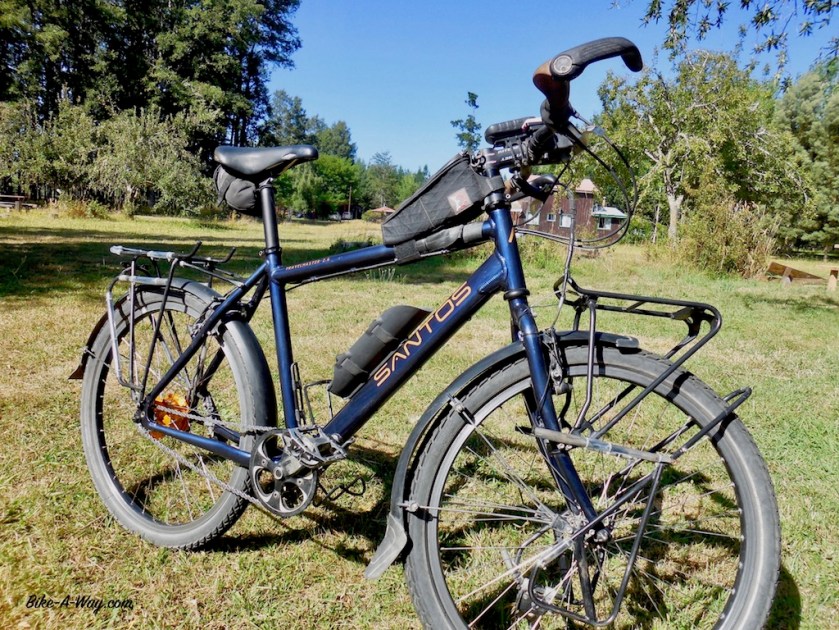
On a Santos bike ! 🙂
It was John, a Dutchman cycling from Brazil to Santiago de Chile, then flying out to New-Zealand.
We chatted for quite some time. He warned me a stretch of 8 kilometer was coming up. Like a dried out river, full of loose sand and stones. Eight kilometer of pushing.
This was my fourth longer conversation in 24 hours.
Good, but that’s enough socializing for this month 😉
I pitched the tent a bit further on, leaving the hard part for tomorrow.
John, the Dutch cyclist going the opposite way.
Having that part behind, I reached the pass (2.655 m) at a place cold Tocota.
Only thing here is a police check point. Reluctantly, they gave me some water. They claimed they didn’t have much themselves.
The 8 km section of loose sand.
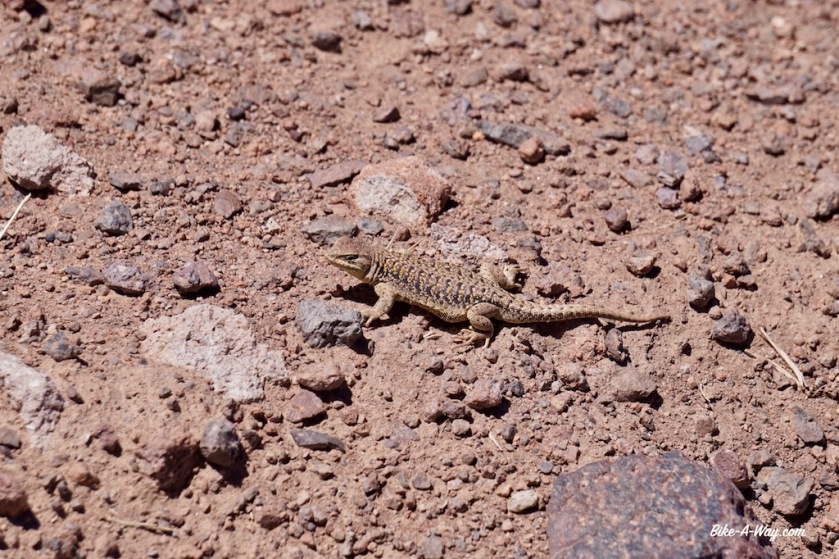
This little chap was hiding low after he saw me. When walking, they have legs a few cm high.
At the town of ‘Iglesia’, I’m back on asphalt, and there are some shops.
Both my guide book and map claimed I should visit ‘Capilla de Achango’, an old chapel, some three kilometer from the main road, along a bad gravel path.
I went down.
‘If the chapel is closed, you can get the key from the house next door’, the guidebook said.
Not when nobody’s home of course.
In Rodeo, I went to the park headquarters of the Parque Nacional San Guillermo.
It was closed.
Just after Rodeo, at the ‘Dique Cuesta del Viento’, they’ve built a dam in the Rio Jachal, thus creating one of the top windsurfing spots in the world, just at the foot of the Andes mountains. Apparently, in summer wind is blowing almost every day here at speeds upto 120 km/hr. It wasn’t blowing that hard the morning I passed, but the wind sure made me work hard until half way down the road to San José de Jachal. In this town, one should visit the ‘Iglesia Sande Jachal’ with it’s black Madonna.
It was closed.
The lake at Cuesta del VientoRio JachalAnother road victim.
Since halfway between Rodeo and San José de Jachal, I felt this strange ‘wobble’ in my back wheel. I trust my rims, since they are Belgian made Rigida touring rims, so it had to be the tyre. And sure enough, it was torn for about 20 cm right where it fits in the rim (this is not the tyre I repaired back in Chile, that one is still holding out).
I limped into town. A Maxxis mountainbike tyre was the bast I could get
San José de Jachal is also the place where I have to decide whether I ‘ll make the detour via Parque Natural Provincial Ischigualasto, better known as ‘Valle de la Luna’ and Parque Nacional Talampaya. Both are renowned to be among the most beautiful in Argentina.
BUT, both can be visited under guidance of a ‘guardaparque’ only.
Now, it is claimed you can get a guardaparque on a bike in ‘Valle de la Luna’, but I can see from here they probably don’t have a bike, or it’s broken, or ….
Furthermore, I heard (part of ?) the park is flooded by the heavy rains and can’t be visited.
Nothing of all these question can be confirmed or denied in San José de Jachal, so I decide not to take my chances and ride directly north through the Cuesta de Huaco towards Guandacol and Villa Union, again on Ruta 40.
It’s still rainy season here (till end of March) and almost every evening and night there’s a thunderstorm with a spectacular light show. That’s nice enough as long as there’s not a real storm coming with it, or hail, which I don’t like on the tent.
Some nights, I’m out in the open pampa and my tent with it’s three aluminium poles the highest thing around for kilometers, which makes me worry not to get hit by the lightning.
After the horse flies further south, there are now smaller flies, only a few millimeter long which annoy me. They do bite as well.
And ants.
Zillions of ants. Everywhere. Just before Guandacol, every spot I inspected was even infested with red ants.
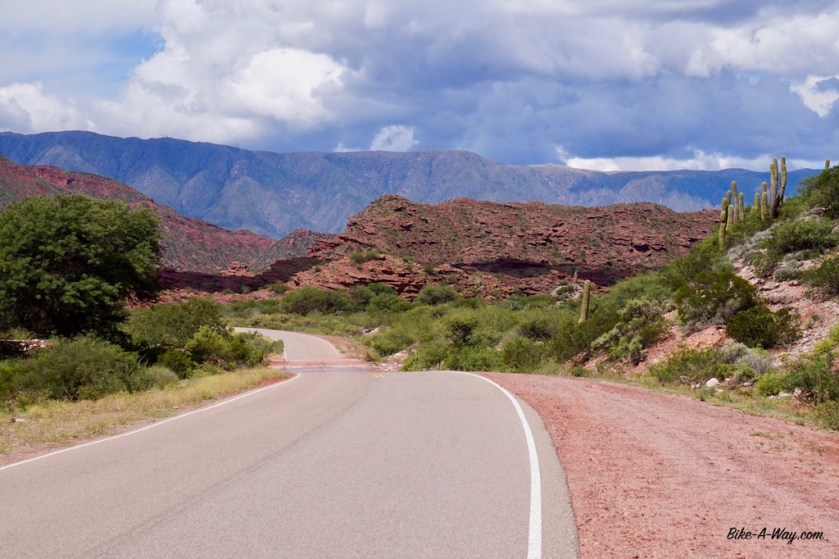
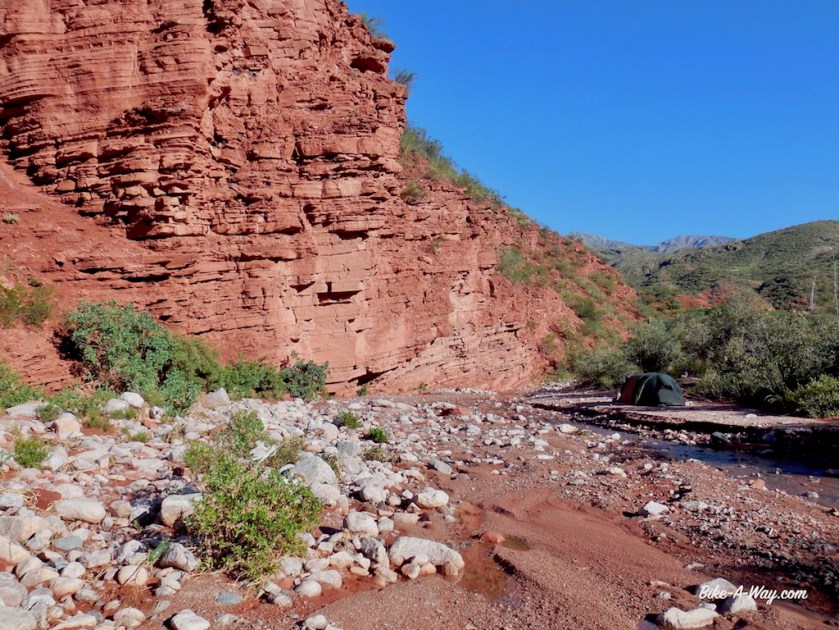
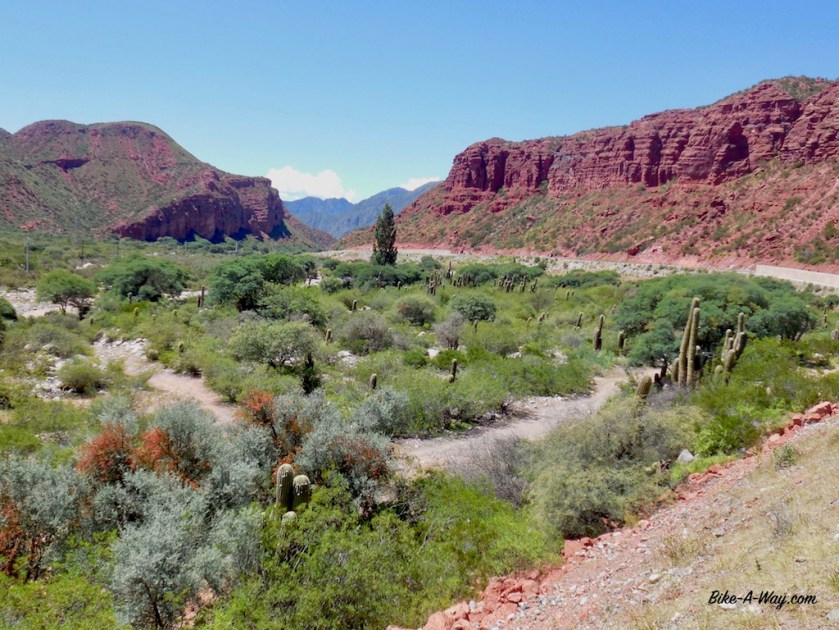
I’ve been cycling between beautiful red rocks for a couple of days now, but 40 kilometer after Villa Union, when one starts climbing towards the Cuesta de Miranda, suddenly I spot the first big cacti along the road. It’s like a wild west country here.
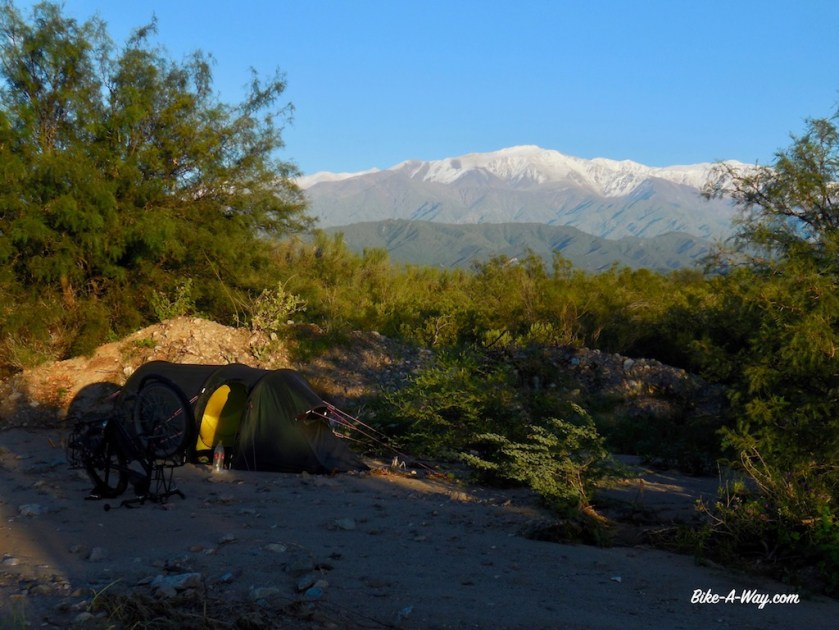
Terrific wild camping spot just under the top of the Cuesta de MirandaNear the top of Cuesta del Miranda, red & green scenery here.
Continuing traveling along Ruta 40, I pass Chilecito, Pituil, and cycle into Londres, one of the oldest little towns of the province Catamarca. For the first time since quiet a while it’s raining heavily and when I see a loaded touring bike at the hostel in Londres, I call it a day as well. The bike was from a Japanese cyclist, heading south.
We go for diner together later that night. He’s a university student at the Kyoto university.
Between Nonogasta and Chilecito is one of the very few cycling lanes in Argentina. Lot’s of wild camping options next to it.Ah, choices, choices…Not one of the most beautiful spots, but it gave me perfect shelter from the winds.The Japanese cyclist I met in Londres, one of the oldest towns in Argentina.
Route: Lago Aluminé – Las Lajas – Chos Malal – Bardas Blancas – Malargüe – San Rafaël – Tunuyan – Tupungato – Potrerillos – Uspallata
27/01/2018
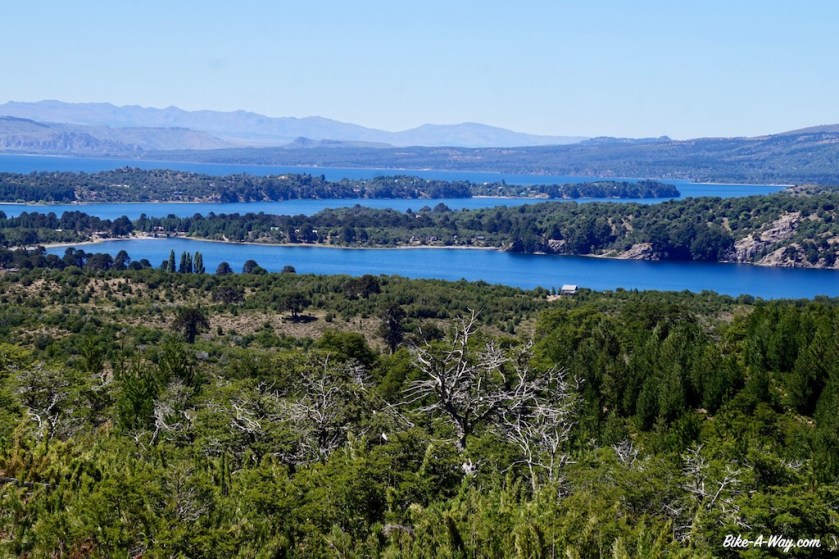
After having spend the night in the no men’s land between the Chilean and Argentinean immigration posts, I descend towards Lago Alumine. Coming from the Icalma Pass (1.335 m), I get a beautiful birds eye view of the lakes. Being back in Argentina, I can enjoy their bakery culture again, with a bigger variety as their Chilean neighbors.
I slowly ride along the northern shores of the big Aluminé lake, stopping sometimes to check out the beach and the water.
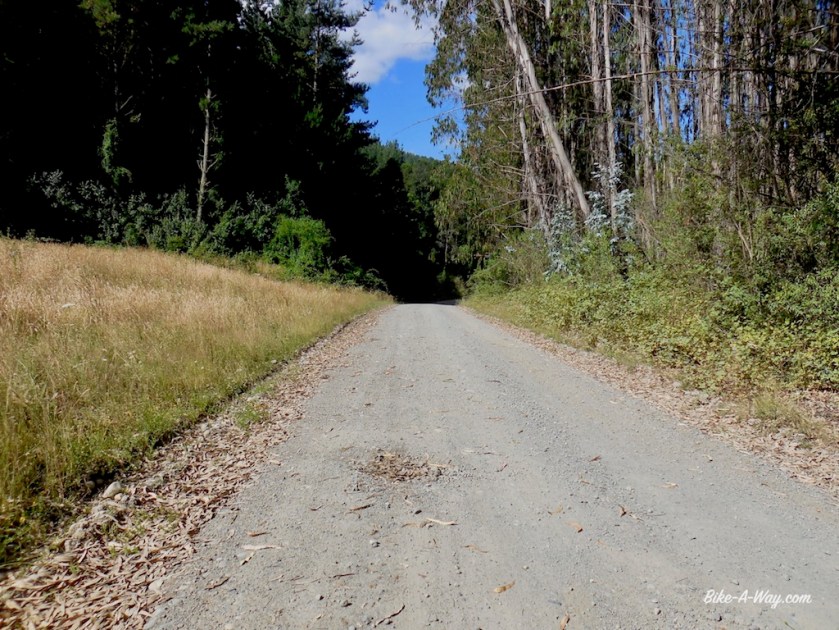
Route 23, again a gravel route of the worst kind, with rough wasboard, loose sand (yes, that combination is possible) or just a bunch of stones slows me down on the flat parts to 6 or 7 km/hr.
Luckily, the gradient is much, much gentler as what I had in Chili. Slowly my road climbs up the valley of the Rio Litran. I spot a few possible camping spots along the river, but the fire pits, broken bottles, rubbish and car tracks suggest I might get company in the evening, so I press on, finding a nice spot under an araucania tree in the bed of a dried up stream, a few hundred meters from the road.
Next day there are only a few, bumpy kilometer left to the highest point of the road at 1.621 meter. The ‘road’ stays high up for a while before descending towards the paved road 242 on which I have an easy way down towards the town of Las Lajas.
To ensure a quiet night, I chose to wild camp next to the Las Lajitas River, a few km before town.
After Las lajas, I suddenly seem to enter another world again. After having spend the last months in a wet and green environment, I’m suddenly back in the dry and hot desert. I was a bit careless about that upon leaving Las Lajas, and should have taken more water.
Luckily, there’s some sort community building for Mapuche’s at Coihueco where I can refill my bottles.
Due to the strong winds, I need to put my helmet on top of my sombrero to keep it on.
After a rest day in Chos Malal, I had to choose between the paved Ruta 40, or a small white road on the map, going through the ‘Reserva Nacional Tromen’, via the ‘El Tromen’ Volcano.
The latter, off-road route is way more interesting of course.
I fill up all the water bottles and the water bladder before taking off. As soon as I leave the Ruta 40, I’m on ripio again. Still some traffic. Nineteen cars until the junction to Tricao Malal.
After that, I would encounter one more car until the end of the day at Laguna Tromen.
As there aren’t any sheltered places to pitch the tent, I opt to sleep in the refugio near the Guardaparques. The climb isn’t too steep, but the temperatures went up to 47,5 degrees in the sun. As there’s no shade here, that’s the only temperature that counts.
To the west of me is the ‘Cordillera del Viento’, which luckily doesn’t create to much of a wind this time around. But from what I’ve heard, it can get pretty bad here.
After an extra rest day in the refugio, it’s only a short climb to the top off the pass at 2.277 meter.
Volcan ‘El Tromen’
The huge lava field below El Tromen.
Highway 37
Between the little town of Barrancas and Bardas Blancas, I encounter a much longer, and also much worse ripio stretch as I expected. I camp somewhere in the middle along the Rio Grande (one of so many Rio Grande’s). It’s a brownish fast flowing river, suitable to get a quick wash of the body, but useless to drink.
A Canadian family + 1 friend, cycling from Ecuador to the Southern tip of South-America.
The area to my east is the Reserva Provincial El Payén, a huge area with more or less the highest volcano density in the world. To the west of me, there’s the Sierra de Cochico, and the the Andes of course.
Thirty kilometer south of Malarguë, the misery starts again: brain death drivers speeding at centimeters passed your legs. I thoroughly enjoyed the ride all the way from where I entered Argentina again near the Lago Aluminé, but it couldn’t last.
I really wonder how this works. Do these people have a perimeter of about 30 kilometer from their town which they never leave, or do they change their attitude if they do so ?
The only thing I do in Malarguë, besides buying provisions, is having lunch in the YPF gas station and use their pretty good wifi connection.
A Swiss guy comes ver for a chat. He came down to South-America a couple of months ago for a big cycling trip but has given up since. Reason: The way people behave on the road. He bought a car in Chile and is now traveling in that.
I’m facing a little problem. Ruta 40 has an unpaved section a bit further north of here. It’s 163 kilometer long, and apparently in a very bad state, pushing required in some sections.
Not a problem normally.
On the contrary, I would look forward to it, but I’ve had so much ripio lately in Chile, then had the hard ripio climb via El Tromen, after that the bad ripio sections between Barrancas and Bardas Blancas.
It has come to a point where my hands, pulses and especially my shoulders really hurt. So now I plan to follow the paved (longer) route via San Rafael, which most cyclists seem to take.
I worry a bit I will end up in San Rafael in the weekend of 11 & 12 February. The internet tells me that’s when carnaval is celebrated.
I am not looking forward to share my time with drunk, excited, loud carnaval party goers.
When I enquire with the lady at the gas station if she knows if they have carnaval celebrations in San Rafael, she doesn’t know. But tonight there s some kind of “fiesta” here in Malarguë, she says cheerfully, as if i’m the luckiest guy in the world to arrive just at this day.
I pretend to be excited by this news, but can’t hurry enough to leave town. At the far end of town is a tourist information, where I again try to find out about possible carnaval celebrations in San Rafael. Both guys working there don’t have a clue, but, we have a fiesta tonight in Malarguë.
Thanks guys…
I cycled of into the wind and found an excellent place to pitch the tent. There was an open gate, leading to a row of trees. Behind the trees some of these big rolls off grass behind with I pitched the tent. Perfect shelter. The wind blew super strong from the mountains, making lot’s of noise in the trees, but the tent hardly moved.
Nice, wind sheltered place.
In the morning, the gate was closed, of course.
Back on the road, I had to cover another 40 kilometer towards El Sosneado.
Strong side wind blowing from the Andes, but I didn’t worry. In El Sosneado, I would turn east and have this wind in my back. It would blow my fast and easy towards San Rafael (in two days).
And yes, after refilling my water bottles at the police station, I left switched ruta 40 for ruta 144.
I hardly had to peddle to get the speed above 30 km/hr.
Wow, this is insane, I have to be careful, or I will arrive in San Rafael tonight already.
Five kilometer it lasted.
Five kilometer, then one big wind gust in my face.
My speed went down to 20 km/hr.
The wind turned immediately.
It never blows from the north east.
Excepted when karma has it’s roll to play.
Now I moved like a turtle at 8 km/hr. Even that I ‘ve learned to accept by now. But not on roads like this, with that much traffic. Eyes locked on the rear view mirror.
Losing your concentration for four or five seconds is immediately rewarded with a near death experience from the next passing cars.
I hate them.
I truly hate these Argentinean and Chilean drivers.
They won’t slow down, ever.
I tried everything, claiming 1/3 of the lane, so here’s no actual space to pass me when another car or truck is coming from the other side.
They don’t care.
They go a little, little bit closer to the centre of the road, hoping the car from the other side goes a bit to the side, but if he doesn’t, your done.
I tried claiming half of my lane.
Sure no place now for them to come in between me and the car from the other side.
They are not impressed.
None of them.
They keep coming at full speed.
As a cyclist you have two options. Dive in the ditch, or end up in a wheel chair (if you’re lucky).
I can’t count the times I feared for my life today.
I cycled 115 kilometer and ended up sleeping at the ‘Salar del Diamante’. Not one suitable place to pitch your tent on this windy pampa.
The commercial operations on the Salar seem to be something of the beginning of the previous century, with very, very old trucks, machinery still showing names of English manufacturers. It must have been a state of the art, modern thing back then, but it seems not much has been invested or maintained since those days.
From San Rafael I will take the bus. The road going north connects with Mendoza. this are the two biggest cities of the province, so I know already what that will be like.
I’ve completely had it with the sick attitude of these drivers. And that’s 99% of what’s out on the road here.
Salar del Diamante
My home for the night at the Salar del Diamante
I gave up on cycling the potential death road between Malarguë and San Rafael. An employee of the salar gave me a lift into town. There I went straight to the bus station and bought a ticket out of town, to Tunuyan, a place south of Mendoza. It appeared a small place on the map, but is much bigger as expected.
The campground, ‘El Festival’, where I write this at 1 am in the morning.
It hasn’t stolen it’s name. It seems like a festival here. Tents are pitched at 50 centimeters interval. I placed mine in the only corner with still a bit place left, but at 23:00 hrs, four guys arrived in an old Ford Sierra. Before they pitched their tent, they built their ‘sound system’, with huge loud speakers.
Now, at 1 am, people are still arriving and building their tent at less then 50 centimeter of mine.
Three couples with small kids and toddlers.
At 1 am !
Am I strange if I find all this abnormal ?
Either way, I’m getting sick of the fact it is never quiet in South-America.
Argentina and Chile not very populated ?
Don’t make me laugh.
They are everywhere, they are loud and if there’s one thing nobody seems to do here, it’s thinking about other people.
Why on earth are peoples with kids & toddlers still building tents at 1:30 am (they have troubles erecting it).
There’s a buggy almost standing inside my tent.
I truly wonder how much I can have before I….
The tent next door, kids start to cry.
I’m pretty close to crying myself as well.
At 2:45, they finally had their tents up. They struggled a bit with the last one.
Well, they struggled with that one over an hour. No wonder when you’re trying to pitch it inside out !
“Now it’s time to start the bbq”, I wanted to joke, but no need for that, because that’s exactly what they did.
Kids, all under five years old, still running around.
At 3:45, a couple of the babies are brought inside the tent, not all of them.
The other kids have to go in the tent at 4:15.
Babies start to cry.
Now the parents start the car stereo.
Some of the adults go to sleep.
Drunk snoring mixes with the ‘music’.
Camping ‘El Festival’ at Tunuyan, the worst campground ever.
So it went on and on all till morning.
I went inside my tent, exhausted at 4:45 am.
Woke up two hours later. Two of the guys were still siting outside, obviously drunk and under influence of other drugs. Only way to manage the sleep deprivation, I guess. They’ll probably hit the road later on in their cars.
I start to make some noice with pots and pans to have my little revenge on those sleeping.
By 9 am, freshly showered but overly tired, I leave the campground.
The Carrefour in town is the first ever around the world not selling any fruits, vegetables and bread.
The yellow roads on the map, indicating minor paved roads west of Tunuyan are still traffic infested.
Probably more then a few of them on drugs and alcohol. I anticipated that and made a route on gravel roads towards Tupungato with the help of the great online routeplanner ‘BRouter’.
This routeplanner seems to be able to come up with great options the world all over.
I got it thanks to a tip of one of my idols, Frank Deboosere. He’s got a great webpage, including a blog section about his cycling trips.
Apart from Ben Crabbé, Frank Deboosere and his colleague Sabine Hagedooren are the only decent people left on the BRT.
Anyways, that BRouter is a great tool.
An old Vailant car 🙂
I pitch my tent a bit off the road a few kilometer past the village San José, at the start of the climb towards Uspallata.
It isn’t the very best of places, but I’ve got a tiny irrigation channel passing by, which means I don’t have to use any of my drinking water to do the dishes (and it makes a calming sound like a little pont with a bubbling stone), andI’ve got a line of trees protecting me from the wind if needed.
The only nuisance a fair amount of traffic passing by till after sunset.
The tent is pitched by 6 pm. I start reading a bit inside the tent but fall asleep within minutes.
One way or the other, I find energy to make diner around sunset.
Apart from the occasional barking dog, the night was quiet and I decide to take a rest day here. I badly need that after the horrible day in traffic on route 144 to San Rafael, the bus ride to Tupuyan and the worst night of my life on the worst camp ground I ever encountered in that same place.
All is good again.
Well the ground under my tent is a bit bumpy. No problem at night as the excellent Therm-A-Rest NeoAir filters all that out, but it’s not very comfortable during the day.
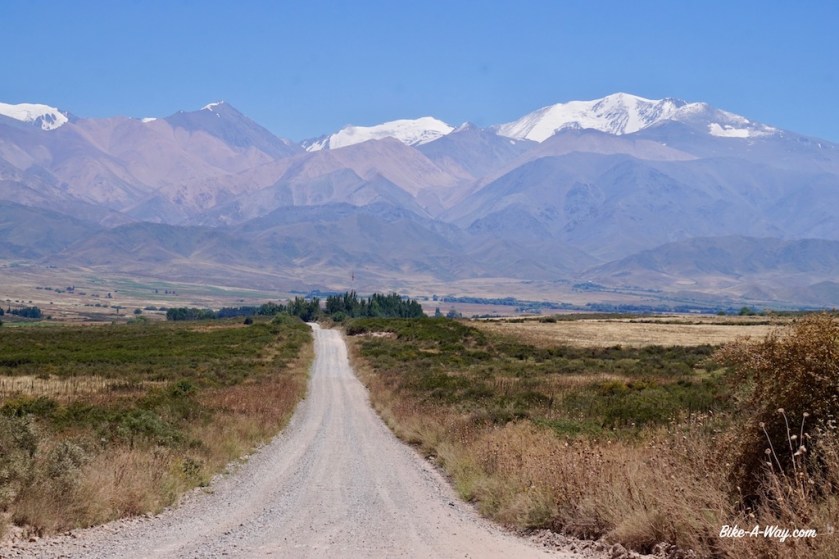
The road soon turned to ripio again after my wild camping spot. I’m entering a part of the Andes with some of it’s highest mountains. The very highest, Aconcagua (6.960 m) is not visible from here, but I have terrific views of it’s smaller brothers, Volcan San Jose (5.856 m), Cerro Tupungato (6.570 m) and Cerro Juncal (6.072 m). The views from the unnamed pass I’m taking today, 2.292 meter high, are splendid.
The traffic on Route 7, the main highway between Buenos Aires, Mendoza and Santiago de Chile is of course busy, but somehow not as bad as expected. The scenery again is amazing.
I leave the bike in a hostel in Uspallata and take the bus up and down to Santiago de Chile for a day.
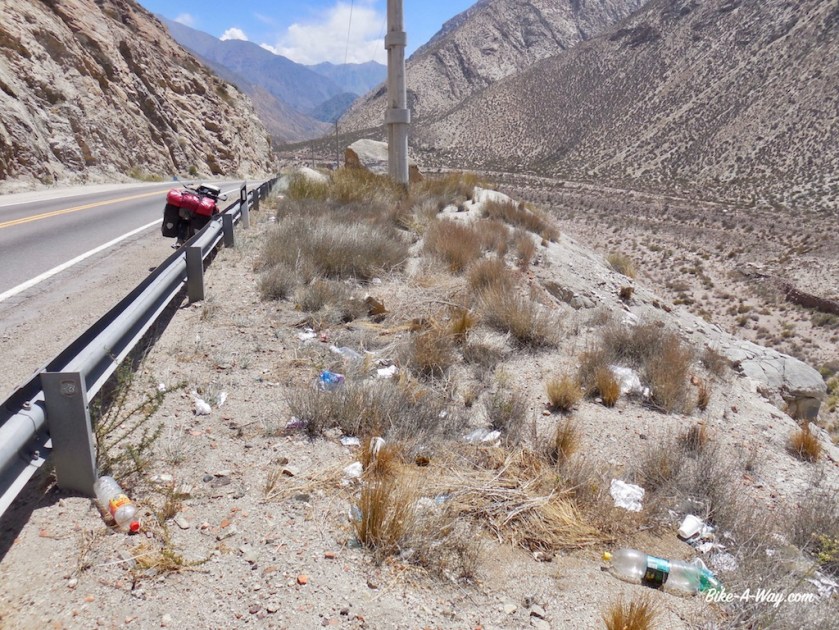
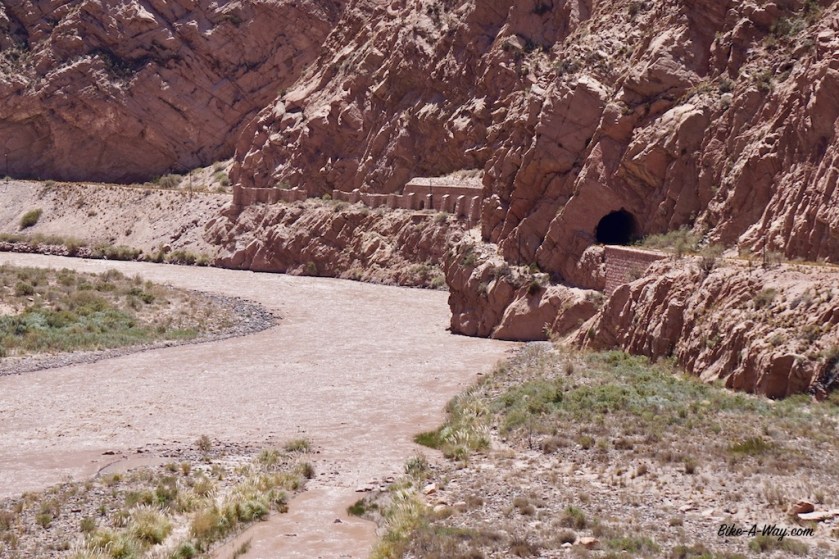
Old railway infrastructure built by the English.Typical roadside garbage. For one reason or another, diapers are everywhere, often bags full. Why can’t they throw that away at home instead of throwing full bags of that along the road ? Another favorite is bottles with yellos liquid. and it ain’t Fanta.The old railway tunnels which could be easily converted into the most spectacular cycling track.
There is a huge, huge, huge potential here in creating the worlds most spectacular bike path.
An old railway line, build by the English, is climbing from Mendoza, via Uspallata towards the Cristo Redentor (= Paso Los Libertadores) Pass (3,200 m). The line runs at the other side of the Mendoza River for most of the way and most of the tunnels and bridges are still intact.
On the Chilean side, another railway line, completely out of use is going down.
If both governments would invest in a bit of asphalt, or even just take the railway away and level the ground, not any other bike path in the wold could match this.
Thousands of cyclist would come to ride this, hostels and restaurants on the way up would get good business, it would be one of these ‘little adventures’ one must do.
But they prefer to just let it crumble to pieces, just like the rest of the lines in the southern half of South-America.
What a pity.
Passo Cristo Redentor on the Chilean side. Spectacular downhill (I did this by bus, going up & down into Santiago de Chili from Argentina for a day).Taken from the back window of the bus. Spectacular road, but I don’t want to be here on my bike with that traffic.
Route: Puerto Monto – Puerto Varas – Ensenada – Entre Lagos – Puerto Novo – Los Lagos – Huellahue – Villarica – Los Laureles – Melipeuco – Paso Icalma
18/01/2018
There are two roads to leave Puerto Montt to Puerto Varas. Road nbr 5, the “Panamericana”, and one via the airport. The last one seemed to be the smallest one.
When I asked about traffic conditions at the tourist information, the lady told me I can not take that last road. I will 100% sure end up without a bike and without luggage.
Oh ?
And also most of the locals take that road to avoid the fee one has to pay for the Panamericana.
This Panamerica is busy as well, according to her. It also has no shoulder. “We don’t do that in Chile”, she said.
“You’ll have to pay a small fee, but take that road, it’s much safer”, according to her.
I thought it over for a bit. Mostly car drivers are not very well placed to judge what’s ‘safer’ for a cyclist.
As my guesthouse was closer to the Panamerica as the other road, I decided to follow her advise (my guesthouse was in a ‘very dangerous area’ as well, according to her).
Cyclists (which are allowed on the Panamericana highway) don’t have to pay a fee and there is a shoulder all the way. I hope her perceptions about safety and dangerous are as wrong as her other advise.
So, a busy highway it is to Puerto Varas, but it’s only twenty kilometer and this way I get to experience for a little, little bit what the Panamerican is like. Incredible some people choose to cycle this highway all the way across the Americas.
Puerto Varas is a little bit the Brasschaat of this area. A nice upmarket little place, expensive hotels, outdoor stores and a beautiful setting at the Lago Llanquihue. I checked whether they didn’t have a decent camera shop here, but they told me Puerto Montt had it all …
Volcano Calbuco with Lago Llanquihue in front.
The paved road around the lake has a bicycle lane !
It goes all around the lake, said the lady in the tourist information.
Things really get good here 🙂
Outside Puerto Varas, there’s a Jumbo supermarket. It’s not huge as it’s name might indicate, a bit like the Delhaize in Brasschaat and perhaps even more beautiful. They even sell Camembert cheese, have a nice selection of fruit and vegetables, excellent -)
Didn’t know a good supermarket could make me so happy.
Cycling lanes, a tailwind, a good supermarket…. something must spoil the fun a bit, no ?
Indeed, these black / orange terrorist bugs. They are around me in the dozens. I need to take tree branch and sway it around myself while cycling to keep them of me. Half a second after I stop, they’re all over me, diving right at me. They are terrible and so numerous here.
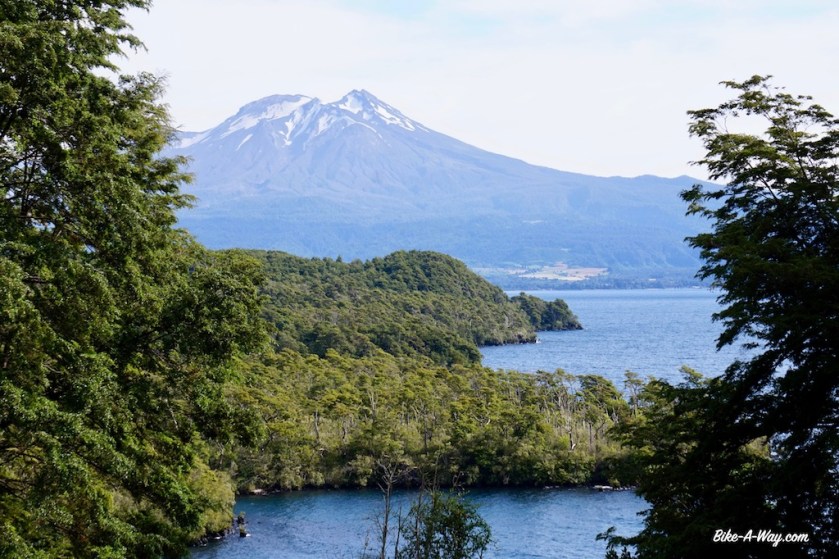
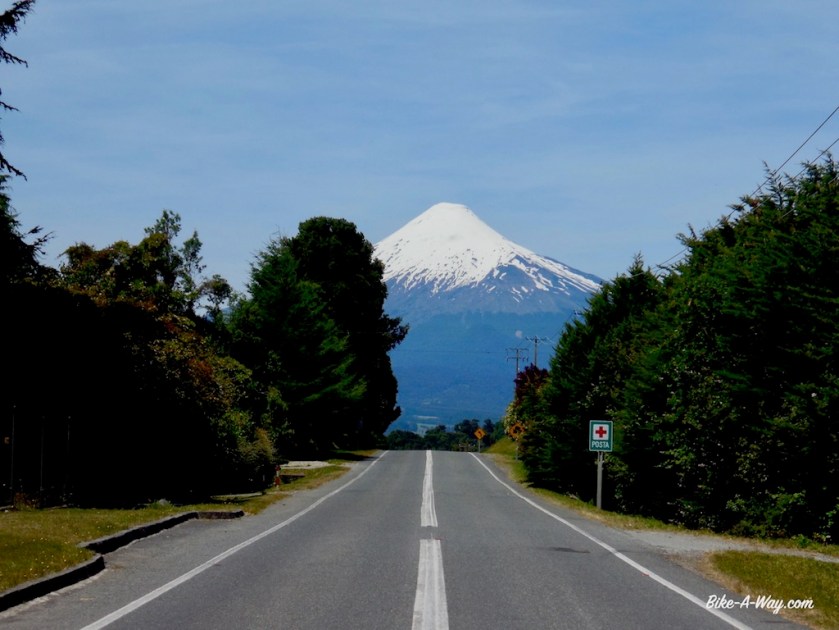
Cycling along the lake, I have Volcano Calbuco on my right side, which had a major eruption on 26th May 2015, in front of me the beautiful Osorno Volcana and behind that, Volcano Puntiagudo.
Volcan Osorno.
Volcan Osorno again.
The bicycle lane stopped in the village Cascadas…
More tailwind blew me quickly to the next lake, Lago Rupanco and then to yet another one, Lago Puyehue. This is where some really bad ripio road started. Big stones and enough low flying traffic to cover me with a big layer of dust.
It sticks in the suncream.
Temperatures always go into the mid or high thirties in the sun during the day.
No complaints 🙂
Lago Ranco is one of the bigger lakes in the Chilean lake region. It being Saturday and the proximity of some bigger coastal towns as Valdivia means it’s packed with tourists. Beaches filled with unhealthy looking tourists, frying more sausages, eating more potato chips, more ice-cream, more soft drinks, more beer.…
Lot’s of garbage along the jammed road.
Bushes full of toilet paper and its smells coming at you.
Jet ski’s, car stereo’s….
Some people seem to love it though.
I can’t be away from it soon enough, but the cycling ain’t fun here, sharing the narrow road with speeding, stressed pick-up trucks racing from one lake to the next.
I pitch the tent in a field, a few meters from that busy road. High grass in between, so nobody will see me.
It’s not your quiet, natural wild camping spot but it beats the camping ground for sure.
Enjoying sunny evenings near the tent.I passed the 40th latitude again. Last time around, in the other direction near Junin de los Andes, that meant the start of terrible head winds. Today it is calm.
After a short day, I end up at Camping ‘Los Suizos’, run by a Swiss man. The camping lays at the top of a 35 meter high cliff with below the Rio Calle Calle.
I have some overdue bike maintenance to do, like switching the front and back tyre, changing back to the first chain and give the bike a good scrub. And most importantly, look for some good alternative, little used back roads going north.
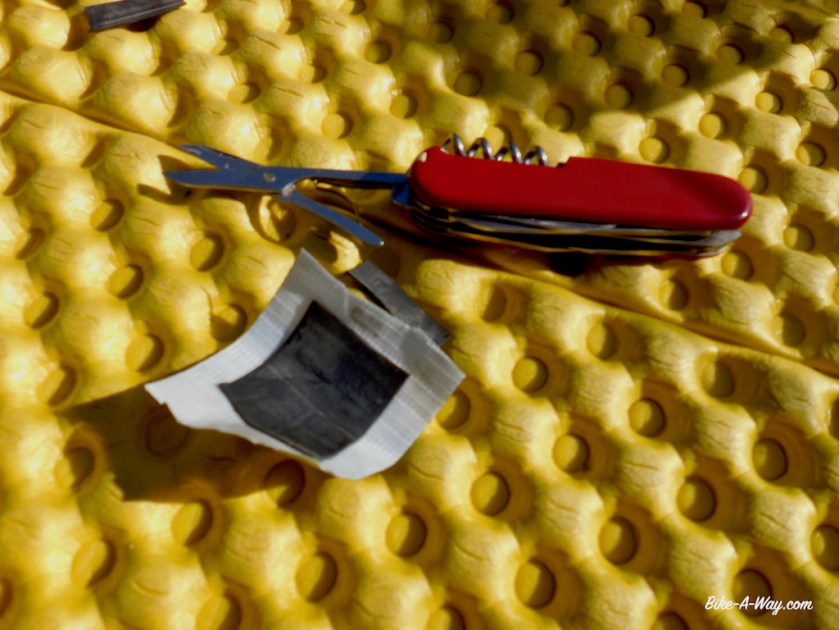
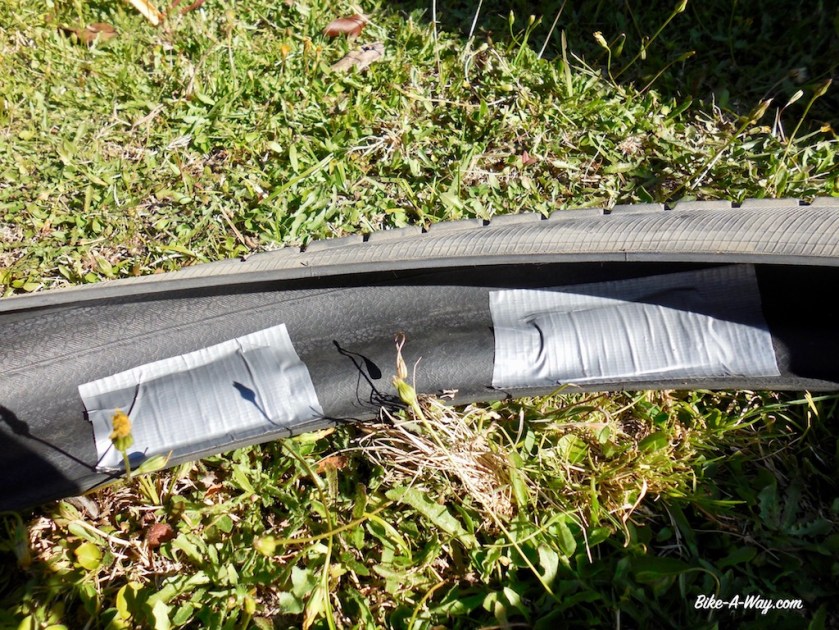
I’m having a few rips in the side wall of my tyre. I was thinking to buy another one in Puerto Montt, but they don’t sell Schwalbe here, so I try to repair it. A repaired Schwalbe is still better then some crappy mountain bike tyre.I cut an old tube in little pieces, attaching it to some duct tape.Hope this will hold out for the next months.After cutting tyres, it’s cutting veggies.A shinny bike, for an afternoon. Tomorrow it’s back on ripio.
In hindsight, the route I drew out, was fantastic. Still a few kilometer on the busy main road from Los Lagos towards Panguipulli, but then I take a left turn and cross the Rio San Pedro with a little cable ferry. From here it’s all ripio for a while with literally less then a handful of cars the rest of the day. Inclines are steep sometimes and require pushing, but they are never long.
Obesitas is a big problem in South-America
In Huellahue I join the paved road again for a while. Not as busy as further west, but still requires a constant eye in the rear view mirror.
I do have some views of the Lago Calafquen from higher up, but instead of riding down towards the village of Lican Ray and ending up on the busy road to Villarica, I again choose some little used ripio option.
All is good. Again I find a nice place to pitch the tent.
Well, the place is nice, but unfortunately the chain saws from different directions go on till sunset, barking and howling dogs from the north-west, north-east and south-west. The dogs are soon joined by a guy who is shouting really, really loud “whooohaaaa – whoooohaaa” in the distance. The dogs going more crazy. Then he cranks up his ‘music’.
When he finally decides it’s been enough for the day, one of his neighbors a bit to the east opens his sound system. More ‘boonk-e-boonke’ till midnight.
Buying blue berries along the road.Good exemple of the roads you’re on. No shoulder, no way for you to go but to dive into the side when vehicles have to cross. Again, slowing down seems never to be an option here. It doesn’t even seem to come into their mind.This looks worse than it is. They stick to you, but don’t hurt.
The chain saw gang resumed at 07:00. Mowing the trees from 07:00 till 21:00 hrs. No time to waste.
It’ll be good for the economy. For someones economy.
My chosen path towards Villarica sure isn’t the easiest. Washboard and lot’s of loose stones. But when I hit the main road, a few kilometer outside of Villarica, I’m super-glad I was on these bad tracks. Suddenly it’s like I’m in the Monday morning traffic jams to enter Antwerp. Terrible. Are all seventeen million Chileans here ?
Upon entering Villarica, I pedal my seven thousandth kilometer in South-America away.
The famous Volcano Villarica, one off the most active in South-America lies at the other side of the lake. It’s last major eruption was on 3rd March 2015. It became super-popular to climb it.
Over 20.000 people a year, I read.
Queuing to the top, not my thing.
I tried again to find a lens for my camera, but in vain. There was a shop selling the same Sony camera I have, but they don’t sell ‘accessories’ and were not prepare to sell it’s lens alone.
First views of Volcano Villaricathe busy road into Villarica.Volcan Villarica, with Lago Villarica in the front, as seen from the city Villarica 🙂 They are very creative with names here.It can’t be pasta every day. I never liked couscous, but it’s good travel food, as you just have to put it in the boiling water and let it sit for 5 minutes. Add some curry powder while it sits there, then prepare your veggies again with some curry & coco milk if available and put it all together. Healthy and yummy.
Allas, I leave the town asap. Soon on ripio again; of the worst kind.
Good.
Slowly I’m getting nearer and nearer to the cordillera, it’s peaks clearly visible now to my east.
As the ripio gets rougher, and the traffic seems oddly enough to increase as well, I decide to take the asphalt road to Los Laureles instead of continuing on ripio towards Lago Corico.
Not special to see in Los Laureles, but I found it a need little village.
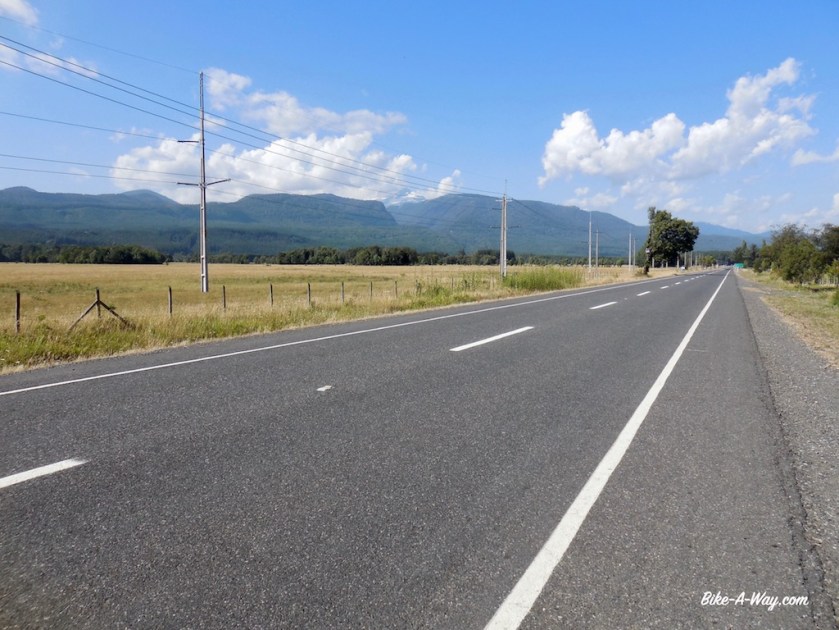
The road between Cunco and Melipeuco is the best cycling Chili had on offer. A nice wide shoulder and hills both side of the road. Throw sunshine, temperatures above 30 degrees and a tail wind in, and your day is perfect.
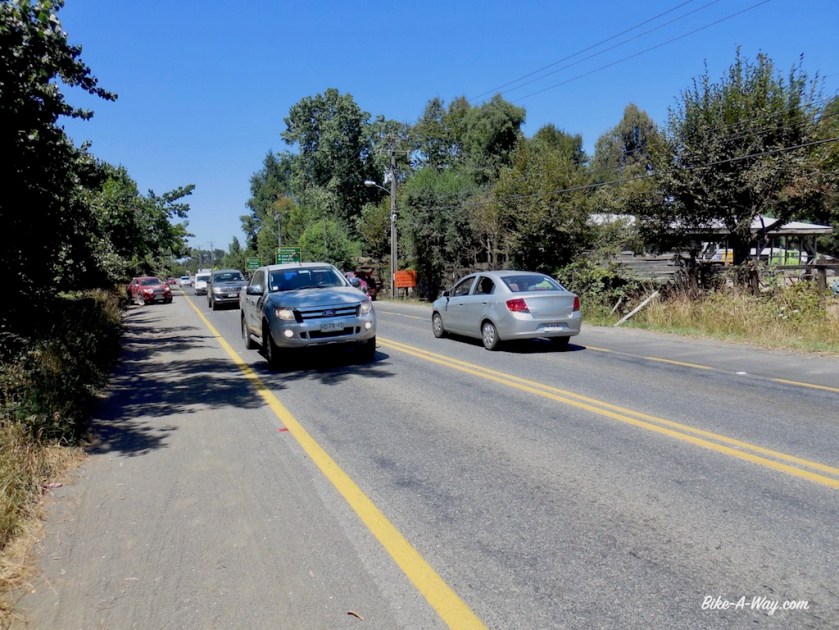
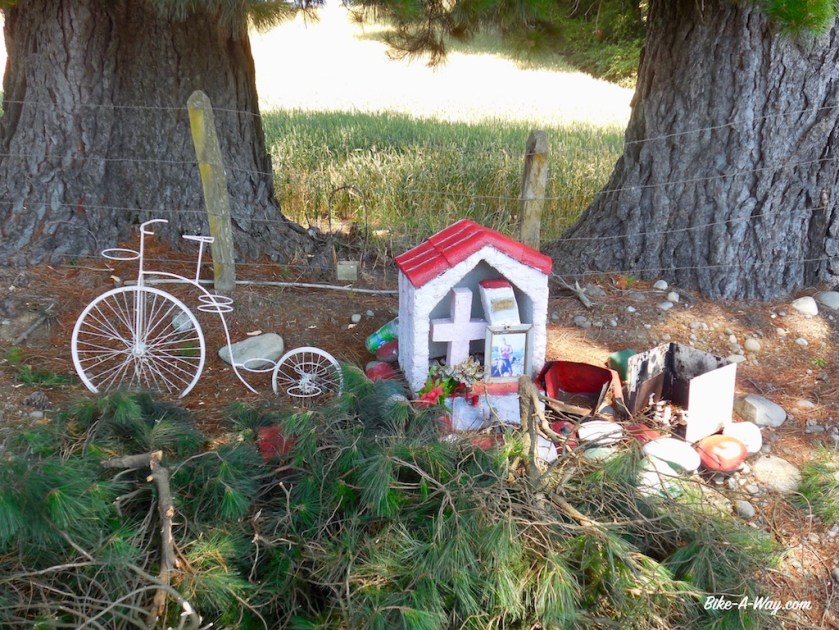
The end of a fellow cyclist ?You see this, authorities and road constructors ? This is all we cyclists need, a white line and a few extra buckets of asphalt makes life more pleasant, and safer, for everybody. Can’t be that hard to construct your roads like that, right ?
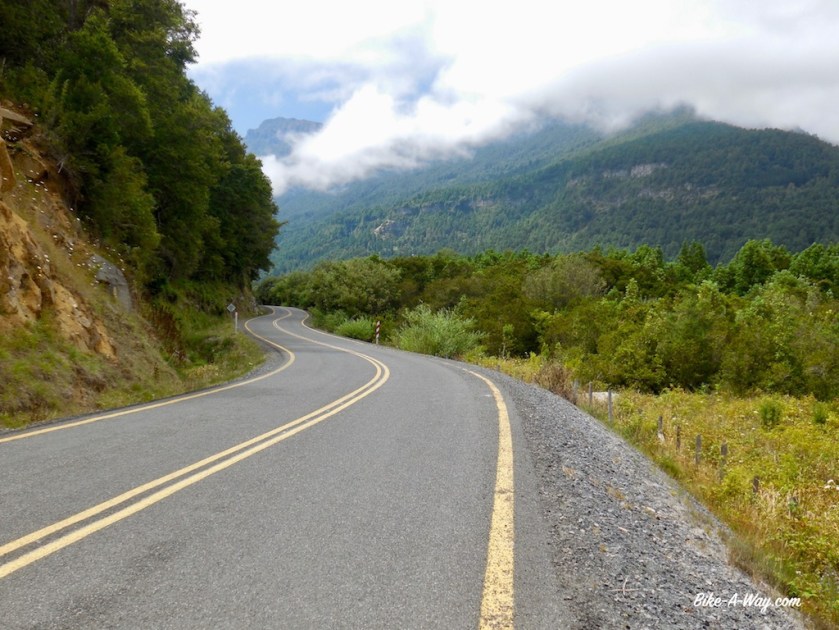
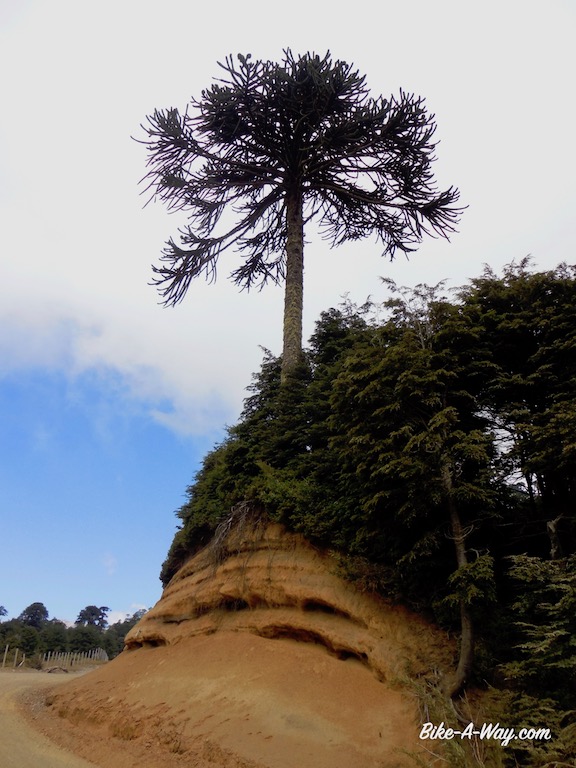
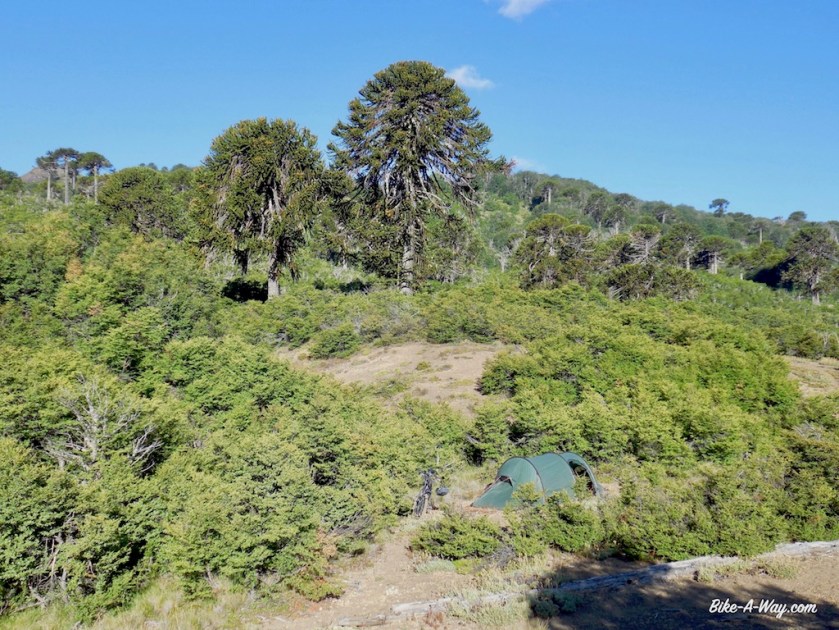
After Melipeuco, the last 40 kilometer or so to Paso de Icalma, which is the border with Argentina, is again on a sometimes rough ripio road, climbing steep at times (i.e; in the 10 to 14% range). Once I’m above 1.000 meter, I’m cyclingbetween the spectacular and odly shaped araucaria trees.
Ashes from the Volcan Llaima, one of the largest and most active volcanoes in Chile.The days often start cloudy, but by late morning, the sun always came out.
Araucaria Trees.
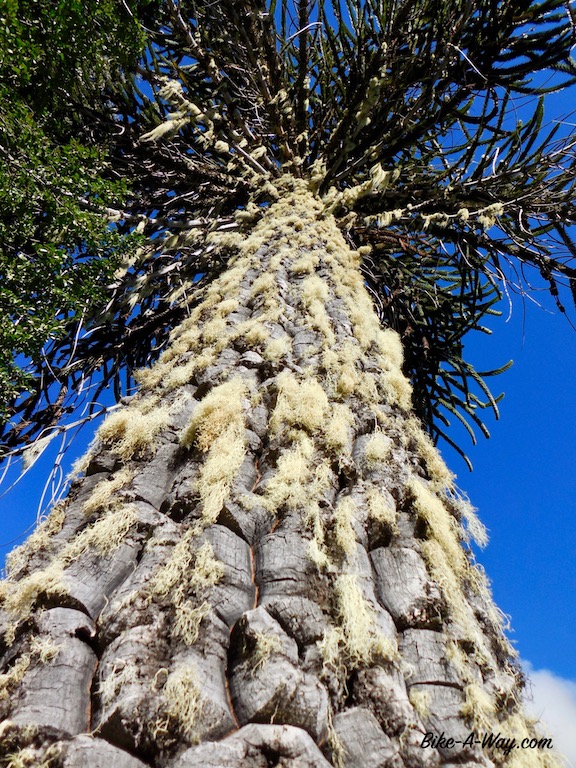
Camping in the no man’s land between the Chilean and Argentinean immigration posts. Paso Icalma.These Araucaria’s have a beautiful bark.
I haven’t met any other cyclist in the Lake Region.
Perhaps because I was too often on the little, steep gravel roads.
Few other things that stand out: The dogs here, as well as in the Argentinean part of Patagonia are brilliant. They do somtimes make faint attempts ‘attacking’ you, but you only have to lift as much as your little pinky and the crawl away, their tail between their legs.
Also remarkable is the high number of Chinese cars on the Chilean roads. “Great Wall” seems to be the most popular mark (and they actually look pretty good), but there were other brands as well. Also many trucks are Chinese made.
I think the Western, Japanese and Korean brands are up to a hard future if the Chinese are going to dump cheaper cars on our markets.
More cars for more people …..
El Chaltén – Passo Icalma
Distance: 2.161 km
Average km per cycling day: 58,41 km
Altimeter: 28631
Nights slept inside: 4 (3 in hostel, 1 in the “ferry terminal” at Rio Bravo)
Nights slept outside: 44 (of which 30 wild camping)
Flat tires: 0